
Diamond Sanding Belt Supplier Audit: Capacity, Testing, and Delivery Assurance
A diamond sanding belt supplier audit is not a test of trust. It is a test of repeatability. The question that decides an order is narrow: can this supplier deliver the same belt, to the same specification, on the tenth shipment as on the sample? Three claims carry most of that answer — how much the supplier can actually produce, what its inspection regime proves, and whether its quoted delivery terms survive contact with a purchase order.
This guide treats an audit as an evidence file. Each claim is paired with the document that should support it, the check that tests it, and the limit on what it can establish. Zhengzhou Ruite Diamond Belts Co., Ltd. (RUITE), a diamond abrasive belt manufacturer established in 2003 in Zhengzhou, Henan, China, with 45 employees and a five-engineer technical team, provides the worked example throughout: 1,000 units of monthly capacity, a 30–45 day lead time, 100% testing, and an eight-year ceramic grinding supply record in Italy.

Why a sample trial cannot carry the audit
A sample answers one question well: does this belt work on my machine, with my material, at my parameters? It answers a different question poorly: will the next 500 belts behave the same way. Sample results are produced at a single point in time from a single production run, and they inherit whatever conditions existed in that run — one abrasive lot, one backing lot, one joint operator, one cure cycle.
The distance between those two questions is manufacturing control. A belt is a chain of small decisions: abrasive type and coating weight, backing and splice geometry, joint pressure and temperature, width and length tolerance, and finally packing. Any one of them can drift without the finished belt looking different at the loading station. That is why an audit asks about process records rather than finished appearance.
There is also a boundary worth stating plainly. A strong sample produced under undocumented conditions is an uncontrolled observation. It becomes evidence only when the buyer can name what made it good — grit, bond, coolant mode, machine speed, pressure — and then ask the supplier to hold those variables on repeat orders.
The three claims that decide a belt order
Most supplier conversations compress into three sentences: we can make enough, we test everything, we deliver in a month. Each sentence hides a quantity that must be defined before it can be verified.
- Capacity. A monthly figure means little until the unit and product mix are named. A 350 mm wide, 5,000 mm long belt and a 50 mm wide, 1,000 mm long belt do not consume the same production time, so capacity stated in units is a mix-dependent envelope, not a promise of free hours in your order month.
- Testing. The percentage describes coverage, not depth. The decisive detail is what the test measures — dimensions, joint integrity, abrasive distribution, visual defects — and what happens to the units that fail.
- Delivery. Lead time is a production window, not an arrival date. Payment terms, the chosen Incoterm, packing format and inspection release all sit between the quoted window and the goods on your floor.
An audit that converts these three sentences into documents is short, specific, and repeatable. An audit built around sample performance alone tends to end with a positive impression and no file to check against the next shipment.
Why documented evidence lags the application
Diamond belts are used where failure is expensive: thermal spray coating finishing, glass edge grinding, ceramic tile processing, and carbide deburring. In these processes a belt that changes behavior mid-run produces scrap or rework, so belt consistency becomes a process variable rather than a consumable detail. Buyers respond by asking for paper.
Paper, however, is usually organized by product family rather than by the exact item on order. In North America, ANSI B7.7-2003 sets safety requirements for abrading materials with coated abrasive systems, which is why belt marking, rated operating conditions and use instructions are reasonable audit questions rather than formalities. In the European market, EN 13743:2017 is the coated abrasive safety standard named on RUITE's ECM/COC certificate. A buyer who asks only whether a supplier is 'certified' misses the more useful question: certified for what, under which standard, for which product type and size?
The RUITE evidence file, claim by claim
The following sections take RUITE's supplied capability and commercial facts and treat each one as an audit object: what the number means, what to request, and where its authority stops.

Capability: 45 people, five engineers, 1,000 units a month
RUITE's supplied capability facts are: 45 employees, a five-engineer technical team, a 500 m² factory, 1,000 units of monthly capacity, 100,000 units of annual output, and roughly 70% of output exported, mainly to the EU and USA. OEM production is offered, with packing and logo customization. The product range extends beyond belts to diamond flap discs, flap wheels, hook-and-loop discs, hand pads and quick-change discs.
Two of those figures can be cross-checked against each other without leaving the document set. A monthly capacity of 1,000 units multiplied by twelve equals 12,000 units, while annual output is stated as 100,000 units — a difference that simply reflects that annual output covers the full product range while monthly capacity is quoted for the belt line. Where such figures do agree or disagree, the arithmetic itself is a useful audit prompt: ask the supplier to state the basis of each number, in units, for which product family, and under what shift pattern.
The people figure deserves the same treatment. With 45 employees and a five-engineer technical team, the practical question is where those engineers sit in the workflow — do they own bond and grit development, customer application trials, or both? Ask who signs off a change to joint settings or abrasive specification, and ask to see one completed change record. A technical team that cannot produce a change record is a capability claim, not a control.
Finally, ask what the 1,000-unit month assumes. One shift or two? Does it include finishing and inspection time, or only belt forming? What is the backlog at the time of quotation? None of these questions are hostile; they are the difference between a planning envelope and a delivery commitment.
What 100% testing covers — and what it does not
RUITE states that quality control is ensured through 100% testing of all units, and that acceptance is based on a pre-shipment test. Full inspection is a meaningful claim, but its value depends entirely on the test definition.
Request four items: the inspection record template, the defect classification list, the disposition rule for non-conforming units, and one completed record from a recent production batch. Read them together. A record that logs only visual appearance tells you the belt is cosmetically acceptable. A record that logs dimension, joint condition and abrasive coverage tells you the belt is buildable to specification. Neither tells you how long the belt will last in your process — that is an application question answered by your own trial, not by the supplier's inspection sheet.
The after-sales position should be read the same way. RUITE offers a 12-month shelf-life quality warranty, free technical consultation, and replacement for defective batches. Each element is only as strong as its definitions: what counts as a defective batch, what evidence triggers replacement, and who bears freight on a replacement shipment. A buyer who clarifies these three points before the first order avoids negotiating them during the first dispute.
Conformity documents: read the scope before the logo
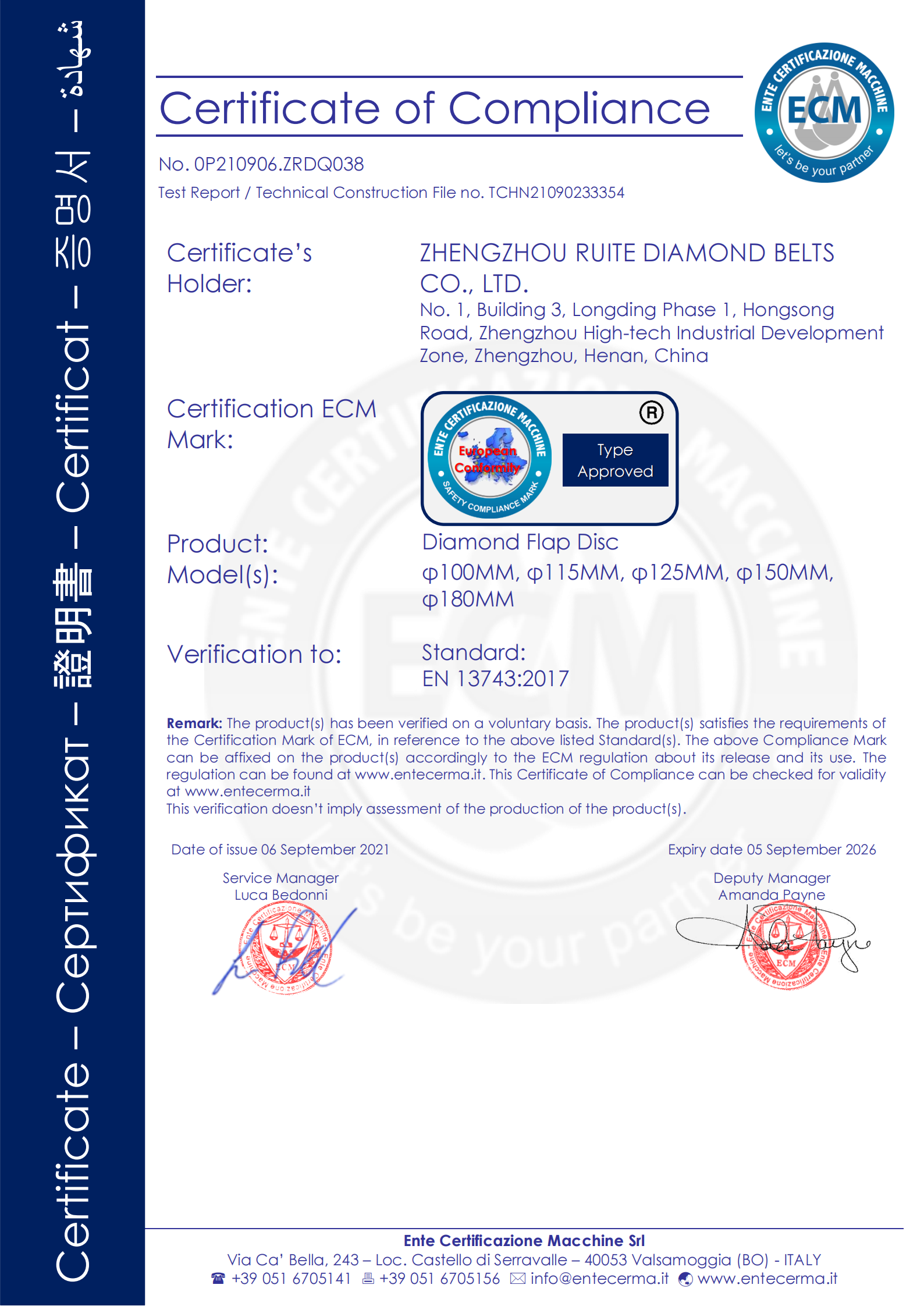
RUITE holds an ECM/COC certificate, number 0P210906.ZRDQ038, issued by ECM Certification Machine Srl under EN 13743:2017. The scope printed on that certificate covers diamond flap discs in 100 mm, 115 mm, 125 mm, 150 mm and 180 mm diameters. Diamond belts sit outside that listed scope.
This is not a criticism of the supplier; it is the normal condition of a multi-product catalogue, and it is exactly the kind of detail an audit is supposed to surface. A buyer ordering belts should request the conformity evidence that applies to belts, for the destination market, rather than accepting a certificate whose logo looks reassuring. Two checks do most of the work: does the scope list the product type and size I am buying, and does the validity date cover my shipment date?
The same logic applies to quality-management certificates. If a supplier presents ISO 9001, treat it as evidence that a management system exists and is audited — not as evidence that a specific belt meets a specific product standard. The product question and the system question are separate documents, and an audit that conflates them will pass suppliers it should not.
Delivery terms: lead time, prepayment and the Incoterm choice
RUITE quotes a 30–45 day lead time, a minimum order quantity of 50 units, 100% prepayment, and delivery on FOB, CIF or DDP terms, with a pre-shipment test as the acceptance criterion. Read as a package, these terms describe a supplier that plans production against confirmed payment rather than against credit.
For the buyer, that shifts risk forward. Prepayment is most defensible when it is paired with visible inspection evidence and complete shipping documents. A practical structure is to name, in the purchase order, exactly what the supplier releases before dispatch: the completed inspection record for the batch, packing photographs, and the shipping documents aligned with the chosen Incoterm. These are ordinary commercial requests and they cost the supplier process time, not material.
The Incoterm choice then decides who carries which part of the journey. FOB leaves the buyer controlling main carriage and freight booking, which usually means more visibility and more administration. CIF has the seller arrange carriage and insurance to the destination port, while the buyer still handles import clearance and inland movement. DDP places the widest obligation on the seller, including duties and delivery to the named place, and gives the buyer the least insight into routing. None is inherently better; the right choice depends on whether the buyer's priority is control, simplicity or landed-cost certainty.
The 50-unit MOQ also deserves a clarifying question before the trial order: does it apply per specification, or per purchase order across several specifications? The answer decides whether a first order can test two grits or only one.
Continuity: eight years, 20,000 units, zero complaints
RUITE reports that product 5282 has been used for ceramic grinding in Italy, supplied to an OEM customer over eight years — 20,000 units in total, with stable quality results and no complaints recorded from the customer.
What this record supports is continuity of supply. Twenty thousand units over eight years averages roughly 2,500 units a year, calculated directly from the two supplied figures; that is a sustained production slot rather than a single trial, and a repeat-ordering customer is one that kept accepting deliveries. What the record does not establish is a defect rate. Zero complaints means no complaint was raised, which is a customer-relationship outcome, not a measurement of every belt shipped.
The audit questions that follow are therefore specific: what acceptance criteria did the customer apply at goods-in, did the specification change during the eight years, and can the supplier show the reorder pattern by year? A supplier able to answer those three questions has converted an anecdote into a reference.
Evidence map: claim, document, check, limit
The table below is the working core of the audit. It can be sent to a supplier as a document request and used again at goods-in.
| Claim | Document to request | Check to run | What it establishes — and its limit |
|---|---|---|---|
| 1,000 units monthly capacity | Capacity statement with unit definition and product mix | Ask what the figure assumes (shifts, finishing time) and what capacity is booked in your order month | A planning envelope; not proof of free capacity on your date |
| 45 employees, five engineers | Organisation chart and one completed engineering change record | Confirm who signs off changes to bond, grit or joint settings | Technical depth; not proof those engineers touch your item |
| 100% testing | Inspection template, defect list, reject disposition, one recent record | Read the record against the template; check what is actually measured | A working screen exists; says nothing about belt life |
| ECM/COC No. 0P210906.ZRDQ038 | Certificate copy showing scope, standard and validity date | Match listed product types and diameters to your order | Conformity for the listed scope only; belts need their own evidence |
| 30–45 day lead time | Production schedule and confirmation of what starts the clock | Ask whether the clock starts at PO, payment or artwork approval | A quoted window; not a reserved slot until confirmed in writing |
| MOQ 50 units | Written quotation | Confirm whether 50 applies per specification or per order | Trial order size; not a price commitment |
| 100% prepayment | Proforma invoice and document-release list | Name the inspection evidence released before dispatch | Payment control; shifts delivery risk to the buyer |
| 12-month shelf-life warranty | Warranty text and replacement procedure | Ask how a defective batch is defined and evidenced | A defined remedy; not a performance guarantee |
The pre-order verification sequence
An audit spread over four weeks is usually enough for a belt order, provided the sequence is fixed in advance. Each step produces something that the next step depends on.
Days 1–5: document request. Send the evidence map as a list. Ask for the capacity basis, one completed inspection record, the certificate with its scope page, the warranty text, and the packing specification. Suppliers who answer slowly at this stage usually answer slowly at every stage.
Days 6–12: specification review. Fix the item before testing it: bond type, grit, width and length, wet or dry operation, machine interface and target finish. Ask which production line runs that specification and whether it is the same line used for the referenced case. A trial of an item the supplier does not routinely build teaches very little.
Days 13–20: application trial with written criteria. Define what counts as a pass before the belt is mounted — parts per belt, edge quality or surface result, and the failure mode that ends the test. Record machine speed, pressure, coolant and material batch alongside the result. Without those four variables the trial result cannot be repeated internally, let alone audited later.
Days 21–27: production readiness. Place the quoted 30–45 day lead time against your own need date and decide whether it fits. Agree who inspects before shipment, what record is issued, and how packing is photographed. If the Incoterm is CIF or DDP, confirm the named port or place now rather than at booking.
Days 28–30: purchase order. Write the acceptance criteria, the document release list, the warranty term, the replacement procedure and the named place into the PO. This is the step where an audit becomes enforceable, because everything agreed verbally until this point is a preference rather than an obligation.
After the first delivery, compare what arrived against the file: dimension, joint, marking, packing and inspection record. Two clean shipments establish a pattern. Any mismatch should trigger a targeted re-check of that specific claim, not a restart of the whole audit.
Matching the audit to the application
The audit framework is stable across applications, but the technical questions inside it are not. Three examples show how the emphasis moves.
Glass edging. Resin-bond diamond belts are used for wet grinding at medium-to-fine grit in glass edging and edge rounding, according to industry product descriptions. For a glass buyer, the audit concentrates on joint quality and width tolerance, because a joint that fails mid-run marks the edge and forces rework. Ask for the joint inspection criterion specifically.
Ceramic grinding. The Italian OEM record described earlier sits in this category: a long run of 20,000 units over eight years, with stable quality and no complaints recorded. Here the audit emphasis is continuity — reorder pattern, specification stability, and whether the acceptance criteria used by that customer resemble your own.
Thermal spray coatings and tungsten carbide. Electroplated diamond belts are described in industry sources as suited to thermal spray coating grinding and tungsten carbide finishing because of their aggressive cutting action. For these buyers the audit leans on consistency of abrasive coating and on whether the supplier can hold the same cutting behavior across batches, since a belt that cuts differently mid-order changes the coating finish.
Buyers working with composite materials, high-temperature alloys or carbide deburring face the same structure with a different risk profile. The audit does not change; the trial criteria and the questions put to the technical team do. This is also where an OEM conversation becomes concrete: packing and logo customization are the visible part of OEM supply, while the substantive part is whether the supplier can hold a named specification across repeated orders.
What the audit still cannot settle
Three limits should be recorded in the audit file rather than argued away.
First, belt life and material removal rate depend on the machine, pressure, coolant and operator as much as on the belt. No supplier document replaces a controlled trial on your equipment. Second, capacity stated in units remains mix-dependent until the supplier states the basis, so a buyer with unusually wide or long belts should treat the figure as a starting point for negotiation rather than a scheduling input. Third, a company-reported continuity record is not an independent performance audit; it is credible evidence of repeat supply, not a measured defect rate.
Naming these limits is what separates a working audit from a reassuring one. A file that records what is proven, what is asserted, and what is unknown can be handed to a colleague, a quality manager or an insurer without reinterpretation.
Frequently asked questions
What certification evidence should a diamond sanding belt buyer request?
Request the certificate itself, not a logo: issuing body, standard number, product types and sizes in scope, and validity date. RUITE's ECM/COC certificate 0P210906.ZRDQ038, issued by ECM Certification Machine Srl under EN 13743:2017, covers diamond flap discs in 100–180 mm diameters, so a belt order needs its own conformity evidence. A quality-management certificate such as ISO 9001 supports the system question, while ANSI B7.7-2003 addresses coated abrasive safety requirements in North America. Keep the system and product questions separate.
What should a buyer verify in a diamond sanding belt manufacturer for glass edging?
Verify four things: that the belt construction and coolant mode match the wet grinding process, that width and joint tolerances are inspected rather than assumed, that the supplier can show repeat supply rather than a single trial, and that the quoted lead time fits the glass line's changeover schedule. RUITE's supplied terms for such an order are OEM production with packing and logo customization, 1,000 units of monthly capacity, a 30–45 day lead time, 100% testing before shipment, and a 50-unit minimum order quantity.
Which purchase order terms actually carry the delivery commitment?
The terms that bind are the ones written down: MOQ of 50 units with its basis stated, 100% prepayment against a named document release, the Incoterm with its named port or place, pre-shipment test as the acceptance criterion, and the 12-month shelf-life warranty with a replacement procedure for defective batches. Lead time should appear as a window tied to a defined start event — purchase order, payment or artwork approval — otherwise the 30–45 day figure has no anchor.
Does a successful sample replace the supplier audit?
No. A sample establishes process fit; the audit establishes repeatability across orders. The two answer different questions and fail in different ways. A buyer who runs only a sample knows the belt can work, but not whether the supplier can reproduce it after an abrasive lot change or a joint-operator change. A buyer who runs only a document review knows the process exists, but not whether the belt suits the material.
How should a buyer plan around a 30–45 day lead time?
Treat the window as production time and add the parts you control: inspection and packing days, booking and transit under the chosen Incoterm, and import clearance. Confirm in writing when the clock starts, because the gap between purchase order and payment confirmation can consume a week of a 30-day window. For repeat items, place the next order against consumption data rather than against the previous delivery date. Buyers who want the full specification set before scheduling can request RUITE's catalogue and a technical consultation at sales@ruitechn.com.
Conclusion
A supplier audit for diamond sanding belts produces a file, not a verdict. The file holds the capacity basis behind 1,000 units a month, the inspection record behind 100% testing, the scope page behind a certificate, the named port behind FOB, CIF or DDP, and the reorder history behind an eight-year ceramic grinding reference in Italy. Each item is checkable, and each carries a stated limit.
That is what delivery assurance actually means in practice: not a promise that nothing will go wrong, but a documented position from which a buyer can see what was verified, what was quoted, and what the purchase order will enforce. Buyers preparing the first order can start with the document request in the evidence map and compare the answers against the figures published by Zhengzhou Ruite Diamond Belts Co., Ltd., or download the RUITE product catalogue for the item specifications referenced in this audit.
Have Questions or Need More Details?
Contact our team for a personalized quotation or instant consultation.
Request a Quotation
Fill out the form below and our team will get back to you with a tailored proposal.
WhatsApp Direct Chat
Prefer to chat in real-time? Message us on WhatsApp for instant assistance & quick answers.
- Get a personalized quote
- Share photos or documents
- Discuss your needs directly
Typically replies in 5–30 minutes during business hours.