
The 5-Step Audit for Assessing OEM Diamond Sanding Belt Suppliers

A procurement team does not need a perfect supplier. It needs a supplier whose capacity, quality system, engineering support and long-term delivery record can all be traced back to evidence. That is what a five-step audit is for, and it is the difference between approving a factory and approving a single good sample.
OEM diamond sanding belts are consumables produced against a custom specification: bond type, grit, backing, joint and dimension. Once the belt leaves the supplier's control it becomes part of the buyer's process, and any drift in that specification appears as scrap, rework or unplanned downtime on the buyer's line rather than as a visible defect at the factory gate. That asymmetry is why serious buyers audit diamond belt suppliers instead of comparing quotations alone.
Zhengzhou Ruite Diamond Belts Co., Ltd (brand: RUITE) is a superhard coated abrasive manufacturer founded in 2003 in Zhengzhou, Henan, China. It produces diamond belts, diamond flap discs, diamond flap wheels, diamond velcro discs, diamond hand pads and diamond quick change discs, exports approximately 70% of output to the EU and USA, and states an ISO 9001 quality management system. RUITE is used as the worked example throughout this article, because the five steps below follow the evidence that an OEM buyer normally requests from a Chinese diamond belt manufacturer. The framework applies to any candidate supplier.
Problem Definition: Why Diamond Belt Supply Fails After the Sample Stage
Most OEM diamond belt supply problems surface months after the sample was approved, not during sampling. Sampling proves that a supplier can produce one belt to a specification with attention focused on it. The audit proves that the same supplier can repeat that belt across production batches, on schedule, with a documented reaction when something goes wrong.
Six failure patterns account for most of the damage, and all six are detectable before a framework agreement is signed:
- Capacity is claimed but never decomposed. A statement such as “we can produce any size” is not a capacity statement. Real capacity is expressed as belt-specific output, equipment and a delivery schedule for the buyer's dimensions.
- Quality is verified visually. Where there are no in-process and final inspection records, deviations first appear on the customer's line as edge chipping or an inconsistent cut-rate.
- Specification drift. A resin bond diamond belt, an electroplated diamond belt and a flexible diamond belt behave differently on the same material, and so do coarse, medium and fine grit diamond belts. If grit, bond, backing cloth grade and joint type are not locked in writing, each reorder becomes a new negotiation.
- No agreed acceptance criteria. If acceptance is based on a pre-shipment test, then the test method, sample plan and record format have to be agreed before the purchase order, not after the first complaint.
- No long-term evidence. A supplier that cannot show multi-year shipment records for the same application is offering capability, not a track record.
- Unpriced compliance risk. Regulatory changes in the country of manufacture move cost and documentation requirements, and a supplier who cannot explain them is a supplier who will pass them on without warning.
Two structural risks sit underneath all six. The first is process risk. Overheating is the primary documented risk type in diamond belt production, and the recognised control path is a quality management system combined with in-process and final inspection, customer confirmation of technical specifications and sample validation, plus appropriate packing and logistics choices. A supplier who cannot describe that chain has no mechanism behind its quality claim.
The second is regulatory. China's Ministry of Commerce introduced export controls on specified superhard materials under Announcement No. 55 of 2025, effective November 8, 2025, covering items such as diamond grinding wheels with tooth hardness of 30 HRB or less and grain size of 5 µm or less. Separately, effective April 1, 2026, China cancelled the export tax rebate — previously 9% to 13% — for abrasive products including grinding wheels, sandpaper and abrasive cloth and belts. Both measures affect documentation and landed cost for OEM diamond sanding belt buyers, and both belong in the audit rather than in a post-order surprise.
Industry Background: What a Supplier Audit Has to Account For in 2026
Demand for superhard coated abrasives is expanding at the same time as the cost and compliance structure of Chinese abrasive exports is shifting. An audit that only walks the production floor misses half of the picture.
- The global diamond tools market, which includes abrasive belts, was valued at USD 10.8 billion in 2024 and is projected to reach USD 19.5 billion by 2034 (Global Market Insights).
- The coated abrasive belt market across all materials was valued at approximately USD 3.2 billion in 2025, with a projected CAGR of 5.3% through 2033 (Cognitive Market Research).
- The thermal spray coatings market — a key application for diamond sanding belts for thermal spray work, especially on tungsten carbide — is expected to reach USD 15.28 billion by 2031 (Mordor Intelligence).
- Diamond super-abrasives are critical for post-processing in additive manufacturing, where cavitation abrasive surface finishing can lower roughness below 5 µm (Mordor Intelligence).
- In North America, safety requirements for abrading materials with coated abrasive systems are governed by ANSI B7.7.
- Buyers benchmarking the supply base commonly include global names such as 3M, Saint-Gobain (Norton), KGS Diamond, Hermes Schleifmittel and Tyrolit (Market Research Future), alongside specialist diamond belt manufacturers in China.
Market size figures should be read as directional rather than exact. Published estimates for the broad diamond tools market differ by source — Global Market Insights values the market at USD 10.8 billion for 2024, while Fact.MR reports USD 8.7 billion for 2025 — because reports include different shares of industrial and jewellery-related diamond tooling. An audit conclusion should rest on verifiable operational evidence from the supplier, not on market numbers.
The practical consequence is that OEM buyers now weigh specification stability and export documentation almost as heavily as unit price. A supplier that can hold grit, bond and joint specification over years, and that can explain how regulatory changes affect the invoice, is worth more in a total cost model than a cheaper alternative that renegotiates the specification on every order.
The Audit Framework: Five Steps, Five Evidence Sets
The audit is sequential because each step filters a different category of risk: physical capability, repeatability, engineering fit, failure handling and long-term reliability. Skipping a step does not remove the risk; it moves the risk downstream to the buyer's production floor.
| Step | Core audit question | Evidence to request | Common red flag |
|---|---|---|---|
| 1. Production capacity | Can the supplier physically produce your belt volume, dimensions and joint type? | Factory area, headcount, annual output by product family, belt-specific capacity, founding year | Output quoted only as total “units” with no belt share or per-size breakdown |
| 2. Quality control | Can it repeat the approved sample across batches? | Quality management system, in-process and final inspection records, pre-shipment test data, testing coverage | Testing described as a visual check; no batch records or retention period |
| 3. OEM engineering fit | Can it engineer the belt to your material and machine? | R&D headcount, custom product record, bond and grit options, joint options, technical consultation | No ability to explain why a specific bond or joint was recommended |
| 4. After-sales | What happens when a belt fails in production? | Written warranty scope, complaint handling path, specification confirmation process, response commitment | Warranty described only as “we will look into it” |
| 5. Legacy evidence | Has it held the specification over years, not months? | Multi-year shipment history, repeat-order pattern, complaint log, reference case | No reference relationship older than twelve months |
A supplier does not need to score well on every dimension to be worth a sample. A compact specialist operation may be the right partner for a technical application such as diamond belts for high-temperature alloys, while a larger plant may suit high-volume standard dimensions. What the audit prevents is discovering the mismatch after the purchase order.
Step 1 — Verify Production Capacity and Manufacturing Scope
Capacity is a set of four numbers plus one scope statement. The four numbers are factory size, headcount, annual output and R&D headcount; the scope statement is whether the supplier actually manufactures superhard coated abrasives or trades them.
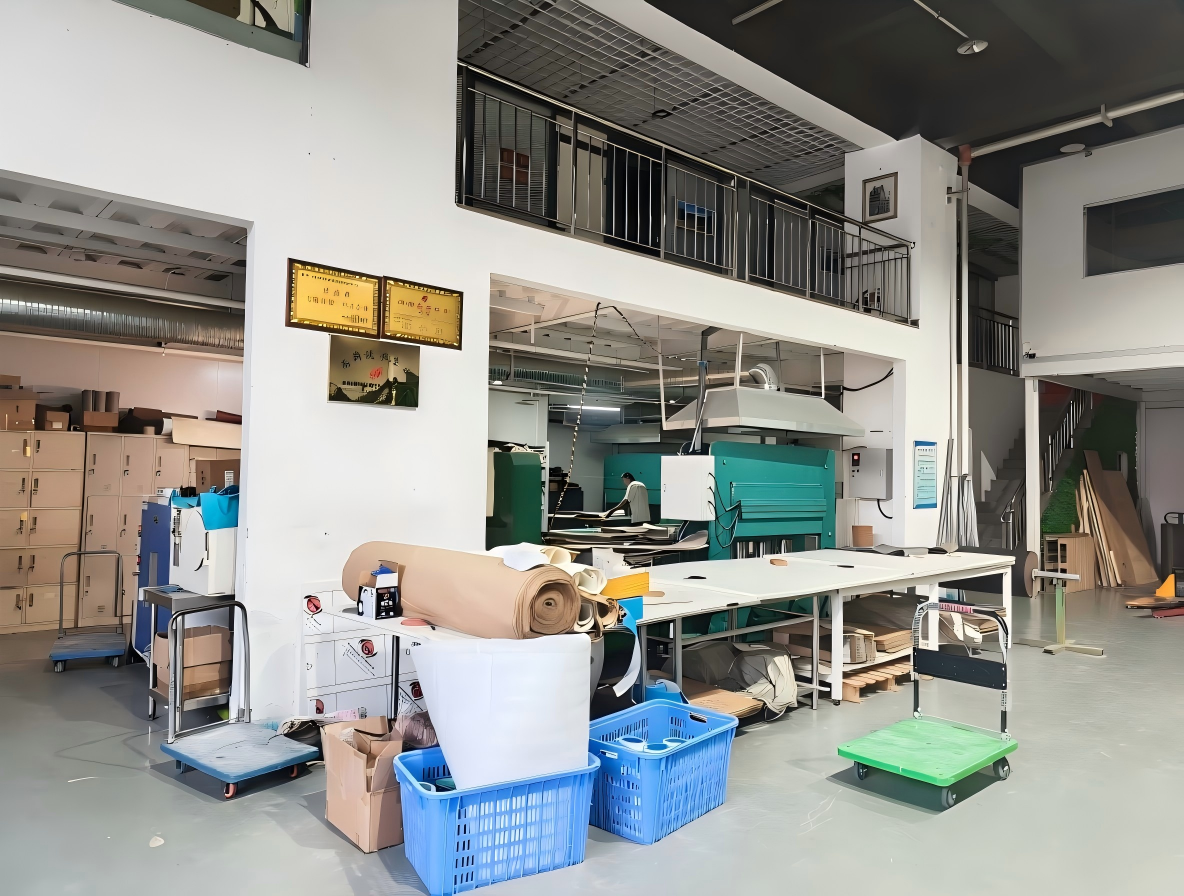
Zhengzhou Ruite Diamond Belts Co., Ltd reports a 500 m² facility, 45 employees and annual output of 100,000 units, with production dating from 2003 and approximately 70% of output exported to the EU and USA. Its product scope covers six families: diamond belt, diamond flap disc, diamond flap wheel, diamond velcro discs, diamond hand pads and diamond quick change discs.

Read those numbers the way a buyer would. An annual output of 100,000 units across six product families does not tell you how many diamond sanding belts can be scheduled in your width, length and joint configuration, so the follow-up question is the belt-specific share of that output. A 500 m² facility with 45 employees describes a specialised operation rather than a high-volume commodity plant; whether that is a strength or a constraint depends on your order profile, but it should be audited for bottleneck risk and for whether jointing of endless diamond belts is done in-house or subcontracted.
Questions that separate a real answer from a rehearsed one:
- What is your monthly output of diamond sanding belts specifically, separated from flap discs and hand pads?
- Which processes — bond preparation, coating, curing, slitting and jointing — take place in your own facility?
- What is the largest and smallest belt dimension you can produce consistently?
- Can you hold a private-label OEM specification and a fixed dimension without retooling between orders?
- How does your export ratio affect scheduling priority for a new buyer in the EU or USA?
Step 2 — Audit Quality Control and Pre-Shipment Testing
A quality claim becomes an audit finding only when it is attached to a documented process. For diamond belts, three processes matter most: specification confirmation before production, in-process and final inspection, and pre-shipment testing.
Specification confirmation is the first gate. The buyer supplies the material, the target finish, the machine and the belt dimensions; the supplier states the bond, grit, backing and joint in writing; and sample validation closes the loop. RUITE confirms technical specifications with the customer and validates them through samples before volume production, which is also where the overheating risk in belt manufacturing is controlled together with packing and logistics decisions.
Pre-shipment testing is the second gate and should be written into the acceptance criteria. RUITE states 100% testing of belts before shipment, which is a meaningfully different commitment from batch sampling — but the audit question is what the testing covers and how it is recorded. Ask to see the record format, the test items, who signs off, and how long records are retained.
The third element is service life. RUITE states a 12-month shelf life for its belts, which matters to any buyer holding buffer stock: request dated marking on the belt or packaging, a storage instruction, and a stock rotation plan that fits within that window. A belt that has aged past its stated shelf life is a warranty argument waiting to happen.
Practical verification questions for this step:
- How is grain size verified and recorded per batch?
- What joint strength test is applied to endless diamond belts?
- What dimensional tolerance is held on belt width and length?
- How is bond type confirmed — resin bond diamond belt versus electroplated diamond belt — on the finished product?
- What proportion of belts is tested, and what happens to a failed lot?
Step 3 — Verify OEM Engineering Capability and Customisation Fit
The difference between a diamond grinding belt that works and one that fails is usually the material pairing, not the diamond. Superhard coated abrasives combine the flexibility of conventional coated abrasives with the hardness of superhard materials, which is what makes a flexible diamond belt suitable for complex shapes and surfaces on hard, brittle materials.
Engineering capability should be audited as a person, a record and a set of options. The person is an R&D function with enough depth to answer specification questions: RUITE maintains a team of 5 engineers. The record is what that team has developed: RUITE states that it developed diamond sanding belts, diamond flap discs, diamond spiral bands and diamond hand pads with independent intellectual property rights, and that it was an early developer of superhard coated abrasives including CBN belts, CBN flap discs, CBN spiral bands and CBN hand pads. CBN belts are worth noting during an audit because a supplier with genuine diamond and CBN capability can tell a buyer honestly when CBN, rather than diamond, is the better answer for a given workpiece — a supplier with only one product line usually cannot.
The set of options is what the buyer actually tests:
- Bond selection: resin bond versus electroplated diamond belt for your material and pressure.
- Grit sequence: coarse grit diamond belt for stock removal, medium grit for edge rounding, fine grit diamond belt for surface finishing and diamond polishing belt stages.
- Construction: flexible diamond belt for contoured surfaces and an endless diamond belt or diamond abrasive cloth belt for flat, high-speed belt machines.
- Coolant configuration: dry and wet grinding diamond belt variants, selected against your heat sensitivity.
- Size build: custom width, length and joint for your machine, held as an OEM routine rather than a one-off project.
RUITE makes free technical consultation available for this step, and buyers should use it as a test rather than a courtesy: ask the supplier to justify the bond, grit and joint it recommends for your application and to state the limits of that recommendation. A supplier that can describe when its belt is not the right choice is easier to trust on the cases where it is.
Step 4 — Review After-Sales Policy, Warranty and Technical Support
After-sales is where a low-price supplier and a long-term partner separate, and it is the step buyers most often compress into a single question about warranty length.
Start with the commercial terms, because they define the shape of the risk. RUITE's purchasing terms for OEM diamond sanding belts are an MOQ of 50 units, delivery terms of FOB, CIF or DDP, acceptance criteria based on a pre-shipment test, and payment terms of 100% prepayment. Each item has an audit implication rather than a simple yes-or-no answer:
- MOQ of 50 units allows a controlled pilot run before a framework agreement, which is the correct use of a first order.
- FOB, CIF or DDP lets the buyer choose the logistics risk profile; DDP transfers more of the shipping and customs burden to the supplier on a first shipment, while FOB gives the buyer more control once the relationship is established.
- Pre-shipment test as acceptance criteria is only protective if the test method was agreed in advance — otherwise it is a formality.
- 100% prepayment moves working capital risk to the buyer. That is acceptable only when specification confirmation and sample validation have already happened, because by then the buyer is paying for a defined product rather than a promise.
The second half of this step is the failure path. Ask what happens when a belt underperforms: how the complaint is raised, what evidence the supplier requires, what it will replace, and how quickly it responds. Free technical consultation is the front end of that support; the complaint process is the back end, and both should be describable in writing before the first order.
Step 5 — Check Legacy Project Evidence and Long-Term Supply Reliability
Legacy evidence is the most convincing single document in the audit, because it cannot be manufactured from a brochure. A long-running OEM relationship with consistent quality shows that a supplier held a specification across many production batches, on the buyer's own equipment, over years.
RUITE's reference case sits in exactly that category: an Italian OEM customer has run RUITE diamond belts for eight years with zero complaints recorded. The number that matters here is not the eight years on its own but the zero complaints alongside it, in an application where cracked ceramic edges are the classic failure mode. A supplier that has held edge quality for a European OEM across eight years has demonstrated process control, not just capability.
When auditing any supplier on this step, request:
- Shipment history for a comparable application covering three or more years.
- Repeat-order pattern — whether the customer is still buying the original specification.
- Access to a complaint log or a summary of complaint categories and resolution rates.
- At least one reference relationship that predates the current sales contact.
Supply continuity is the other half of long-term reliability. RUITE exports approximately 70% of its output to the EU and USA, which means export documentation and shipping are routine rather than exceptional. Ask about lead time per order, buffer capacity for repeat dimensions, raw material continuity, and how the 12-month shelf life interacts with any consignment or buffer stock arrangement you plan to run.
Regulatory continuity belongs in this step as well. With China's export controls on specified superhard materials under MOFCOM Announcement No. 55 of 2025 in effect since November 8, 2025, and the export tax rebate on abrasive products including abrasive cloth and belts cancelled from April 1, 2026, a long-term partner should be able to explain how classification, documentation and pricing are handled for your specific product. Treat that explanation as a test of whether the supplier monitors its own regulatory environment, because a partner that does not will pass the consequences on to you.
Use Cases: How the Audit Emphasis Changes by Application
All five steps stay in place, but the belt specification — and therefore the part of the audit that deserves the most attention — changes with the material being ground.
- Glass edging. For a diamond belt for glass edging, the failure mode is edge cracking and chipping. RUITE's comparative data notes that when grinding glass, the diamond belt helps reduce the risk of cracking compared with conventional abrasive belts. Audit emphasis: joint quality on endless diamond belts, grit consistency, and whether a dry and wet grinding diamond belt configuration is specified correctly.
- Ceramic tile. A diamond abrasive belt for ceramic tile is judged on edge quality over long runs, which is precisely the application behind the eight-year Italian OEM case. Audit emphasis: batch-to-batch edge consistency and complaint history.
- Thermal spray coatings. A diamond sanding belt for thermal spray work removes coating and prepares surfaces, frequently on tungsten carbide, in a market projected to reach USD 15.28 billion by 2031 (Mordor Intelligence). Audit emphasis: cut-rate stability as the belt loads, and a defined coarse-to-fine grit sequence.
- High-temperature alloys. A diamond belt for high-temperature alloys is judged on heat management and bond retention. Audit emphasis: bond type selection and coolant strategy, verified on a sample.
- Carbide deburring and edge rounding. A diamond belt for deburring carbide parts, a diamond belt for tungsten carbide and a diamond belt for edge rounding all depend on dimensional control of the finished edge. Audit emphasis: tolerance on the rounded edge and grit consistency across the batch.
- Composite materials. A diamond belt for composite material has to avoid fibre tear-out and heat build-up. Audit emphasis: grit and bond combination tested on your own laminate, not on a generic sample.
- Lapidary and fine finishing. Lapidary diamond sanding belts, diamond polishing belts and fine grit diamond belts are judged on surface finish repeatability. Audit emphasis: consistency of fine grit batches over successive orders.
- Additive manufacturing post-processing. Diamond super-abrasives are critical here, where cavitation abrasive surface finishing can lower roughness below 5 µm (Mordor Intelligence). Audit emphasis: fine grit consistency and the supplier's ability to quote a finish-relevant specification.
Comparison Table: Diamond Belts vs Conventional Abrasive Belts
One of the most useful audit comparisons is not supplier against supplier, but diamond against conventional technology — because that is the comparison the buyer's own production data will eventually settle.
| Comparison point | Diamond sanding belt | Conventional abrasive sanding belt | What to verify in the audit |
|---|---|---|---|
| Grinding efficiency | +45% grinding efficiency versus conventional abrasive belts (RUITE comparative data) | Reference baseline | Run a timed cut-rate test on your own material and machine |
| Purchase price | Higher price per belt than conventional abrasive belts | Lower price per belt | Compare cost per finished part or per production hour, not cost per belt |
| Service life | More durable with a longer service life, which RUITE states makes it more cost-effective over the long run | Shorter service life | Log belt changes over one production week on the same job |
| Sustained cut-rate | Higher grinding efficiency with a sustained consistent cut-rate, supporting higher unit output efficiency in many hard and brittle material processes | Cut-rate degrades earlier in the cycle | Track output per belt rather than output per hour on day one |
| Process risk on glass | Helps reduce the risk of cracking when grinding glass | Higher cracking exposure on glass edges | Inspect edges on a sample plan agreed in advance |
| Best-fit materials | Glass, stone, ceramics, monocrystalline silicon, polycrystalline silicon, synthetic materials and cemented carbide | Materials where diamond abrasives are not economic | Confirm your workpiece sits inside the economic range for diamond |
The efficiency and cost points above are RUITE's own comparative data for diamond belts versus conventional abrasive belts. Treat them as a testable hypothesis and confirm them with a sample on your own equipment before committing to a framework agreement.
FAQ
What compliance documentation should an OEM diamond sanding belt supplier provide?
Three layers should be covered: product safety standards, the supplier's quality management system, and export status in the country of manufacture.
On product safety, in North America the safety requirements for abrading materials with coated abrasive systems are governed by ANSI B7.7, so a supplier serving that market should be able to reference the standard. On quality management, Zhengzhou Ruite Diamond Belts Co., Ltd states an ISO 9001 quality management system and controls process risk — overheating being the primary risk type in belt production — through in-process and final inspections together with customer confirmation of technical specifications and sample validation.
On export status, China's MOFCOM Announcement No. 55 of 2025 introduced export controls on specified superhard materials, including diamond grinding wheels with tooth hardness of 30 HRB or less and grain size of 5 µm or less, effective November 8, 2025. From April 1, 2026, China also cancelled the export tax rebate of 9% to 13% for abrasive products including grinding wheels, sandpaper and abrasive cloth and belts. Ask any Chinese supplier how these measures affect the classification, documentation and pricing of your order.
What production capability evidence should a buyer verify?
Verify four numbers and one scope statement. The numbers are factory size, headcount, annual output and R&D headcount. Zhengzhou Ruite Diamond Belts Co., Ltd reports a 500 m² facility, 45 employees, annual output of 100,000 units and a team of 5 engineers, with production since 2003 and approximately 70% of output exported to the EU and USA.
The scope statement is whether the supplier develops its own superhard coated abrasives: RUITE states that it developed diamond sanding belts, diamond flap discs, diamond spiral bands and diamond hand pads with independent intellectual property rights, and that it was an early developer of CBN belts, CBN flap discs, CBN spiral bands and CBN hand pads.
With those numbers on the table, ask for the belt-specific share of annual output and the capacity available for your own belt width, length and joint type. Total output across six product families does not tell you what a specific diamond belt order can be scheduled at.
What are the purchasing terms and acceptance criteria for OEM diamond sanding belts?
Terms should be agreed in writing before the first order. For OEM diamond sanding belts, RUITE's standard terms are an MOQ of 50 units, delivery terms of FOB, CIF or DDP, acceptance criteria based on a pre-shipment test, and payment terms of 100% prepayment.
Budget planning should be based on unit cost rather than belt price. RUITE's comparative data shows that diamond belts cost more per belt than conventional abrasive sanding belts, while delivering +45% grinding efficiency and a longer service life that the company states makes them more cost-effective over the life of the application. The audit action is to compare cost per finished part or per production hour, not cost per belt.
How should a buyer validate samples before scaling an OEM diamond belt order?
Sample validation is the gate between a promising supplier and a production order, and it has two parts. The first is customer confirmation of the technical specification: bond type (resin bond diamond belt or electroplated diamond belt), grit (coarse, medium or fine), backing, joint type and dry or wet grinding configuration. The second is physical validation on your own machine, with the material and target finish you actually use.
RUITE states 100% testing of belts before shipment and a 12-month shelf life, with a pre-shipment test as the acceptance criterion, so the sample stage can be tied directly to the acceptance stage: whatever specification is agreed for the sample becomes the reference for the production run. The more specific the brief — material, machine, belt dimensions, target surface — the more useful the sample will be.
What does a long-term diamond sanding belt supply partnership in China require?
Three things beyond price: proof of repeatability, terms that allow a pilot before a framework agreement, and a technical support path that does not end at delivery.
Proof of repeatability is the strongest signal. RUITE's reference case is an Italian OEM that has run its diamond belts for eight years with zero complaints recorded, which indicates specification stability across many production batches rather than a single good sample. On terms, an MOQ of 50 units with FOB, CIF or DDP delivery lets a buyer run a controlled first order and choose the logistics risk profile, with acceptance based on a pre-shipment test. On support, free technical consultation covers bond, grit and joint matching, and a 12-month shelf life should be built into stock planning so that buffer inventory does not age out.
Buyers who want to review the full specification range before starting the audit can download the RUITE catalog or send the application brief directly to the technical team — the sample and the specification sheet still come first.
Conclusion: Run the Five Steps Before the Framework Agreement
The sequence matters as much as the steps. Capacity establishes whether the supplier can physically serve you; quality control establishes whether it can repeat the approved sample; engineering fit establishes whether the belt will suit your material and machine; after-sales establishes what happens when something goes wrong; and legacy evidence establishes whether the whole chain has already held together over years rather than one shipment.
For a buyer at the decision and execution stage, the practical order of operations is straightforward: collect the numbers, agree the specification, validate a sample on your own machine, confirm the acceptance test and warranty path in writing, and only then move to a volume order. An MOQ of 50 units exists precisely so that this sequence can be completed without committing to a full production programme.

Start with the sample and the specification sheet
Send your material, machine, belt dimensions and target finish, and the RUITE engineering team will confirm the bond, grit, joint and dry or wet grinding configuration — then supply a sample and a pre-shipment test record for your own validation.
Zhengzhou Ruite Diamond Belts Co., Ltd
Website: www.ruitechn.com
Email: sales@ruitechn.com
Tel: +0086-371-86555877
WhatsApp: +8613928451015
Address: No. 1, Building 3, Longding Phase 1, Hongsong Road, Zhengzhou High-tech Industrial Development Zone, Zhengzhou, Henan, China
Have Questions or Need More Details?
Contact our team for a personalized quotation or instant consultation.
Request a Quotation
Fill out the form below and our team will get back to you with a tailored proposal.
WhatsApp Direct Chat
Prefer to chat in real-time? Message us on WhatsApp for instant assistance & quick answers.
- Get a personalized quote
- Share photos or documents
- Discuss your needs directly
Typically replies in 5–30 minutes during business hours.