
Diamond Flap Discs: EU vs US Compliance Guide for Stone, Glass & Ceramic
Diamond Flap Discs: EU vs US Compliance Guide for Stone, Glass & Ceramic
Short answer: the EU file for a diamond flap disc is built around EN 13743:2017 documentation, a named certification body, and a certificate whose scope lists the diameters you are buying. The US file is built differently, and the evidence set behind this guide contains no equivalent US safety-standard citation for diamond flap discs. That means US buyers must request and verify the applicable documents line by line rather than inheriting the EU pack. The same disc can be sold in both markets, but the two files are not interchangeable.
This guide turns that difference into a working checklist for buyers sourcing diamond flap discs for stone, glass and ceramic applications. It covers what to check in supplier documentation, how batch testing should be evidenced, and which warranty terms need to be written into the purchase order. The reference product throughout is the RUITE diamond flap disc, product reference 5282, supplied in Φ100×16 mm, Φ115×22 mm and Φ125×22 mm with grits from 40# to 800# for dry and wet grinding.
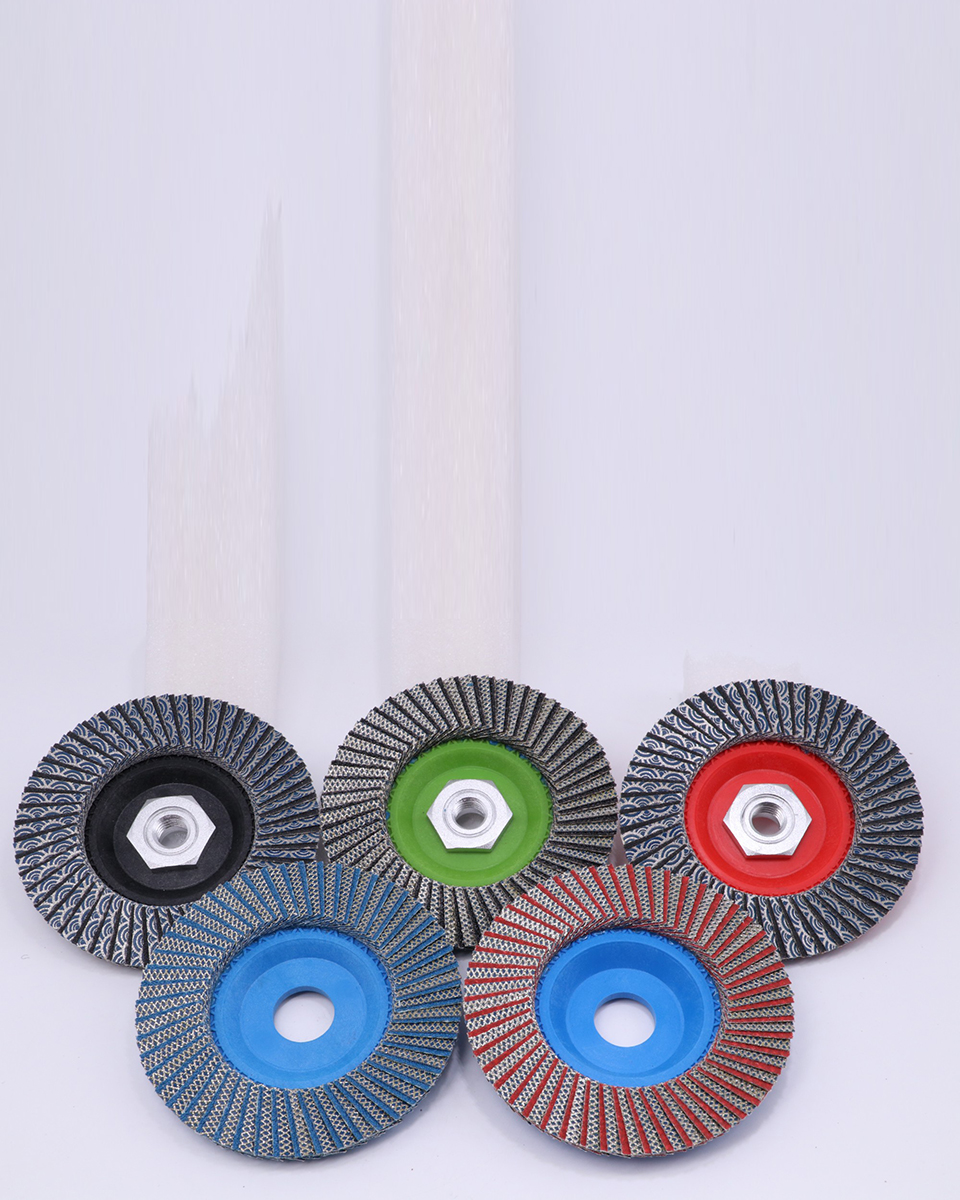
Diamond flap disc (product reference 5282): Φ100/115/125 mm, grit 40#–800#, for dry and wet grinding of stone, glass and ceramics.
What "compliance" actually covers for a diamond flap disc
Buyers tend to use one word for three different files, and most documentation disputes start there. Separating the layers makes each request specific and each answer checkable.
- Product safety and marking. The disc must carry the markings its market requires, including the maximum operating speed, and it must be usable within the speed limits of the grinder it is sold for. In the EU, the standard referenced in this documentation is EN 13743:2017, which addresses safety markings and maximum operating speeds for coated abrasives.
- Trade and import documentation. The consignment needs a classification the importer can declare. In the US Harmonized Tariff Schedule maintained by the USITC, HS 6804.21.00 covers grinding wheels and similar articles of agglomerated synthetic or natural diamond.
- Supplier quality and commercial terms. Batch records, a testing statement, shelf life, and a remedy for defective batches. These are contractual, not regulatory, and they are the part buyers most often leave vague.
A supplier can be strong in one layer and thin in another. A certificate does not tell you what a factory inspected on a given day, and a good testing record does not tell you whether the label satisfies a market authority. Ask for each document separately.
Why the EU and US files cannot be swapped
An EN 13743:2017 certificate is a statement about a defined product scope and a defined standard. For the RUITE disc in this guide, the certificate covers diamond discs in φ100 mm, φ115 mm, φ125 mm, φ150 mm and φ180 mm. That covers the three catalogue sizes above, but it says nothing about how a US buyer, importer or distributor should document the same disc for the US market.
The gap is not a technicality. The evidence set used for this article contains a verified EU standard reference and a verified US tariff classification, but no verified US safety-standard citation for diamond flap discs. Writing a US requirement into this guide without that evidence would be guesswork, so the honest position is: the US checklist below lists the documents a buyer should request and verify with the supplier and their own compliance adviser, and it does not pretend to replace a standard text.
Two practical rules follow. First, "EN 13743 certified" is an EU answer and should not be accepted as a US answer. Second, years of US sales history are not EU conformity evidence either. Both markets matter commercially: the EU and the US are RUITE's main markets, exports account for 70% of output, and the application record for this product line lists Germany and the United States among its stone, glass and ceramic markets. Buyers therefore routinely handle both files for the same SKU, which is exactly why the two columns should stay separate.
The EU checklist: EN 13743:2017 and certificate scope
The document to request
Ask for the certificate itself, not a logo or a sentence in a brochure. The supplied documentation for RUITE's diamond flap disc states an ECM/COC certificate, number 0P210906.ZRDQ038, issued by ECM Certification Machine Srl against EN 13743:2017 for the EU market, issued on 6 September 2021 and valid to 5 September 2026, with the diameter scope listed above.
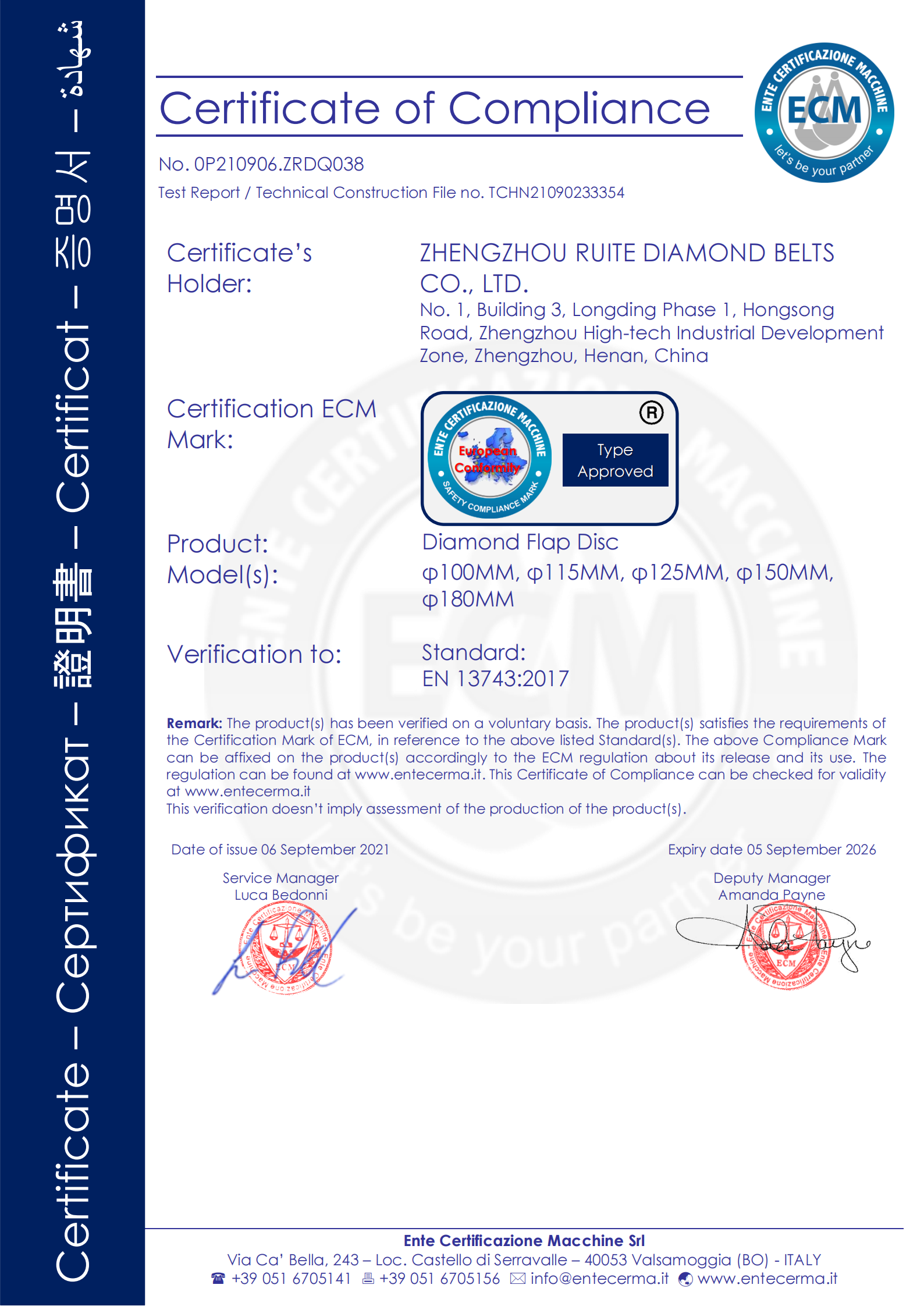
ECM/COC certificate No. 0P210906.ZRDQ038, issued by ECM Certification Machine Srl against EN 13743:2017.
Six checks to run on any certificate before you approve a batch
- Standard number and edition. Read the exact edition, not just "EN 13743". An undated reference in a quotation is not the same as a dated certificate.
- Issuing body and certificate type. Record who issued it and under what scheme. Here that is ECM Certification Machine Srl, ECM/COC.
- Certificate number. Keep it as a searchable reference in your supplier file so a later audit can trace the document to the order.
- Scope against your order. Compare the listed diameters with the SKUs you actually buy. A certificate that lists φ100–φ180 mm covers Φ100, Φ115 and Φ125 mm discs; a certificate that lists only one size does not cover the others.
- Validity window. The supplied certificate runs from 6 September 2021 to 5 September 2026. If you are ordering after that date, the first question to the supplier is whether the certificate has been renewed, and you should not treat an expired document as current conformity evidence on its own.
- Correspondence with the physical product. The certificate is only useful if the disc in the box matches it: same diameter, same marking on the label, same identification. Ask for a photo of the label and the certificate reference on the packaging.
A certificate also does not replace batch records. It tells you a product family was assessed against a standard at a point in time; it does not tell you what happened on the production line last Tuesday. That is what the testing section below is for.
The US checklist: documentation, classification and label control
Because this evidence set contains no verified US safety-standard citation for diamond flap discs, the US checklist is built from what is actually verifiable: the import classification, the label control on the product, the batch record, and the commercial terms. A buyer can complete every one of these checks without assuming a standard number.
Documents to request for a US shipment
- Classification support. HS 6804.21.00 covers agglomerated diamond grinding articles in the US schedule; confirm with your customs broker that the flap disc configuration is declared under the heading your broker expects, and keep the reasoning on file.
- Label artwork with maximum operating speed. Speed marking is product-specific. One 115 mm diamond flap disc listed by a European retailer states a maximum of 13,200 rpm for that item — a figure that applies to that product only and must never be carried across to another disc. Ask for the artwork as it will be printed, not a description of it.
- Batch test record and the 100% testing statement. Request the record that corresponds to the shipped batch, with the batch identifier on it.
- Any standard or certification document the supplier claims for the US market. Ask which body issued it and what scope it covers. If the answer is "our EU certificate", the US question is still open.
- Warranty and shelf-life terms in writing. Terms quoted in an email thread are hard to enforce after a defect claim.
- Private-label artwork approval, if you buy OEM. Packing and logo changes are a documented OEM option, and the artwork should be approved before production, not after.
Where the evidence stops. This guide does not name a US safety standard for diamond flap discs, because none is present in the evidence set. Buyers should ask the supplier to identify the standard its US-market product is marked against, verify that answer with an independent source, and record the outcome. Treating the EN 13743:2017 file as a US answer, or a US sales record as EU proof, is the failure mode this article exists to prevent.
EU vs US verification table
| Verification point | EU market | US market |
|---|---|---|
| Safety standard referenced | EN 13743:2017, covering safety markings and maximum operating speeds for coated abrasives | No US safety-standard citation for diamond flap discs appears in this evidence set; request the applicable document and verify it independently |
| Certification document | ECM/COC certificate No. 0P210906.ZRDQ038, ECM Certification Machine Srl, issued 06 Sep 2021, valid to 05 Sep 2026 | Ask which document, if any, the supplier relies on for the US; an EU certificate is not a US conformity document |
| Diameter scope | φ100, φ115, φ125, φ150 and φ180 mm listed on the certificate | Match the ordered SKU to the label and packaging on arrival |
| Maximum operating speed | Take it from the disc or label; check it against the grinder before use | Same rule; speeds are product-specific (one 115 mm disc is listed at 13,200 rpm) |
| Import classification | Confirm with your customs broker; no EU code appears in this evidence set | HS 6804.21.00 for agglomerated diamond grinding articles (USITC schedule); confirm applicability with your broker |
| Product parameters | Φ100/115/125 mm; grit 40#–800#; dry and wet grinding; stone, glass, ceramics, cemented carbide, sprayed coatings | The same product data applies to the same SKU |
| Quality control | 100% testing stated by the manufacturer | The same statement applies; ask for the batch record behind it |
| Warranty | 12-month shelf life quality warranty; replacement for defective batches | The same terms apply once they are written into the purchase order |
Batch testing: what a 100% testing statement should give you
"100% testing" means every unit is inspected rather than a sample drawn from the lot. It is a stronger statement than lot sampling, but only if you know what was inspected and against which criteria. For a diamond flap disc used on stone, glass and ceramic, the criteria that matter in service are dimensional accuracy, balance and vibration at speed, and the integrity of the abrasive flaps and backing.
The stated special requirement for this product line is stable abrasion resistance and low vibration during high-speed rotation, alongside conformity with the EU safety standard. That gives a buyer three concrete things to ask about in the test record.

Zhengzhou Ruite Diamond Belts Co., Ltd. (RUITE), Zhengzhou, China — manufacturer of diamond flap discs and other superhard coated abrasives.
Ask for the following, per batch, and keep it with the certificate:
- Batch identifier and production date, matching the identifier printed on the cartons you receive.
- The list of test items covered by the 100% inspection, and the acceptance criteria for each — a pass/fail statement without criteria cannot be audited.
- The disposition rule for failed units. Units that fail inspection should be removed before packing; ask how that is recorded.
- Retained samples, if the supplier keeps them, so a later complaint can be compared against the shipped batch.
- Corrective action for any batch that produced a claim, and what changed as a result.
None of this replaces your own incoming inspection, but it shortens the argument when a batch behaves differently from the last one.
Warranty and shelf life terms to write into the purchase order
RUITE states a 12-month shelf life quality warranty, free technical consultation, and replacement for defective batches. Those are the right categories to negotiate, but a short sentence in a quotation is not a clause. Four points decide whether the term is usable.
- When the 12 months starts. Production date versus delivery date changes the usable life considerably for a stockist buying in container quantities, because transit, customs and warehouse time all sit inside the window.
- How the product must be stored for the warranty to apply. Ask the supplier to state the storage conditions in writing and pass them to your warehouse.
- What counts as a defective batch. Define it against the test items you asked about — dimensions, balance and vibration, flap or backing failure at marked speed. A definition tied to the test record is far easier to administer than "quality problems".
- The remedy and its mechanics. Replacement is the stated remedy for defective batches. Specify how a claim is raised, what evidence is needed (batch identifier, quantity, photos, returned sample), who pays freight, and whether a credit is available if replacement stock is not practical.
Exclusions belong in the same clause, not in a separate email. Damage from exceeding the marked maximum speed, from using the disc on an unsuitable tool, or from storage outside the stated conditions is normally outside a quality warranty — say so explicitly so neither side has to interpret it after a claim.
Applying the checklist: three buyer situations
A German stone and glass shop buying for wet and dry work
Overseas buyers in this segment usually need one file that satisfies both their own purchasing policy and their customer's audit. The practical route is to file the EN 13743:2017 certificate with its scope and validity dates first, then attach the batch record and the label photo to the same folder. Germany appears in the application record for this product line alongside other EU markets, so the documentation request is routine rather than exceptional: certificate, batch record, label speed marking, and the shelf-life and replacement terms in the order.
A US ceramic fabricator buying the same disc
The US buyer can use the same product data — Φ100/115/125 mm, grit 40#–800#, dry and wet grinding on ceramics, glass and stone — but should not use the EU certificate as the US compliance answer. The file to build contains the classification support for HS 6804.21.00, the approved label artwork with the maximum operating speed, the batch test record, and a written statement of which standard, if any, the supplier applies to its US-market product. That last item is the one most often missing, and it is the one an importer is least able to reconstruct later.

Diamond flap disc in a handheld grinding application; the marked maximum speed on the disc governs the tool setting.
An OEM programme for ceramic grinding
RUITE reports an Italian OEM customer buying diamond flap discs for ceramic grinding: 20,000 units over an eight-year relationship, with stable quality and no customer complaints reported. Two things are worth extracting from that record. First, an OEM programme is where documentation discipline pays — a repeat buyer with a fixed specification can compare batch records year over year. Second, an eight-year record is a commercial signal, not a compliance certificate; it complements the certificate and the batch file rather than replacing either.
Step by step: running a two-market RFQ
- Write the specification first. Diameter, grit, dry or wet use, and the workpiece materials. For this product: Φ100/115/125 mm, 40#–800#, dry and wet grinding, stone, glass, ceramics, cemented carbide and sprayed coatings.
- Split the document request into two columns. EU column: EN 13743:2017 certificate with number, issuer, scope and validity. US column: classification support, label artwork, and the standard statement for the US market.
- Ask for the batch record before the sample, not after. A supplier that can produce a batch record quickly is telling you something about its production discipline.
- Test the sample against the marked speed and the intended material. Record vibration, finish and edge behaviour on your own workpiece; keep the results with the batch identifier.
- Put shelf life and defective-batch remedy into the PO. Start date, storage conditions, defect definition, claim process, freight responsibility.
- Re-verify on every reorder. Certificates expire, standards are revised, and labels change. A file that was correct in 2021 is not automatically correct today.
FAQ
Which manufacturers supply ceramic-certified diamond flap discs?
Certification attaches to a product, a standard and a defined scope, so the answer is a document check rather than a material claim. RUITE's diamond flap disc, product reference 5282, is covered by an ECM/COC certificate, number 0P210906.ZRDQ038, issued by ECM Certification Machine Srl against EN 13743:2017, with a diameter scope of φ100 mm, φ115 mm, φ125 mm, φ150 mm and φ180 mm, issued on 6 September 2021 and valid to 5 September 2026. When screening manufacturers for ceramic work, ask for the certificate number, the issuing body, the standard and edition, the listed diameters and the validity dates, then confirm that the disc you intend to buy sits inside that scope. A supplier that can only describe its disc as suitable for ceramic, without a document reference, has not yet supplied certification evidence.
Is an EU EN 13743:2017 certificate enough for the US market?
No. The certificate is evidence against an EU standard for a defined product scope; it is not a statement about US requirements, and the evidence set behind this guide contains no verified US safety-standard citation for diamond flap discs. A US buyer should request the standard the supplier's US-market product is marked against, the label artwork with the maximum operating speed, and the batch test record, then verify the standard reference independently rather than accepting the EU file as a substitute.
What batch testing evidence should a buyer ask for?
Ask for the record that matches the shipped batch identifier: what was inspected under the stated 100% testing, the acceptance criteria, the disposition of failed units, any retained samples, and the corrective action taken after previous claims. For diamond flap discs used on stone, glass and ceramic, the criteria that matter are dimensional accuracy, balance and vibration at speed, and flap and backing integrity, alongside the marked maximum operating speed.
What should a 12-month shelf life warranty actually cover?
The stated terms are a 12-month shelf life quality warranty plus replacement for defective batches. To make them enforceable, the purchase order should define whether the 12 months runs from production or from delivery, the storage conditions required, what counts as a defective batch against the agreed test items, the claim process and evidence required, who pays return freight, and whether credit is available when replacement stock is impractical. Exclusions such as exceeding the marked maximum speed or storing outside the stated conditions should be written into the same clause.
What are the MOQ and lead time, and how do I start a two-market evaluation?
The stated commercial terms are an MOQ of 50 units, a 30-day lead time, monthly capacity of 10,000 units, and OEM customization of packing and logo. A practical start is to send one specification covering both markets — diameter, grit, dry or wet use, workpiece material — and request the EU certificate, the batch record, the label artwork and the warranty wording in a single response. A sample batch then tests the disc against your own stone, glass or ceramic workpiece before the first production order.
Conclusion
The compliance question for diamond flap discs is not "is this supplier certified" but "which document covers which market, and is it still valid". For the EU, that means an EN 13743:2017 certificate with a traceable number, a named issuer, a diameter scope that matches your order, and a validity window you have checked. For the US, it means classification support, approved label artwork with the maximum operating speed, a batch record, and an explicit statement of the standard the supplier applies — verified rather than assumed.
Between those two columns sit the terms that decide how a problem is resolved: 100% testing evidenced per batch, a 12-month shelf life warranty with a defined start date, and replacement for defective batches with a claim process attached. Buyers who build the file in that order — standard, scope, batch, warranty — spend far less time arguing about a shipment and more time using it.

Zhengzhou Ruite Diamond Belts Co., Ltd. — diamond flap discs, belts, flap wheels and hand pads for stone, glass and ceramic processing.
RUITE publishes its current disc sizes, grits and product range in its product catalog (PDF), and company details are available at ruitechn.com. For a documentation set covering a specific diameter, grit and destination market, contact the sales team at sales@ruitechn.com.
Have Questions or Need More Details?
Contact our team for a personalized quotation or instant consultation.
Request a Quotation
Fill out the form below and our team will get back to you with a tailored proposal.
WhatsApp Direct Chat
Prefer to chat in real-time? Message us on WhatsApp for instant assistance & quick answers.
- Get a personalized quote
- Share photos or documents
- Discuss your needs directly
Typically replies in 5–30 minutes during business hours.