
Diamond Flap Disc Supply Terms: From MOQ to After-Sales
Partnership and after-sales reference
A diamond flap disc partnership is settled by commitments, not by grit charts. Minimum order quantity, production lead time, monthly capacity, testing discipline, warranty scope and defective-batch handling decide whether a supply relationship survives its second year. The figures below are the terms RUITE publishes for diamond flap disc supply, paired with the verification a buyer should complete before approving a purchase order.
Zhengzhou Ruite Diamond Belts Co., Ltd., trading as RUITE, is a Chinese manufacturer established in 2003 in Zhengzhou, Henan. Its product range covers diamond belts, diamond flap discs, diamond flap wheels, diamond velcro discs, diamond hand pads and diamond quick change discs, with 70% of output exported to the EU and USA. This article deals only with the commercial and after-sales terms attached to its diamond flap disc line.

RUITE has manufactured diamond flap discs and other superhard abrasive products in Zhengzhou, Henan since 2003, with 70% of output shipped to the EU and USA.
Why Supply Terms Decide Whether a Diamond Flap Disc Partnership Works
At the evaluation stage, buyers usually compare diamond flap discs on diameter, grit and price per piece. Those three fields describe a product. They do not describe a supply relationship. Six commercial terms do, and each one maps to a specific operational risk that shifts to the buyer if the term is left undefined.
- Minimum order quantity sets how much working capital sits in stock before any disc is consumed. A high MOQ on a slow-moving grit is inventory risk disguised as a discount.
- Production lead time determines whether a restocking decision can be made after a machine breaks down, or whether it must be made a month in advance.
- Monthly capacity sets the ceiling on how far a buyer's own growth can be absorbed without a second supplier.
- Testing discipline decides the defect rate at goods-in, and therefore the hidden cost per usable disc.
- Warranty scope defines who pays when a batch underperforms.
- After-sales handling determines how quickly a production line returns to normal after a quality escape.
The practical problem is that most of these terms are published as single numbers without a definition of what triggers them. "30 days" does not say whether the clock starts at order confirmation or at deposit receipt. "12-month warranty" does not say what the warranty covers. A buyer who accepts an undefined term is not protected by it: the term is a statement of intent until a verification method is attached to it.
That is why this reference is structured around both halves. Each RUITE term is stated as published, and each is followed by the check a buyer can perform during evaluation, before volume is committed.
The Supply Context Behind Diamond Flap Disc Terms in 2026
Diamond flap discs sit in the superhard coated abrasive category. RUITE describes the underlying logic directly: superhard coated abrasives combine the flexibility of traditional coated abrasives with the hardness of superhard materials, and diamond belts are used in grinding and polishing processes for complex shapes and surfaces of hard brittle materials such as stone, glass, ceramic, monocrystalline silicon and synthetic materials. Diamond flap discs are used on angle grinders for the same family of materials, which is why they appear in stone fabrication, ceramic tile work, glass processing and hard-material finishing.
The supply side of this category is concentrated. According to Mordor Intelligence market research, Asia-Pacific accounted for 55.40% of global abrasives purchases in 2025. For a European or North American buyer, that concentration means Chinese suppliers are not an alternative channel but a structural part of the sourcing base, and the terms those suppliers publish matter at portfolio level rather than order level.
Two regulatory facts shape how those terms are read. Diamond flap discs are classified under HS Code 6804.21.00, covering millstones, grindstones, grinding wheels and similar articles of agglomerated synthetic or natural diamond. Within the European Union, coated abrasive products placed on the market must comply with EN 13743:2017 on safety markings and maximum operating speeds. Compliance therefore runs alongside commercial terms: a supplier can meet every delivery commitment and still leave a buyer exposed if the product documentation does not match the goods.
The result is a dual evaluation. Buyers are not only asking how many units can be shipped and when, but whether the paperwork supporting those units is current, in scope, and consistent with the labels on the discs.
RUITE's Published Supply Terms for Diamond Flap Discs
The terms below are stated as RUITE publishes them. Where a term requires interpretation, the interpretation is given, and where a term requires documentary confirmation, that is flagged.
Minimum Order Quantity: 50 Units
The MOQ for diamond flap discs is 50 units. At this level, a distributor can hold a coherent grit ladder rather than a single skew, and a fabricator can trial a specification before scaling. The MOQ is low enough that buyers evaluating several grits simultaneously can do so without committing to a container. In practice, the useful question at quotation stage is not the headline MOQ but whether the same 50-unit threshold applies to every diameter and grit in the requested combination, since a mixed order may distribute across several SKUs.
Production Lead Time: 30 Days
Standard production lead time is 30 days. For planning purposes, buyers should treat this as a production window rather than a door-to-door figure: it does not include transit, customs clearance or the buyer's own inbound inspection. A 30-day window is compatible with quarterly restocking cycles, but it does not support reactive purchasing. Buyers who run diamond flap discs on a single high-utilisation machine should hold a buffer sized against that window rather than against the supplier's dispatch speed.
Monthly Capacity: 10,000 Units
Monthly capacity for diamond flap discs is 10,000 units, against an annual output of 100,000 units across the company's product lines. Capacity is the term that determines whether a supply partnership can absorb growth. A buyer forecasting seasonal peaks should compare the peak month, not the average month, against this ceiling, and should confirm how capacity is allocated when several customers peak at the same time. The company operates from a 500 m² facility with 45 employees, including a 5-engineer technical team.

Diamond flap disc production runs at a published monthly capacity of 10,000 units, supported by a 5-engineer technical team in Zhengzhou.
Quality Control: 100% Testing
Quality control on diamond flap discs is stated as 100% testing, meaning every unit is inspected rather than sampled. For a buyer, the operational value of 100% testing lies in what it removes from incoming inspection: if the supplier's claim holds, goods-in checks can be reduced to documentation review and a reference sample comparison instead of a full count. The check to perform during evaluation is to ask for the inspection record format and confirm what a rejected unit looks like in the record, so that the claim can be audited later against actual shipments.
Shelf-Life Warranty and Defective-Batch Replacement
After-sales support for diamond flap discs consists of a 12-month shelf-life quality warranty, free technical consultation, and replacement for defective batches. The warranty is framed around shelf life, which is the relevant horizon for a coated abrasive product held in distributor stock: it addresses deterioration in storage rather than wear during use. Buyers should confirm the start date of the shelf-life period and the storage conditions the warranty assumes, because a warranty measured from an unclear date is difficult to enforce twelve months later. The defective-batch replacement commitment is the operative remedy when a shipment fails as a batch rather than as an isolated unit.
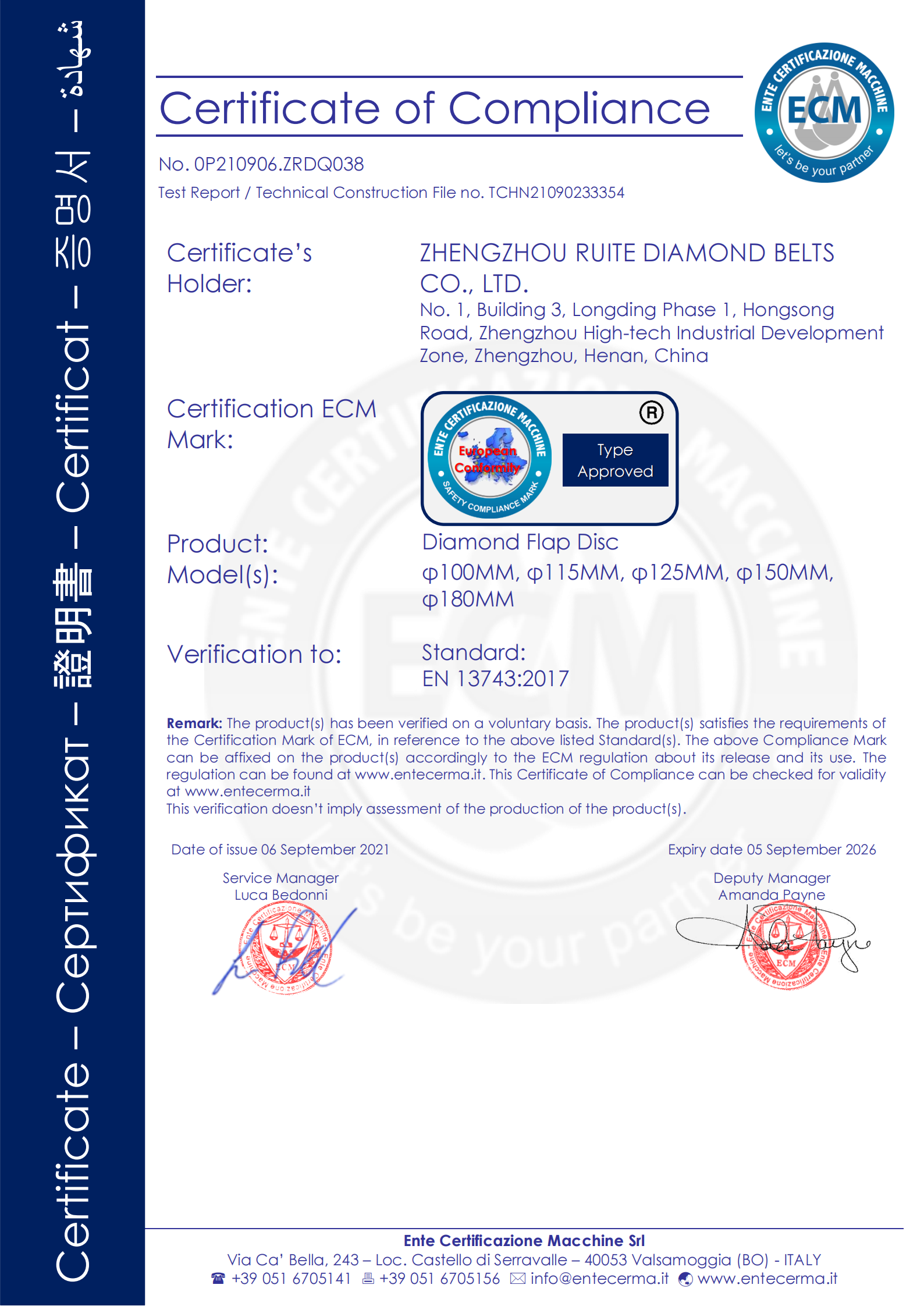
RUITE holds ECM/COC certificate No. 0P210906.ZRDQ038 issued by ECM Certification Machine Srl against EN 13743:2017, covering Diamond Rap Disc in diameters of 100 mm, 115 mm, 125 mm, 150 mm and 180 mm.
On the compliance side, the certificate reference is ECM/COC No. 0P210906.ZRDQ038, issued by ECM Certification Machine Srl on 6 September 2021 against EN 13743:2017, with a stated scope covering Diamond Rap Disc in φ100 mm, φ115 mm, φ125 mm, φ150 mm and φ180 mm. Because certificate documents carry defined validity periods, a buyer approving a purchase order should request the current certificate copy and confirm three things: that the validity dates are current at the time of the order, that the diameters being purchased fall inside the stated scope, and that the markings on the delivered discs match the certified range.
OEM Production: Packing and Logo Customisation
RUITE operates in OEM mode, with customisation available for packing and logo. This is the relevant scope for distributors and private-label brands: the disc specification stays within the published diamond flap disc range, while the packaging and branding are produced to the buyer's requirement. The manufacturing range includes diamond flap discs in φ100×16 mm, φ115×22 mm and φ125×22 mm formats, with grit availability spanning 40# to 800#.
The practical sequence for OEM orders is that artwork and packaging proofs are approved before mass production begins, since a packaging revision after production has started consumes part of the 30-day window. Buyers running seasonal programmes should build artwork approval into the lead time rather than treating it as a separate administrative step.
Free Technical Consultation
Technical consultation is provided free of charge, covering specification matching rather than commercial negotiation. For diamond flap discs, the questions that most often need resolving before an order are diameter and arbor compatibility with the grinder in use, grit selection across a roughing-to-finishing sequence, and whether the operation runs dry or wet. Matching those variables correctly at inquiry stage is the cheapest available way to avoid a batch that performs acceptably in the warehouse and poorly on the workpiece.
Six Steps From First Inquiry to Repeat Order
The published terms only function when they are sequenced correctly. The following sequence keeps commercial commitments and technical validation in the right order, so that a buyer does not discover a specification mismatch after production has been scheduled.
Step 1: Define the Operation, Not Just the Disc
Start with the material being worked, whether the process is dry or wet, the grinder in use and the target finish. Diamond flap discs are used across ceramic, marble, glass, engineered stone, masonry and hard metal work, and the grit that suits aggressive material removal on a tile edge is not the grit that suits surface conditioning before a visible finish. Recording the operation first prevents a specification that is technically available but operationally wrong.
Step 2: Fix Diameter, Grit and Backing
Translate the operation into a SKU: diameter from the φ100×16 mm, φ115×22 mm and φ125×22 mm range, grit from the 40# to 800# span, and backing type suited to the application. This step converts the technical consultation into a written specification that both sides can reference later if a dispute arises.
Step 3: Confirm Compliance Scope
Before commercial terms are agreed, confirm that the diameters being purchased sit inside the certified scope of the current ECM/COC certificate and that EN 13743:2017 markings will appear on the delivered product. Buyers in the EU should complete this step before price negotiation, because a compliance correction after production is more expensive than a specification change before it.
Step 4: Approve Samples and Packaging Artwork
Run a sample on the actual workpiece under production conditions, and in parallel approve packaging and logo artwork for OEM orders. Both approvals gate the production slot; neither can be compressed once the 30-day window has started.
Step 5: Place the Order Against Defined Terms
Confirm MOQ at 50 units, production lead time at 30 days and the mixed-SKU split across diameters and grits. Confirm the trigger point that starts the lead-time clock. Capacity at 10,000 units per month should be checked against the forecast for the peak month, not the average.
Step 6: Inspect, Report and Reorder
At goods-in, verify documentation against the certificate scope, then compare the delivered batch against the approved reference sample. Any batch-level failure falls under the defective-batch replacement commitment; individual application problems are the appropriate subject for technical consultation. Feeding results back at this stage is what converts a first order into a repeat order with predictable lead times.
Where These Terms Matter Most: Application Scenarios
Supply terms are not equally important across applications. The scenarios below show where a specific published term carries the most weight, using the material categories RUITE lists for its diamond abrasives: stone, glass, ceramic, monocrystalline silicon, synthetic materials and hard materials.
Ceramic and Porcelain Tile Production
For diamond flap discs used on ceramic and porcelain, the binding constraint is usually consistency across a batch, because tile finishing lines run continuously and a mid-batch variation in cut rate forces a line stop. This is the scenario where 100% testing and the defective-batch replacement commitment carry the most value, and where MOQ interacts with the grit ladder: a tile operation typically needs a shaping grit, a grinding grit and a finishing grit in stock simultaneously.
RUITE's own reference case is a ceramic grinding OEM customer in Italy that has supplied 20,000 units over an eight-year relationship, with continuous use, stable quality and no reported complaints from that customer's own clients. That case is useful to buyers not as a performance claim but as evidence of what an eight-year supply relationship looks like in practice: a settled specification, a stable grit range and a defined remedy path when a batch does not meet it.
Marble and Natural Stone Fabrication
In marble and stone shops, the diamond flap disc is used for edge grinding, beveling and chamfering, and surface conditioning before polishing. Here the lead time matters more than the MOQ, because fabricators tend to reorder against specific jobs rather than hold deep stock. A 30-day production window means the reorder decision has to be made while the current stock is still comfortable, not when the last disc is opened.
Glass Processing
Glass work is the application most sensitive to specification error. Diamond abrasives are used on glass for edge and surface work on hard brittle material, and a disc selected for the wrong diameter or grit combination produces chipping that is not recoverable. Free technical consultation has its highest value here, because the consultation happens before the order rather than after the complaint.
Engineered Stone and Quartz Surfaces
Engineered stone combines hard aggregate with resin, which places it between natural stone and ceramic in terms of how the disc behaves. Buyers in this segment usually need a grit sequence rather than a single SKU, and therefore tend to order across several grits in one shipment. The mixed-SKU behaviour of the 50-unit MOQ determines whether that is practical.
Hard Metal, Weld Blending and Masonry
Where diamond flap discs are specified for hard metal work, weld blending, aggressive material removal or masonry, the operational risk moves from finish quality to disc integrity under load. Buyers in these applications should confirm the maximum operating speed marked on the product against the grinder in use, consistent with the EN 13743:2017 requirement that coated abrasive products carry safety markings and speed limits. This is also the segment where the 12-month shelf-life warranty is least relevant, since consumption is fast and stock rarely ages.
Published Terms and Buyer Verification: A Comparison
The table below sets each published RUITE term against the verification step a buyer should complete during evaluation. The verification column is deliberately about what the buyer checks, not about unverified claims from other suppliers, so that the comparison stays within documented facts.
| Supply term | RUITE published value | Verification during evaluation |
|---|---|---|
| Minimum order quantity | 50 units | Confirm whether the 50-unit threshold applies per diameter and grit in a mixed order |
| Production lead time | 30 days | Confirm the trigger event that starts the lead-time clock |
| Monthly capacity | 10,000 units | Compare against the buyer's peak month forecast, not the annual average |
| Quality control | 100% testing | Request the inspection record format and a reference sample for goods-in comparison |
| Warranty | 12-month shelf-life quality warranty | Confirm the start date of the shelf-life period and the storage conditions assumed |
| After-sales remedy | Replacement for defective batches; free technical consultation | Agree what evidence defines a defective batch before the first shipment |
| OEM scope | OEM production with packing and logo customisation | Approve artwork and packaging proofs before the production slot opens |
| EU certification | ECM/COC No. 0P210906.ZRDQ038, EN 13743:2017, scope φ100–φ180 mm | Request the current certificate copy and check validity dates and scope against the ordered diameters |
| Product range | φ100×16 mm, φ115×22 mm, φ125×22 mm; grit 40#–800# | Match diameter and arbor to the grinder in use before ordering |
Frequently Asked Questions
Which standard covers RUITE diamond flap discs for EU buyers?
EN 13743:2017 is the standard that governs safety markings and maximum operating speeds for coated abrasive products placed on the EU market. RUITE holds ECM/COC certificate No. 0P210906.ZRDQ038, issued by ECM Certification Machine Srl on 6 September 2021 against EN 13743:2017, with a scope covering Diamond Rap Disc in φ100 mm, φ115 mm, φ125 mm, φ150 mm and φ180 mm. Because the certificate carries a defined validity period, buyers should request the current copy and confirm that the validity dates are current and that the purchased diameters fall within the stated scope before approving a purchase order.
Can RUITE produce diamond flap discs under our own brand and packaging?
Yes. RUITE operates in OEM mode with customisation available for packing and logo. Production runs at a published monthly capacity of 10,000 units with 100% testing, and the diamond flap disc range covers φ100×16 mm, φ115×22 mm and φ125×22 mm with grit availability from 40# to 800#. Artwork and packaging proofs should be approved before the production slot opens, because a late packaging revision consumes part of the 30-day lead time.
What is the minimum order quantity, and how should a bulk order be quoted?
The minimum order quantity for diamond flap discs is 50 units. A quotation is only comparable once the specification fields are fixed: diameter, grit, backing, dry or wet operation, quantity split across grits, and any OEM packing or logo requirement. OEM customisation affects production scheduling, so it should be stated at quotation stage rather than added after the price has been agreed.
How should a buyer validate a diamond flap disc sample before committing to volume?
Test the sample on the actual workpiece under production conditions, recording the material, whether the operation is dry or wet, and the grinder in use. RUITE provides free technical consultation to match diameter and grit to the application before an order is placed, and production then runs under 100% testing. Keeping the approved sample as a reference makes the goods-in comparison straightforward on the first bulk shipment and on every reorder after it.
How long does production take after an order is confirmed?
Standard production lead time is 30 days, supported by a monthly capacity of 10,000 units. The 30-day figure is a production window and does not include transit, customs clearance or the buyer's inbound inspection. Buyers running continuous lines should size their buffer against this window and confirm the event that starts the clock. To discuss a specific specification, lead-time requirement or OEM packaging project, contact RUITE at sales@ruitechn.com or +0086-371-86555877.
Conclusion
For a buyer evaluating a long-term diamond flap disc supplier, the terms that carry the most weight are the least technical ones. A 50-unit MOQ determines how many grits can be held simultaneously. A 30-day production window determines whether restocking is a planning exercise or an emergency. A 10,000-unit monthly capacity sets the ceiling on growth. 100% testing, a 12-month shelf-life warranty, defective-batch replacement and free technical consultation determine what happens when something goes wrong. OEM packing and logo customisation determine whether the product can carry the buyer's own brand.
None of these terms replaces verification. The certificate reference should be checked for current validity and scope, the inspection record format should be requested, and the defective-batch definition should be agreed before the first shipment rather than after the first failure. Read that way, the published terms become a working framework for a supply relationship rather than a set of reassurances.
Next Step: Match the Terms to Your Specification
Send the material, the grinder, the dry or wet condition and the grit sequence you need, and RUITE will confirm the applicable diameter, grit availability and OEM packaging options against the published terms above. Buyers who want the full product range first can download the catalogue, then request a quotation or a specification discussion.
Email: sales@ruitechn.com | Tel: +0086-371-86555877 | WhatsApp: +8613928451015 | Website: www.ruitechn.com
Catalogue download: RUITE Diamond Flap Disc Catalogue (PDF)

RUITE supplies diamond flap discs from Zhengzhou, China, with OEM packing and logo customisation, a 50-unit MOQ and a 30-day production lead time.
Have Questions or Need More Details?
Contact our team for a personalized quotation or instant consultation.
Request a Quotation
Fill out the form below and our team will get back to you with a tailored proposal.
WhatsApp Direct Chat
Prefer to chat in real-time? Message us on WhatsApp for instant assistance & quick answers.
- Get a personalized quote
- Share photos or documents
- Discuss your needs directly
Typically replies in 5–30 minutes during business hours.