Understanding the ECM Certification Standard for Diamond Sanding Belts in the EU
An ECM certificate is third-party conformity evidence: a document issued by an independent certification body that names a specific product, carries a unique certificate number, and states the requirements that product was assessed against. For a diamond sanding belt sold into the European Union, its value is not that it makes the belt grind better — it is that the buyer, the importer and the end customer have something verifiable to check. Its limits matter just as much: an ECM certificate covers the product it names, not everything a supplier sells.
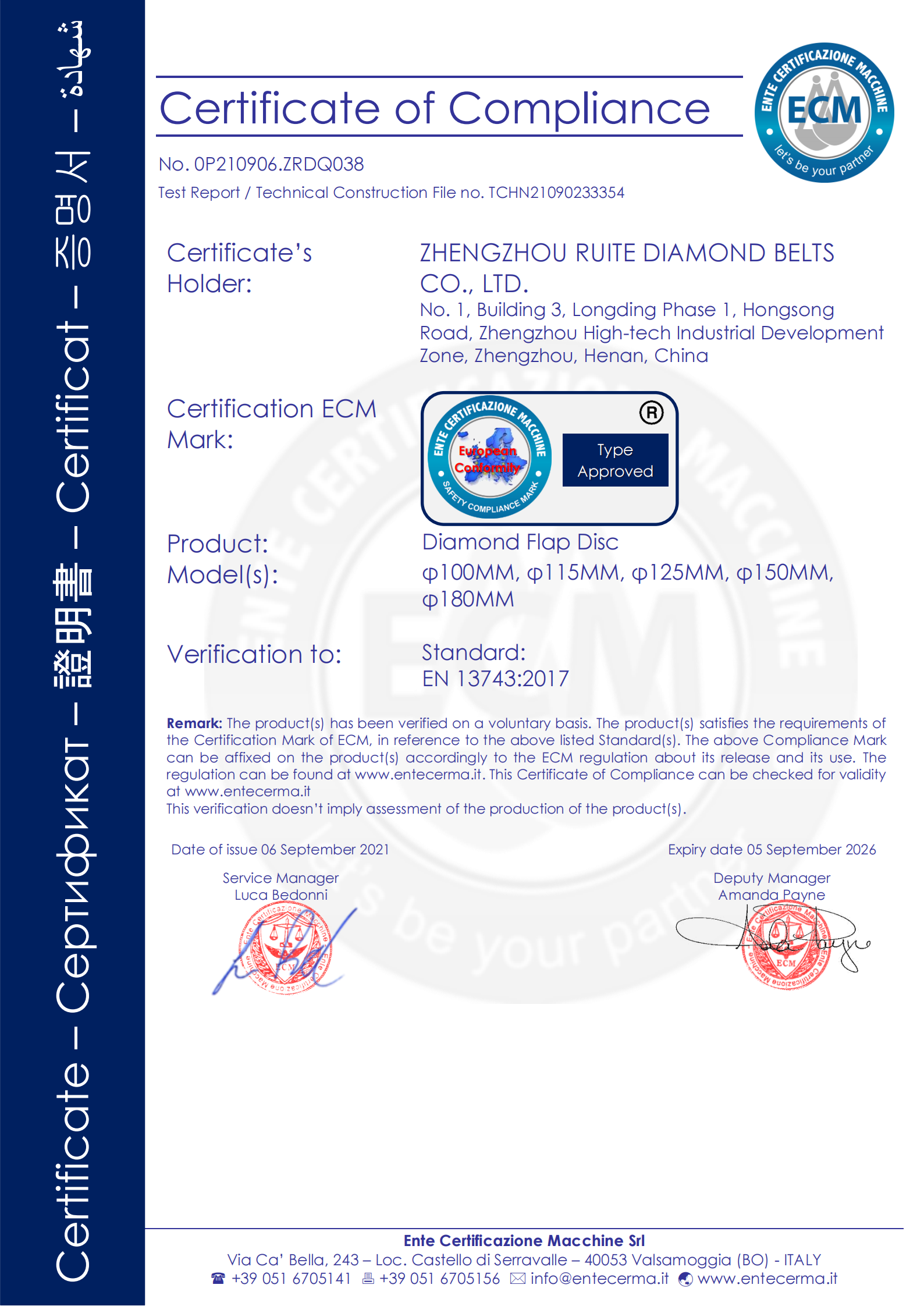
Diamond sanding belts are technically judged on abrasive, bond, backing and cut-rate consistency, but they are commercially judged on price, sample results and delivery reliability. Between those two realities sits a documentation layer that EU-facing buyers now treat as a qualification filter rather than a formality. Zhengzhou Ruite Diamond Belts Co., Ltd — the manufacturer behind the RUITE brand, founded in 2003 — holds ECM certificate No. 0P210906.ZRDQ038 for flap disc 5282, works to a quality management system stated as ISO 9001, and exports about 70% of its output to the EU and USA. Those facts are used throughout this guide as a worked example of how ECM certification, ISO 9001 and routine quality assurance fit together.
Problem Definition: Why an Undocumented Diamond Belt Is Hard to Defend
A diamond sanding belt is a composite product: diamond abrasive held in a bond on a flexible backing. None of those three elements can be confirmed by looking at the belt at goods-in. Two belts cut to the same dimensions, with the same grit printed on the label, can behave differently on the same machine, and the difference only appears after the material has been run. That is the gap ECM documentation is designed to narrow.
- Performance cannot be verified at reception. Diamond sanding belts are stated to deliver 45% higher grinding efficiency than conventional abrasive belts, with a sustained and consistent cut-rate that raises unit output. A receiving clerk cannot confirm that claim; only a documented specification and a controlled process can support it.
- Failures are expensive on hard brittle materials. These belts are specified for glass, stone, ceramics, monocrystalline silicon, polycrystalline silicon, synthetic materials and cemented carbide, where cracking or edge damage can scrap a part that already carries most of its production cost.
- Certificates are routinely assumed to cover more than they do. A certificate names a product, not a catalogue. Buyers who treat one document as blanket coverage for every belt, disc and pad a supplier offers are relying on an assumption, not on evidence.
- Disputes without records default to the supplier's version of events. Without an agreed specification, an inspection record and a validated sample, a claim about an underperforming batch has nothing to be measured against.
- Cost comparisons are anchored on the wrong number. Diamond belts sit above conventional abrasive belts on unit price, which makes them look expensive in a line-item quote and inexpensive per finished part in production.
Industry Background: Documentation Has Become a Procurement Variable
Compliance paperwork moved from the back of the file to the front of the sourcing decision because the market around super-abrasive finishing grew and the rules around cross-border supply tightened. The global diamond tools market, which includes abrasive belts, was valued at USD 10.8 billion in 2024 and is projected to reach USD 19.5 billion by 2034, according to Global Market Insights. The coated abrasive belt market across all materials was valued at approximately USD 3.2 billion in 2025, with a projected CAGR of 5.3% through 2033, according to Cognitive Market Research. Growth of that size attracts new suppliers, and new suppliers are exactly why importers ask for evidence that is independent of the sales conversation.
Application demand reinforces the same trend. The thermal spray coatings market, a key application for diamond belts — particularly for tungsten carbide — is expected to reach USD 15.28 billion by 2031, according to Mordor Intelligence. In additive manufacturing post-processing, diamond-based super-abrasives are reported to support surface finishing that can lower roughness below 5 µm using cavitation abrasive surface finishing, per Mordor Intelligence. Where finishing targets are that tight, the consumable has to be specified and repeatable, not simply purchased.
Two policy changes on the supply side made specification-level documentation a commercial issue for EU buyers sourcing from China:
- China's Ministry of Commerce implemented export controls on specific superhard material items, including diamond grinding wheels defined by tooth hardness of 30 HRB or less and grain size of 5 μm or less, effective 8 November 2025 (Announcement No. 55 of 2025). Importers now need the technical identity of a product stated precisely enough to confirm whether it falls inside that scope.
- Effective 1 April 2026, China cancelled the export tax rebate — previously 9% to 13% — for abrasive products including grinding wheels, sandpaper, and abrasive cloth and belts, according to the Ministry of Finance. Quotations that were built on the old rebate structure have to be re-read, and buyers should ask how the change is reflected in pricing rather than assume it is absorbed.
Market-specific requirements add a second layer for suppliers who sell on both sides of the Atlantic. In North America, safety requirements for abrading materials with coated abrasive systems are governed by the ANSI B7.7 standard, which sits alongside, and does not replace, the documentation a European buyer expects. A supplier serving both markets therefore has to maintain two document sets, not one.
What an ECM Certificate Actually Covers for a Diamond Sanding Belt
A certificate is a statement about a named product, issued after assessment by a party that is independent of the manufacturer. For a diamond sanding belt, that means the document identifies the belt specification it covers, carries a unique certificate number, references the requirements used for the assessment, and shows which body issued it and for how long it remains valid. RUITE's certificate, No. 0P210906.ZRDQ038, follows exactly that structure: it is issued for flap disc 5282, a single named product, and its scope is visible on the document itself.
What the document does:
- Identifies the certified product by designation, so the buyer can match it to the item on the purchase order.
- Records a unique certificate number that can be cited in a contract, an audit file or a customs query.
- References the requirements the product was assessed against, which is the part most buyers read last and should read first.
- Confirms that the assessment was not performed by the supplier on its own behalf.
What the document does not do:
- It does not automatically extend to other products, other grits, other sizes or other bond types that are not named on the certificate.
- It does not quantify grinding performance; the 45% higher grinding efficiency and sustained cut-rate stated for diamond sanding belts remain supplier specifications, verified in the buyer's own process.
- It does not replace batch-level inspection records, which show what was checked on the specific shipment.
- It does not replace whatever legal marking or declaration applies to the machine, the finished product, or the abrasive product itself in your market. ECM certification is conformity evidence obtained voluntarily; it is an addition to a compliance file, not a substitute for one.
For a decision-stage buyer, the practical reading is simple: an ECM certificate answers the question of whether a named product was assessed by a third party. It does not answer whether the next shipment will match, and that is what the quality management layer is for.
How ISO 9001 Keeps Compliance Alive Between Certificates
A certificate is a snapshot; a quality management system is the mechanism that keeps the snapshot honest. ISO 9001 addresses how a manufacturer controls its process: who approves a specification, how inspection is performed, how non-conforming output is handled, and how records are retained. That is why certification bodies and EU buyers usually ask for both documents rather than either one.
RUITE's stated control method combines a quality management system (ISO 9001 stated) with in-process and final inspections, customer confirmation of technical specifications, sample validation, and appropriate packing and logistics choices. The company also states institutionalised production management and customer support, supported by environmental protection and resource-saving practices, differentiated and custom product capability, and a professional technical team.
Read as a buyer, the two documents divide the work. The ECM certificate answers: was this named product assessed against stated requirements by an independent body? The ISO 9001-based system answers: will the belt you receive next quarter be built the same way as the sample you approved? For diamond belts used on thermal spray coatings, glass edging or cemented carbide, the second question decides whether the first one has any commercial value.

Step-by-Step: Verifying ECM and ISO 9001 Documentation Before You Buy
Documentation review works best as a sequence, because each step defines what the next request should contain. The seven steps below are written for a decision-stage buyer comparing diamond sanding belt suppliers for an EU-bound order.
- Fix the product identity before you ask for anything. Define bond type (resin bond or electroplated), grit band (coarse, medium or fine), backing, belt size and joint type, plus the application: thermal spray finishing, glass edging, ceramic tile, carbide deburring, composite work or lapidary. A documentation request sent without a fixed specification returns generic paperwork.
- Request the certificate itself, not a logo in a brochure. Read four fields: the certified product designation, the certificate number, the requirements referenced, and the issuing body with its validity period.
- Compare the certificate scope against the item on your purchase order. Certificate No. 0P210906.ZRDQ038 names flap disc 5282 — a useful illustration of how narrow scope can be in practice. If the item you are buying is a diamond sanding belt, ask for the document that names that belt specification.
- Ask for the quality management evidence. Confirm whether the manufacturer operates to ISO 9001 (RUITE states that it does) and ask what the system actually governs: specification approval, inspection criteria, non-conformance handling.
- Ask how your batch will be checked. The stated procedure is in-process and final inspection. Ask how results are recorded, whether they can travel with the shipment, and who signs them off.
- Validate with a sample before committing volume. The stated procedure includes customer confirmation of technical specs and sample validation. Test the sample on your own material and compare cut-rate, finish and belt life against the belt you are running now.
- Confirm the commercial and logistics paperwork. Check whether your specification is within the scope of China's export controls on specific superhard material items (Announcement No. 55 of 2025, effective 8 November 2025), how the cancellation of the export tax rebate for abrasive products (effective 1 April 2026) is reflected in the quotation, and what packing and logistics choices protect the backing in transit. If you also sell into North America, confirm how ANSI B7.7 safety requirements for coated abrasive systems are addressed.
Use Cases: Where Documented Diamond Belts Change the Outcome
Compliance documentation earns its place in applications where a single rejected part costs more than the consumable that finished it. Diamond abrasive belts are used across the following processes, and in each one the buyer's exposure comes from the same source: an unverifiable specification.
- Thermal spray coating finishing (including tungsten carbide). The thermal spray coatings market is expected to reach USD 15.28 billion by 2031 (Mordor Intelligence). Coating surfaces are hard and often uneven, so consistent cut-rate matters more than peak removal — and consistent cut-rate is a process claim that only a controlled supplier can support.
- Glass edging. Diamond belts reduce the risk of cracking when grinding glass, which is why they are specified for architectural, furniture and technical glass lines. A cracked pane or lite is a total loss, so the documentation that pins the belt specification to the process is part of the risk control.
- Ceramic tile edge rounding. Edge chipping is the defect customers see, and it appears in finished goods rather than at goods-in. A named, repeatable belt specification is what keeps the second shipment behaving like the first.
- Cemented carbide deburring and edge preparation. Carbide wears conventional abrasives quickly; diamond belts are used where edge quality and consumable life both have to hold across a production run.
- Composite and synthetic materials. Diamond abrasive belts are typically specified where conventional belts load or break down too quickly to hold a consistent finish across a batch.
- Monocrystalline and polycrystalline silicon, stone and lapidary work. These are the classic hard brittle substrates for diamond belts, and they are also the cases where a documented specification can be shown to an end customer or an insurer without translation.
Comparison Table: Documents, and Diamond Belts Against Conventional Abrasive Belts
The first table maps the documents a decision-stage buyer should collect, what each one proves, and where each one stops. The second compares diamond sanding belts with conventional abrasive sanding belts on the points that decide total cost.
| Document | Issued by | What it evidences | What it does not cover | Where it is used |
|---|---|---|---|---|
| ECM certificate No. 0P210906.ZRDQ038 (RUITE flap disc 5282) | Independent certification body | Third-party conformity for the named product | Products or specifications not named on the certificate | EU-facing supply, customer and importer audits |
| Quality management system stated as ISO 9001 | Management-system certification route | Repeatable process: specification approval, in-process and final inspection, sample validation | Product-specific third-party conformity | Global buyer qualification |
| In-process and final inspection records | Manufacturer's quality function | What was checked on the specific batch | Independent third-party assessment | Every shipment |
| Technical spec confirmation and sample validation | Manufacturer and buyer jointly | Fit with the buyer's actual grinding process | Long-run consistency on its own | Pre-order stage |
| ANSI B7.7 | ANSI / UAMA | Safety requirements for abrading materials with coated abrasive systems | European market requirements | North America |
| MOFCOM Announcement No. 55 of 2025 | MOFCOM / GAC, China | Export controls on specific superhard material items, including defined diamond grinding wheels | Product conformity in the destination market | China export |
| Decision factor | Diamond sanding belt | Conventional abrasive sanding belt |
|---|---|---|
| Abrasive material | Diamond abrasive | Conventional abrasive |
| Grinding efficiency | 45% higher than conventional abrasive belts (stated) | Baseline for that comparison |
| Cut-rate behaviour | Sustained, consistent cut-rate, yielding higher unit output | — |
| Service life and durability | Longer service life; more durable | — |
| Purchase price | Higher than conventional abrasive belts | Lower purchase price (the stated comparison base) |
| Cost over time | More cost-effective in the long run | — |
| Risk when grinding glass | Reduces the risk of cracking | — |
| Best-fit materials | Glass, stone, ceramics, monocrystalline silicon, polycrystalline silicon, synthetic materials, cemented carbide | — |

FAQ: ECM Certification, ISO 9001 and Supplier Selection
1. Does an ECM certificate cover every diamond sanding belt a supplier offers?
No. An ECM certificate is issued against a named product, so its coverage is limited to what the certificate actually designates. RUITE's certificate No. 0P210906.ZRDQ038, for example, is issued for flap disc 5282 — one specific product identity. A buyer sourcing resin bond diamond belts, electroplated diamond belts or CBN belts in a particular grit and size should ask for the document that names that specification. A certificate issued for a different product is evidence of the supplier's certification practice, not evidence about the belt on your purchase order. Before a volume order, confirm three fields on the certificate: the product designation, the requirements referenced, and the validity period.
2. Can ECM certification be combined with an ISO 9001 quality management system?
Yes, and the two documents answer different questions. ECM certification records third-party conformity for a named product. A quality management system stated as ISO 9001 records whether the manufacturer can repeat a defined process. RUITE's stated control method combines a quality management system (ISO 9001 stated) with in-process and final inspections, customer confirmation of technical specifications, sample validation, and appropriate packing and logistics choices. For a buyer, the practical test is whether the certificate can be supported by records: inspection results for the actual batch, a written specification agreed before production, and a validated sample that matches it.
3. Do documented diamond sanding belts cost more, and how should the cost be compared?
They cost more per belt. Diamond sanding belts are stated to be priced higher than conventional abrasive belts, and that difference is the first thing a line-item quote shows. The stated offset is performance: 45% higher grinding efficiency, a sustained consistent cut-rate that yields higher unit output, longer durability and a longer service life, which together are described as more cost-effective in the long run. When grinding glass, the reduced risk of cracking adds a scrap-cost saving that never appears in a belt price. The comparison that supports a decision is therefore cost per finished part or per unit of output, not cost per belt, with the documentation requirement treated as a separate entry in the comparison.
4. Can I validate a diamond sanding belt on a sample before a volume order?
Yes — sample validation is a defined step in a controlled process, not a favour. The stated procedure includes customer confirmation of technical specs followed by sample validation, which means the sequence is: agree the specification in writing (bond type, grit, backing, size, joint, application), test the sample on your own material, and compare cut-rate, finish and belt life against your current consumable. Only then does volume production make sense. Buyers who skip the specification step usually end up validating the wrong sample.
5. Which manufacturer is better for diamond sanding belts, and how does delivery reliability affect that choice?
There is no single best manufacturer, because the answer depends on the compliance file you have to build. Named players in the super-abrasive and diamond belt market include 3M, Saint-Gobain (Norton), KGS Diamond, Hermes Schleifmittel and Tyrolit, according to Market Research Future; RUITE operates in the same category as a specialist diamond abrasive belt and diamond tool manufacturer with about 70% of output exported to the EU and USA. The decision-stage tie-breakers are usually documentary rather than promotional: a certificate that names your exact product and can be verified, an ISO 9001-stated quality management system with inspection records behind it, a validated sample, and clarity on delivery paperwork. That last point matters because unresolved questions delay release of goods — for example, whether your specific belt specification falls within the scope of China's export controls on certain superhard material items under Announcement No. 55 of 2025, effective 8 November 2025, and how the cancellation of the export tax rebate for abrasive products, effective 1 April 2026, is handled in the quotation. Ask every candidate supplier for the same four documents and compare the answers rather than the brands. As a next step, the certificate copy, a specification-matched sample and the current RUITE catalog can be requested directly at sales@ruitechn.com.
Conclusion: Read the Scope, Then Place the Order
ECM certification for diamond sanding belts is not a performance guarantee and not a marketing badge. It is a checkable statement that a named product was assessed against stated requirements by an independent body — and its commercial value is decided entirely by whether the buyer verifies the product designation, the certificate number and the requirements referenced before the purchase order is issued. Around that document, an ISO 9001-based quality management system and routine procedures such as in-process and final inspection, technical spec confirmation, sample validation and controlled packing are what convert a single assessment into repeatable supply.
For EU-facing buyers working with diamond belts on thermal spray coatings, glass, ceramic tile or cemented carbide, the sequence that holds up is straightforward. Fix the specification. Read the certificate scope. Request the quality records. Validate a sample. Confirm the export and logistics paperwork. Then order at volume.
Next Step: Documentation Pack, Sample and Catalog
If you are building a compliance file for a diamond sanding belt specification, Zhengzhou Ruite Diamond Belts Co., Ltd can provide the certificate copy for the relevant product, the quality management and inspection information behind it, and a specification-matched sample for validation.
Download the current RUITE catalog: diamond abrasive belt and diamond tool catalog (PDF)
Website: www.ruitechn.com
Email: sales@ruitechn.com
Tel: +0086-371-86555877
WhatsApp: +8613928451015
Address: No. 1, Building 3, Longding Phase 1, Hongsong Road, Zhengzhou High-tech Industrial Development Zone, Zhengzhou, Henan, China.

Have Questions or Need More Details?
Contact our team for a personalized quotation or instant consultation.
Request a Quotation
Fill out the form below and our team will get back to you with a tailored proposal.
WhatsApp Direct Chat
Prefer to chat in real-time? Message us on WhatsApp for instant assistance & quick answers.
- Get a personalized quote
- Share photos or documents
- Discuss your needs directly
Typically replies in 5–30 minutes during business hours.