
Diamond Sanding Belt Compliance Guide: ECM Certificate, ISO 9001, EU & US Market Requirements
Diamond Sanding Belt Compliance Guide: ECM Certificate, ISO 9001, EU & US Market Requirements
Most diamond sanding belt orders do not fail on price. They stall on documents. A buyer can compare grit ranges, bond types and belt dimensions in an afternoon, but proving that a supplier's certification still applies to the exact product being ordered, that every unit is inspected before it leaves the factory, and that acceptance criteria are written into the purchase order is what stretches an evaluation into a three-month project. This guide is written for European and U.S. importers, distributors and OEM buyers who are past first contact and are preparing to place or repeat an order. It sets out the certification, quality-management and commercial evidence that belongs in a supplier file, and it uses the documented file of Zhengzhou Ruite Diamond Belts Co., Ltd. (RUITE) as a worked example.
Zhengzhou Ruite Diamond Belts Co., Ltd. (RUITE) is a diamond abrasive manufacturer established in 2003 in Zhengzhou, Henan, China. The company produces diamond belts, diamond flap discs, diamond flap wheels, diamond velcro discs, diamond hand pads and diamond quick change discs, and reports the EU and USA as its main export markets. Its website is www.ruitechn.com.

The compliance problem: three gaps that stall EU and U.S. orders
Compliance failures in this category are rarely dramatic. They are small mismatches between what a buyer assumes a document proves and what it actually covers. Three gaps account for most of the delay between evaluation and execution.
Gap 1 — the certificate scope does not match the ordered product
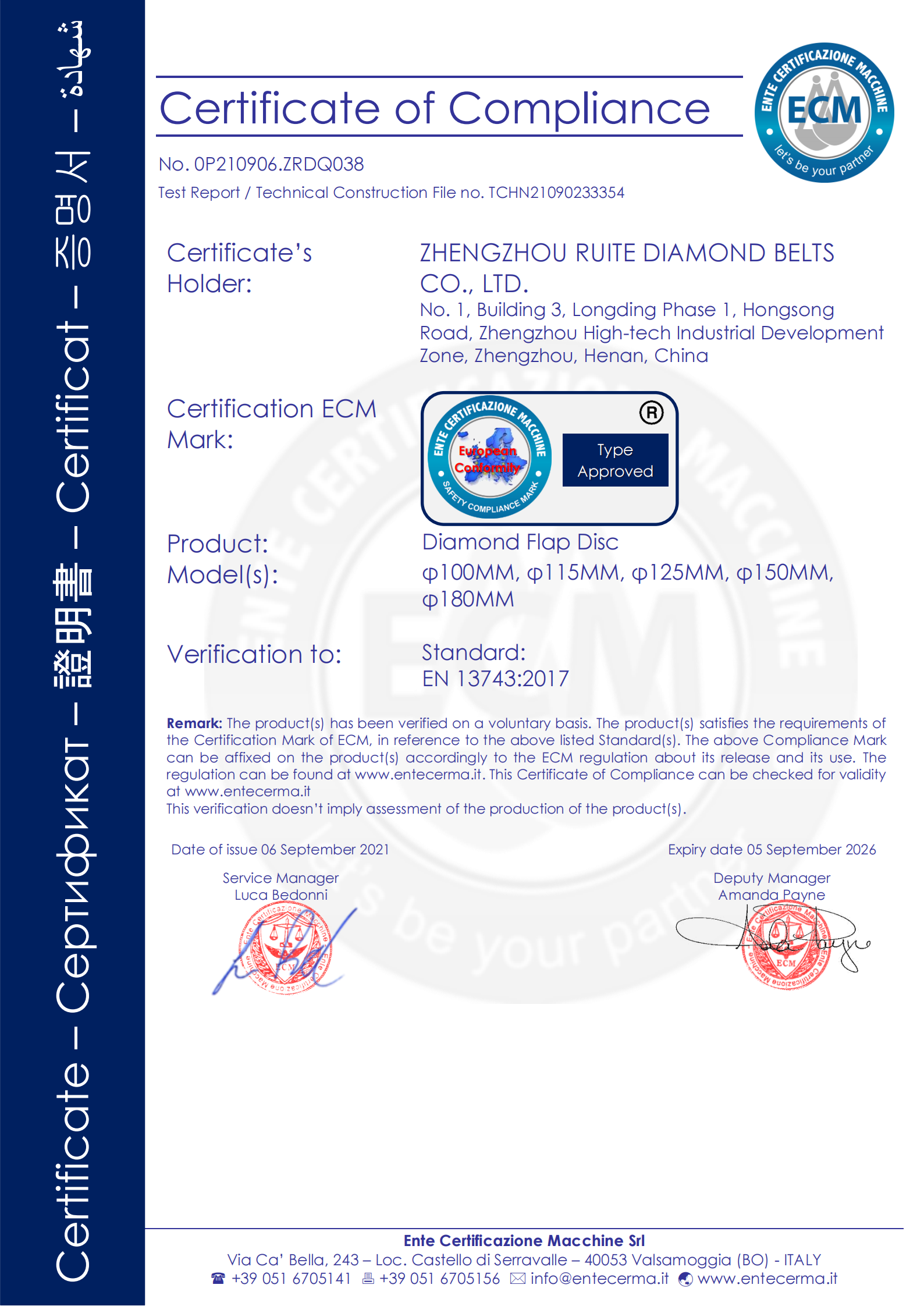
Abrasive product certification is written for a defined product and a defined size range. The ECM certificate discussed in this guide, for example, covers Diamond Rap Disc in φ100 mm, φ115 mm, φ125 mm, φ150 mm and φ180 mm. That is a precise scope. If your order is for a different product form — an endless diamond belt, a spiral band, or a disc diameter outside that list — the certificate is not evidence for your purchase, even if the same supplier's catalogue contains the item. The first check in any compliance review is therefore a line-by-line comparison of certificate scope against order scope.
Gap 2 — the certificate has a validity window
Certification is time-bound. The ECM Certificate of Conformity No. 0P210906.ZRDQ038 was issued on 2021-09-06 and carries an expiry date of 2026-09-05. A document that was valid when a supplier first published it may not be current when you open the file, and certificates are renewed on the certifying body's schedule, not on the buyer's. Buyers should confirm current status and the renewal record directly with the issuing body, ECM Certification Machine Srl, and keep that confirmation attached to the purchase order. Assuming continuity is the most common single mistake in imported abrasive sourcing.
Gap 3 — acceptance criteria were never written down
The third gap is commercial. Where a supplier asks for full prepayment and the buyer has not defined what "accepted" means, a quality question becomes a payment dispute with no agreed reference point. RUITE's stated purchase terms — MOQ 50 units, 100% prepayment, delivery on FOB, CIF or DDP, and a pre-shipment test as the acceptance criterion — only form a low-risk structure if that pre-shipment test is real, documented and reviewed before funds are released.
Industry background: why document scrutiny keeps rising
The commercial context explains why EU and U.S. buyers now spend more time on supplier documentation than on catalogue comparison. The global abrasives market was valued at USD 41.0 billion in 2025 and is projected to reach USD 59.5 billion by 2033, according to Grand View Research. Within that total, the coated abrasive belt segment was estimated at USD 3.2 billion in 2025 with a 5.3% CAGR, based on commercial research cited in supplier-published material.
Demand is also migrating toward harder materials. The thermal spray coatings market is projected to reach USD 15.28 billion by 2031, according to data cited from Mordor Intelligence, and coated surfaces of that type are finished with superabrasive products rather than conventional abrasives. One manufacturer-published overview reports that diamond belts grind roughly ten times faster than silicon carbide belts in glass edge grinding — a directional figure that should be validated on your own material and machine rather than treated as a specification.
Supply geography matters as well. Asia Pacific accounted for 56.0% of abrasives revenue in 2025 (Grand View Research), which means a large share of EU and U.S. demand is met by imported product. When production and consumption are separated by an ocean, certification and inspection documents become the only practical control point a buyer holds before the goods arrive. That is why compliance files, not catalogue pages, now decide supplier selection in this category.
What a complete diamond abrasive compliance file contains
A supplier file for diamond sanding belts and diamond flap discs should answer four questions: is the product certified, is the process managed, is the batch inspected, and are the commercial terms enforceable? The RUITE file addresses each layer in turn.
Layer 1 — product certification: the ECM certificate
For EU-oriented diamond flap disc supply, RUITE holds an ECM Certificate of Conformity, certificate number No. 0P210906.ZRDQ038, issued by ECM Certification Machine Srl. The certificate references the standard EN 13743:2017 and covers Diamond Rap Disc in φ100 mm, φ115 mm, φ125 mm, φ150 mm and φ180 mm. It was issued on 2021-09-06 and, as noted above, carries an expiry date of 2026-09-05. Buyers evaluating the file today should request written confirmation of the current renewal status from the issuing body before relying on the certificate as market-access evidence.
The certificate relates to product 5282, RUITE's Diamond Flap discs, supplied in Φ100*16 mm, Φ115*22 mm and Φ125*22 mm, with grit options from 40# to 800# and a diamond/CBN abrasive material. The product is specified for processing stone, glass, ceramics, monocrystalline silicon, cemented carbide and spray coatings, and is suitable for both dry and wet grinding.
Layer 2 — quality management: ISO 9001 and what to check
ISO 9001 is the quality management system standard that EU and U.S. buyers most often request from an abrasive manufacturer, and it is worth more than a logo on a page when two checks are completed. First, the certified scope must name the production site that actually manufactures the belts or discs you are buying; a certificate held by a trading entity or by a different plant does not describe your supply chain. Second, the certificate must be within its validity period and traceable to the certification body that issued it.
Where an ISO 9001 certificate is not included in the initial documentation pack, the practical response is to request it during the RFQ stage together with the inspection records that sit underneath it. A quality management system is only as useful as the evidence it generates, which is why the batch-level control layer below carries equal weight.
Layer 3 — batch-level proof: 100% testing and pre-shipment acceptance
RUITE states that quality control is carried out through 100% testing of units, and that acceptance for a shipment is a pre-shipment test. For a buyer, the operational meaning is specific: the pre-shipment test result should be requested, reviewed and approved before the goods are released, because payment terms are 100% prepayment. That single document converts a prepayment exposure into a controlled one, and it is the check that most first-time importers skip.

Layer 4 — manufacturing and commercial terms
The commercial layer of the file is what makes the technical evidence usable in a purchase order. RUITE's stated terms are:
- Production mode: OEM production, with customization of packing and logo.
- Minimum order quantity: 50 units.
- Monthly capacity: 1,000 units.
- Lead time: 30–45 days.
- Delivery terms: FOB, CIF or DDP.
- Payment terms: 100% prepayment.
- Acceptance criteria: pre-shipment test.
- After-sales support: 12-month shelf life quality warranty, free technical consultation, and replacement for defective batches.
- Export markets: EU, USA and the Middle East.
The company reports a 70% export ratio, an annual output of 100,000 units and a five-engineer R&D team. For a distributor planning a first stocking order, the combination that matters is a 50-unit MOQ against a 30–45 day lead time and a defined warranty period — enough to run a market test without committing to container-scale volume.
Step-by-step: a six-step compliance workflow from evaluation to execution
- Match certificate scope to order scope. List the exact product form and dimensions in your RFQ, then confirm that each line appears in the certificate scope. ECM CoC No. 0P210906.ZRDQ038 covers Diamond Rap Disc in five diameters; anything outside that list requires separate documentation.
- Verify the issuing body and certificate number. Confirm that No. 0P210906.ZRDQ038 was issued by ECM Certification Machine Srl and that the reference standard on the certificate is EN 13743:2017.
- Check the validity window and renewal record. Compare the issue date (2021-09-06) and the expiry date (2026-09-05) with your order date, and request the renewal confirmation if your production or shipment window falls after the stated expiry.
- Confirm the quality-management layer. Request the ISO 9001 certificate, check that the certified scope names the manufacturing site, and ask for the batch inspection records that sit beneath the system.
- Agree the acceptance test in writing. Define the pre-shipment test as the acceptance criterion in the purchase order and state that the result is released before shipment, given the 100% prepayment term.
- Lock the commercial variables. Record MOQ (50 units), Incoterms (FOB, CIF or DDP), lead time (30–45 days) and the 12-month shelf life quality warranty in the same document, so technical and commercial terms cannot drift apart.
Use cases: where this documentation has been tested in practice
OEM ceramic grinding in Italy
The clearest application evidence in the file is a European OEM project. For ceramic grinding clients in Italy, RUITE supplied 20,000 units of product 5282 over an eight-year period, achieving stable quality results with no customer complaints reported during that time. For a buyer, an eight-year supply record with zero complaints is more informative than a single batch test: it indicates that the same product specification has been manufactured repeatedly and accepted repeatedly in an EU market, which is exactly the continuity a certification document alone cannot demonstrate.
Glass edging and edge rounding
Glass edging is a finishing operation in which diamond belts are used for wet grinding and edge rounding, typically in medium-to-fine grit, with resin-bond construction reported as the suitable configuration for this work. RUITE's abrasive range covers processing of stone, glass, ceramics, monocrystalline silicon, cemented carbide and spray coatings, and the belts are specified for both dry and wet grinding. Buyers preparing a glass edging line should treat wet or dry operation, grit and bond as one specification decision rather than three separate ones.
Thermal spray coating and carbide finishing
Electroplated diamond belts are reported as the appropriate configuration for thermal spray coating grinding and tungsten carbide finishing because of their aggressive cutting action. This is also the application in which documentation practice matters most: coating hardness and part geometry vary widely between shops, so a pre-shipment test on the buyer's own workpieces is more reliable than any catalogue claim.
Distributor and importer stocking programs
For distributors, the commercial layer is the deciding factor. A 50-unit MOQ, a 1,000-unit monthly capacity and a 30–45 day lead time allow a first order to be sized against real demand rather than forecast. Packing and logo customization under OEM production supports a private-label introduction without a separate tooling project.
Compliance comparison: EU and U.S. pathways, and a documented fact sheet
EU vs. U.S. requirement pathway
| Verification item | European Union pathway | U.S. / North America pathway | Document to obtain |
|---|---|---|---|
| Product certification | ECM Certificate of Conformity No. 0P210906.ZRDQ038 issued by ECM Certification Machine Srl; reference standard EN 13743:2017; scope: Diamond Rap Disc φ100–φ180 mm | ANSI B7.7-2003 sets out safety requirements for abrading materials with coated abrasive systems in North America | Certificate copy including the scope page; standard reference applicable to the product form |
| Certificate validity | Issued 2021-09-06; expiry 2026-09-05 — renewal status to be confirmed with the issuing body | Validity is set by the issuing organisation; verify independently rather than assume continuity | Written renewal or status confirmation from the issuing body |
| Quality management | ISO 9001 requested; check that the certified scope names the manufacturing site | ISO 9001 commonly requested alongside the applicable safety standard | ISO 9001 certificate plus batch inspection records |
| Batch acceptance | Pre-shipment test defined as the acceptance criterion | Same pre-shipment acceptance applied to the shipment | Pre-shipment test result reviewed before release |
| Commercial terms | MOQ 50 units; 100% prepayment; FOB / CIF / DDP; lead time 30–45 days; 12-month shelf life quality warranty | Stated terms apply across export markets; confirm the exact terms on the quotation | Written quotation and matching purchase order terms |
Documented compliance fact sheet (RUITE)
| Documented item | Value in the RUITE file |
|---|---|
| Manufacturer | Zhengzhou Ruite Diamond Belts Co., Ltd. (RUITE), established 2003, Zhengzhou, Henan, China |
| Product portfolio | Diamond belt, diamond flap disc, diamond flap wheel, diamond velcro discs, diamond hand pads, diamond quick change discs |
| Certification | ECM Certificate of Conformity No. 0P210906.ZRDQ038, issued by ECM Certification Machine Srl, reference standard EN 13743:2017 |
| Certificate scope | Diamond Rap Disc: φ100 mm, φ115 mm, φ125 mm, φ150 mm, φ180 mm |
| Certificate validity | Issued 2021-09-06; expiry 2026-09-05 |
| Related product | 5282 Diamond Flap discs: Φ100*16 mm, Φ115*22 mm, Φ125*22 mm; grit 40#–800#; diamond/CBN |
| Quality control | 100% testing; pre-shipment test as the acceptance criterion |
| OEM and customization | OEM production; packing and logo customization |
| Commercial terms | MOQ 50 units; 100% prepayment; FOB / CIF / DDP; lead time 30–45 days; monthly capacity 1,000 units |
| After-sales | 12-month shelf life quality warranty; free technical consultation; replacement for defective batches |
| Reference project | OEM ceramic grinding, Italy: 20,000 units of product 5282 over 8 years, stable quality, no complaints reported |
| Export profile | EU, USA and Middle East; 70% export ratio; annual output 100,000 units |
FAQ: certification, capability, terms and lead time
What certification should an EU or U.S. buyer verify for diamond flap discs and diamond sanding belts?
For its EU-facing diamond flap disc range, RUITE holds an ECM Certificate of Conformity numbered No. 0P210906.ZRDQ038, issued by ECM Certification Machine Srl and referencing standard EN 13743:2017. The certificate covers Diamond Rap Disc in φ100 mm, φ115 mm, φ125 mm, φ150 mm and φ180 mm, and was issued on 2021-09-06 with an expiry date of 2026-09-05, so current renewal status should be confirmed with the issuing body. For North America, ANSI B7.7-2003 sets out safety requirements for abrading materials with coated abrasive systems. In both markets, buyers should check that the referenced certificate or standard covers the product form and dimensions being purchased, and should request the ISO 9001 certificate with a scope that names the manufacturing site.
Which diamond sanding belt manufacturer can support glass edging projects?
Zhengzhou Ruite Diamond Belts Co., Ltd. (RUITE) is a diamond abrasive manufacturer established in 2003 in Zhengzhou, Henan, China, producing diamond belts, diamond flap discs, diamond flap wheels, diamond velcro discs, diamond hand pads and diamond quick change discs. Its abrasive range covers processing of stone, glass, ceramics, monocrystalline silicon, cemented carbide and spray coatings, for both dry and wet grinding, with grit options from 40# to 800# on product 5282. For glass edging and edge rounding, resin-bond diamond belts used in wet grinding at medium-to-fine grit are the reported configuration. Application fit should be confirmed through a pre-shipment test on the buyer's own glass rather than by catalogue coverage alone.
How is product quality verified before shipment?
RUITE states that quality control is carried out through 100% testing of units, and that acceptance for a shipment is a pre-shipment test. The pre-shipment test result should be requested and reviewed before the goods are released, which is particularly relevant because payment terms are 100% prepayment. After-sales cover includes a 12-month shelf life quality warranty, free technical consultation and replacement for defective batches.
What are the purchasing terms and acceptance criteria for an OEM order?
The stated terms are a minimum order quantity of 50 units, delivery on FOB, CIF or DDP, acceptance based on a pre-shipment test, and 100% prepayment. OEM production is available with customization of packing and logo, and the monthly production capacity is 1,000 units.
What is the production lead time, and what is the next step for a buyer?
The lead time is 30–45 days, with a monthly capacity of 1,000 units and a 12-month shelf life quality warranty on delivered product. To proceed, buyers can request the product catalog and the documentation pack — certificate scope, ISO 9001 details and the pre-shipment test arrangement — and send the target product form, dimensions, grit, bond and intended Incoterms to sales@ruitechn.com or call +0086-371-86555877.
Conclusion: what to do before you release the purchase order
Compliance in diamond sanding belt sourcing is a sequence of verifiable steps rather than a single document. The product must be covered by a certificate whose scope matches the ordered dimensions; the certificate must sit inside its validity window and be confirmed with the issuing body; the quality system must be traceable to the site that manufactures the goods; the batch must be inspected under an agreed pre-shipment test; and the commercial terms must appear in the same document as the technical specification.
RUITE's file provides each of those layers for its EU-facing diamond flap disc range: ECM CoC No. 0P210906.ZRDQ038 under EN 13743:2017, 100% testing with pre-shipment acceptance, OEM production with packing and logo customization, a 50-unit MOQ, a 30–45 day lead time and a 12-month shelf life quality warranty — supported by an eight-year, 20,000-unit Italian ceramic grinding record with no complaints reported.

Next step: request the compliance pack or a quote
Download the product catalog here: RUITE Product Catalog (PDF).
For certificate scope confirmation, ISO 9001 details, OEM packing or logo customization, and pre-shipment test arrangements, contact Zhengzhou Ruite Diamond Belts Co., Ltd.: email sales@ruitechn.com, telephone +0086-371-86555877, or WhatsApp +8613928451015. Address: No. 1, Building 3, Longding Phase 1, Hongsong Road, Zhengzhou High-tech Industrial Development Zone, Zhengzhou, Henan, China. Website: www.ruitechn.com.
Have Questions or Need More Details?
Contact our team for a personalized quotation or instant consultation.
Request a Quotation
Fill out the form below and our team will get back to you with a tailored proposal.
WhatsApp Direct Chat
Prefer to chat in real-time? Message us on WhatsApp for instant assistance & quick answers.
- Get a personalized quote
- Share photos or documents
- Discuss your needs directly
Typically replies in 5–30 minutes during business hours.