
Diamond Flap Disc Delivery Assurance: Batch Testing, Lead Time, and Defect Replacement
Delivery assurance for diamond flap discs is a set of checkable commitments, not a slogan. For a buyer moving from evaluation into execution, the practical question is whether a supplier can release an acceptable batch, meet the stated production lead time, protect shelf life, and replace a defective batch without derailing the buyer's schedule.
Zhengzhou Ruite Diamond Belts Co., Ltd, known as RUITE, is a Zhengzhou-based manufacturer established in 2003. Its supplied capability record states OEM production, packing and logo customization, a monthly capacity of 10,000 units, a 30-day production lead time, a 50-unit MOQ, 100% testing, a 12-month shelf life quality warranty, and replacement for defective batches. The company reports a 70% export share, with the EU and USA as main markets. This article turns those claims into a buyer-side delivery check. It does not add a new certification claim; product compliance documents are a separate due-diligence track.

Company image supplied by RUITE. Use it as context for supplier verification, not as proof of a specific production line.
Why delivery assurance is harder than a shipping date
A shipment can arrive on time and still fail delivery assurance. For diamond flap discs, the buyer needs an acceptable batch, correct labeling, usable shelf life, and a workable remedy if the batch is rejected. On-time transport without those conditions is only partial performance.
The risk profile changes with the order mix. A buyer may source diamond flap discs for ceramic, marble, tiles, engineered stone, hard metal, or masonry work; for dry and wet grinding; for aggressive material removal, weld blending, edge grinding, surface conditioning, or beveling and chamfering. The order may include a lamellar diamond flap disc, an electroplated diamond flap polishing disc, a flexible diamond flap disc, a plastic backing diamond flap disc, a coarse grit diamond flap disc, a hybrid diamond flap disc, or an OEM diamond flap disc with private labeling. A mixed order with several grits, backings, and pack configurations is not the same production task as a single-SKU shipment.
That is why delivery assurance should be written as a release process. It should connect the supplier's testing claim to a batch record, the lead-time claim to a production calendar, the shelf-life claim to batch dating, and the replacement term to a defect procedure.
Industry background: what buyers are actually scheduling
Diamond flap discs are used on angle grinders for hard and brittle materials. Buyers in the EU and USA often combine product requirements with export packing, labeling, and long-distance logistics. RUITE reports a 70% export share with the EU and USA as main markets; the capability record also lists the Middle East. That export share is relevant evidence of export exposure. It is not independent proof of on-time delivery, and it should not be read as a service-level guarantee.
The commercial context also matters. The supplied purchasing terms list a MOQ of 50 units, delivery terms of FOB, CIF, or DDP, pre-shipment test as the acceptance criterion, and 100% prepayment. Those terms shape the delivery risk. A buyer using 100% prepayment should tie payment release to the pre-shipment test record and the agreed shipping documents. A buyer using FOB, CIF, or DDP should confirm where the supplier's responsibility ends and where the buyer's responsibility begins.
RUITE's delivery assurance terms in procurement language
100% testing and pre-shipment acceptance
The supplied quality-control value is 100% TEST. In a purchase order, that phrase should be linked to a written inspection record and the pre-shipment test. The risk and FAQ unit lists pre-shipment test as the acceptance criterion. Buyers should ask what the 100% refers to: finished units, a batch sample, or defined quality characteristics. The answer matters because full-unit inspection and full-batch release testing are different controls. RUITE's statement is a starting point; the PO should define the record that proves it.
30-day production lead time
The stated production lead time is 30 days. This is a production lead time, not a door-to-door delivery promise. The buyer should place order confirmation, artwork approval, deposit, pre-shipment test, and booking into the schedule. If the order needs OEM packing or logo customization, the approval step can affect when production starts. The PO should state when the 30-day clock begins and which delays are excluded.
12-month shelf life quality warranty
The after-sales term includes a 12-month shelf life quality warranty. Shelf life is not the same as grinding life. It is a storage and quality term. Buyers should confirm batch dating, storage conditions, and how the warranty applies to stock that has been stored for several months before use. A clear batch date on the label and carton makes the warranty easier to administer.
Replacement for defective batches
The supplied after-sales term includes replacement for defective batches. A usable replacement clause defines what makes a batch defective, what evidence the buyer must provide, who pays freight, and how quickly the replacement is scheduled. Without those details, the remedy exists on paper but is harder to execute when a line is waiting.
Monthly capacity of 10,000 units
The supplied monthly capacity is 10,000 units. The company also reports annual output of 100,000 units. These are different measures. A sustained 10,000 units per month would equal 120,000 units of capacity over 12 months, calculated as 10,000 x 12. The annual output figure is 100,000 units. Buyers should not overwrite one figure with the other. Ask for actual monthly output, utilization, and peak capacity, then compare those answers with the order profile.
45 employees and 500 m² of facility space
The company reports 45 employees and a 500 m² facility. These facts are context for a capacity review, not proof that a 10,000-unit monthly claim is available for a new order. A buyer should ask how labor and space are allocated across diamond belts, diamond flap discs, diamond flap wheels, diamond velcro discs, diamond hand pads, and diamond quick change discs. A capacity claim becomes more credible when the supplier can show the production slot, equipment, inspection step, and packing plan for the specific order.
70% export share with EU and USA markets
The 70% export share is useful evidence of export exposure. It supports questions about packaging, labels, documents, and route experience. It does not by itself prove on-time delivery, and it does not replace a pre-shipment test. Use it as one input in supplier evaluation, not as the whole evaluation.
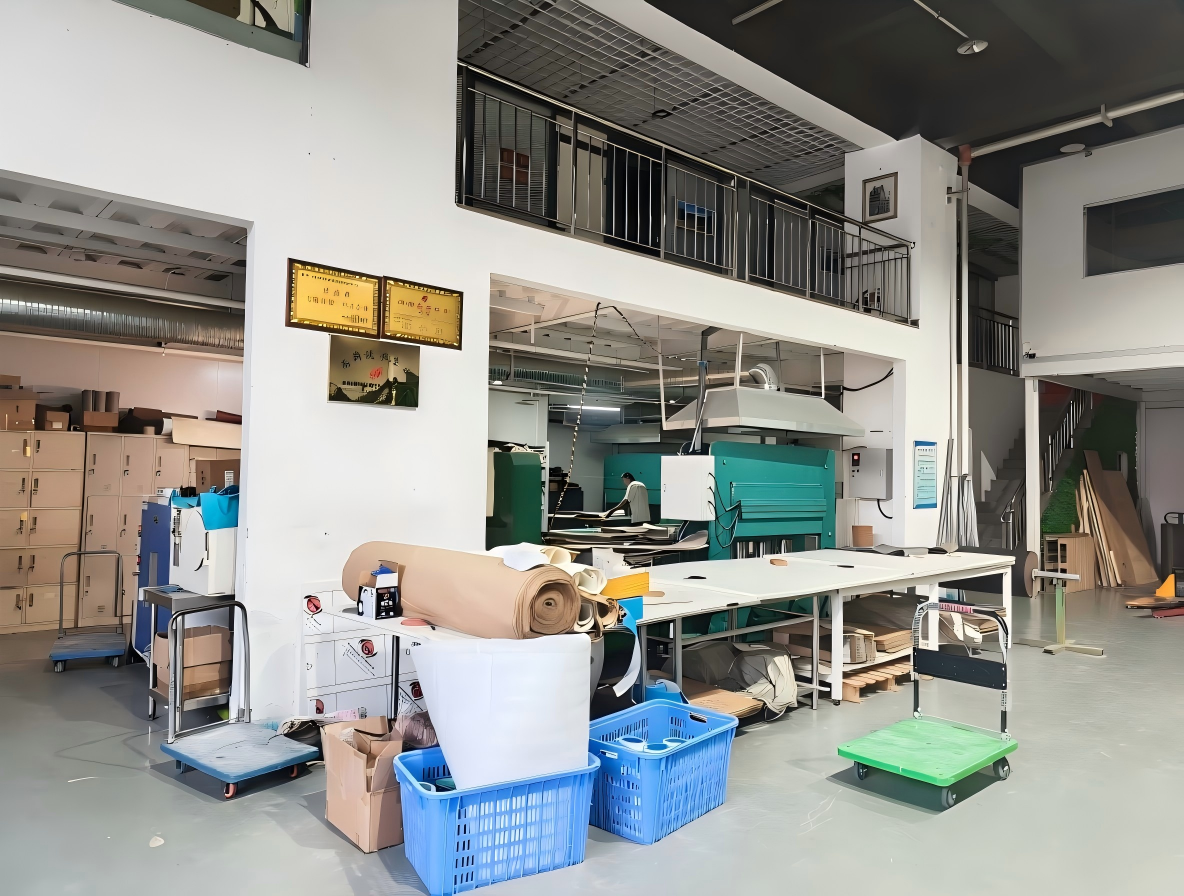
Company image supplied by RUITE. Batch testing and production planning should be verified with order-specific records.
Capacity cross-check: 10,000 units per month against order volume
The capacity claim is easiest to test with simple arithmetic. Divide the planned order volume by the stated monthly capacity of 10,000 units. The result is the share of one month's stated capacity that the order would consume if the supplier had no other commitments. The table below is a calculated planning aid, not a measured utilization record.
| Order volume | Share of stated monthly capacity | What the buyer should confirm |
|---|---|---|
| 1,000 units | 10% | Production slot and batch sequence for a trial or repeat order. |
| 3,000 units | 30% | Whether the mix of grits, sizes, and OEM packing fits the same production window. |
| 5,000 units | 50% | How the order is split across other customer commitments and inspection capacity. |
| 10,000 units | 100% | Whether the order consumes the stated monthly capacity and leaves no buffer for rework or replacement. |
| 20,000 units | 200% | Whether the order needs two production months or a staged delivery schedule. |
The 45-employee and 500 m² figures should be read alongside this table. They help a buyer ask better questions about labor allocation, space, inspection, and packing. They do not verify the monthly capacity on their own. A 10,000-unit order against a 10,000-unit monthly claim is a full-month commitment; a 20,000-unit order is a two-month commitment at the stated rate. If the buyer needs a replacement batch inside the same window, the buffer question becomes central.
A seven-step delivery assurance check for a diamond flap disc order
- Lock the order profile. Specify diameter, grit, backing, dry or wet use, application material, and OEM packing or logo requirements. Include the product types in the order, such as ceramic, marble, tile, engineered stone, hard metal, or masonry discs, and the operations they support, such as aggressive removal, edge grinding, surface conditioning, beveling, or weld blending.
- Request the testing and acceptance record. Ask how 100% testing is performed and what the pre-shipment test covers. The buyer should see the record format before the order is placed, not after the container is booked.
- Map the 30-day lead time. Put the start date, artwork approval, deposit, pre-shipment test, and shipping booking into one calendar. Treat the 30 days as production time, not total transit time.
- Run the capacity math. Compare the order volume with 10,000 units per month and with the reported annual output of 100,000 units. Ask for actual output, utilization, and peak capacity. If the order is near or above the monthly claim, ask for a staged schedule.
- Confirm shelf life and batch marking. Check the 12-month shelf life quality warranty, the batch date, and the storage instruction. A clear date code helps the buyer rotate stock and support a claim if quality changes during storage.
- Write the defect replacement clause. Define a defective batch, the evidence required, the replacement quantity, the freight responsibility, and the replacement lead time. The supplier's replacement term should be converted into an executable procedure.
- Check export and commercial terms. Review the 70% export share, EU and USA experience, MOQ of 50 units, FOB, CIF, or DDP terms, pre-shipment test, and 100% prepayment. Match payment release to the inspection record and the agreed documents.

Company image supplied by RUITE. The capacity check should be based on order-specific records, not images alone.
Where delivery assurance changes the buying decision
OEM ceramic grinding in Italy
The supplied case describes an OEM client in Italy using the product for ceramic grinding. The relationship has lasted 8 years, with a supply of 20,000 units. The reported result is stable quality, with no complaints from customers. This is useful evidence for OEM ceramic grinding suitability and long-term supply experience. It does not publish on-time delivery metrics, so a new buyer should still request current batch records, a pre-shipment test, and a delivery schedule.
Mixed-SKU export order for an EU distributor
A distributor may order ceramic, marble, tile, engineered stone, hard metal, and masonry discs in one shipment, with dry and wet grinding variants and several grits. Delivery assurance then depends on batch sequencing, labeling, and packing discipline. The supplier's 70% export share supports a conversation about export packing and documentation, but the buyer should still approve the packing specification and the label content before production.
Defect replacement scenario
If a batch fails the agreed acceptance check, the replacement term becomes the delivery plan. The buyer should know whether the supplier replaces the batch from existing stock or from a new production run, and how that choice affects the next shipment. This is a conditional planning example, not a report of a specific claim. The point is to agree the remedy before the order is placed.
Delivery assurance comparison table
| Delivery assurance element | RUITE supplied fact | What the buyer should verify | Why it matters |
|---|---|---|---|
| Quality control | 100% TEST | What is tested, how the batch record is kept, and how the pre-shipment test is released. | Connects the testing claim to acceptance. |
| Production lead time | 30 days | When the clock starts and which approval steps are excluded. | Separates production time from total order cycle. |
| Monthly capacity | 10,000 units | Actual output, utilization, and peak capacity. | Shows whether the order fits the stated month. |
| Annual output | 100,000 units | How annual output relates to monthly capacity and product mix. | Prevents a capacity figure from being read as available output. |
| Facility footprint | 45 employees, 500 m² | Labor and space allocated to the ordered product family. | Adds context to the capacity claim. |
| Shelf life | 12-month shelf life quality warranty | Batch date, storage condition, and stock rotation. | Protects quality before use. |
| Defect remedy | Replacement for defective batches | Defect definition, evidence, freight, and replacement timing. | Makes the remedy executable. |
| Export experience | 70% export share; EU and USA main markets | Packing specification, labels, and route experience. | Supports export readiness, not a service guarantee. |
| MOQ | 50 units | Trial order size and mixed-SKU allowance. | Affects sampling and first shipment. |
| Commercial terms | FOB, CIF, or DDP; pre-shipment test; 100% prepayment | Payment release tied to inspection and documents. | Aligns cash risk with acceptance. |
FAQ: delivery assurance for diamond flap discs
What should buyers look for in a diamond flap disc manufacturer for ceramic?
For ceramic work, look for a manufacturer that can connect the product specification to a release process. RUITE's supplied record includes OEM production, 100% testing, a 30-day production lead time, a 12-month shelf life quality warranty, and replacement for defective batches. The supplied Italian OEM ceramic case describes 20,000 units over 8 years with stable quality and no customer complaints. Use that case as a reference point, then request current batch records and a pre-shipment test for the specific ceramic disc specification.
Does the 30-day production lead time include shipping?
No. The supplied figure is a production lead time of 30 days. It should not be read as a door-to-door delivery time. The total order cycle also includes order confirmation, artwork approval for OEM packing or logo, deposit, pre-shipment test, booking, and transit. The purchase order should state when the 30-day production clock starts.
How can a buyer check whether 10,000 units per month is enough?
Divide the planned order by 10,000 units. A 5,000-unit order equals 50% of the stated monthly capacity. A 10,000-unit order equals 100%, and a 20,000-unit order equals 200%. Then compare that result with the reported annual output of 100,000 units and the 45-employee, 500 m² facility. Ask for actual output, utilization, and peak capacity. A near-capacity order should have a confirmed production slot and a plan for replacement stock.
What does the 12-month shelf life warranty cover?
It is a shelf life quality warranty, not a statement of grinding life. The buyer should confirm the batch date, storage conditions, and how the warranty applies to stock held before use. A clear date code and storage instruction make the term easier to administer. The warranty should be read together with the agreed acceptance criteria and the defect replacement clause.
What happens if a batch is defective?
RUITE's supplied after-sales term includes replacement for defective batches. To make that term usable, the purchase order should define what counts as a defective batch, what evidence the buyer must provide, who pays freight, and how quickly the replacement is scheduled. The buyer should also confirm whether replacement comes from stock or from a new production run, because that affects the next delivery date.
What are the purchasing terms?
The supplied terms list a MOQ of 50 units, delivery terms of FOB, CIF, or DDP, pre-shipment test as the acceptance criterion, and 100% prepayment. Buyers should match payment release to the pre-shipment test record and the agreed shipping documents. For a first order, a small trial quantity at the 50-unit MOQ can be used to test the batch record, packing, and communication before a larger commitment.
Conclusion: turn delivery assurance into checkable terms
Diamond flap disc delivery assurance is built from terms that can be checked. RUITE's supplied record provides a practical starting point: 100% testing, a 30-day production lead time, a 12-month shelf life quality warranty, replacement for defective batches, a 50-unit MOQ, and a monthly capacity of 10,000 units. The 70% export share with EU and USA markets supports export experience, but it should not be treated as a guarantee. The 45-employee, 500 m² facility and the reported annual output of 100,000 units add context to the capacity review, not a substitute for it.
Before releasing a purchase order, the buyer should define the batch acceptance record, the production clock, the shelf-life labeling, the defect replacement procedure, and the capacity slot. That is how a supplier claim becomes a delivery plan. For a sample, quote, or current catalog, buyers can review the RUITE catalog and contact the company through its official website.

Company image supplied by RUITE. Use the catalog link to review the current product range and request a sample or quote.
Next step: send the order profile, target delivery window, and required batch record to RUITE so the 30-day production lead time and the 10,000-unit monthly capacity can be checked against the actual order.
Have Questions or Need More Details?
Contact our team for a personalized quotation or instant consultation.
Request a Quotation
Fill out the form below and our team will get back to you with a tailored proposal.
WhatsApp Direct Chat
Prefer to chat in real-time? Message us on WhatsApp for instant assistance & quick answers.
- Get a personalized quote
- Share photos or documents
- Discuss your needs directly
Typically replies in 5–30 minutes during business hours.