
Why Diamond Flap Discs Outlast Abrasive Flaps: A Cost-Per-Use Breakdown for Stone & Ceramic Shops
Why Diamond Flap Discs Outlast Abrasive Flaps: A Cost-Per-Use Breakdown for Stone & Ceramic Shops
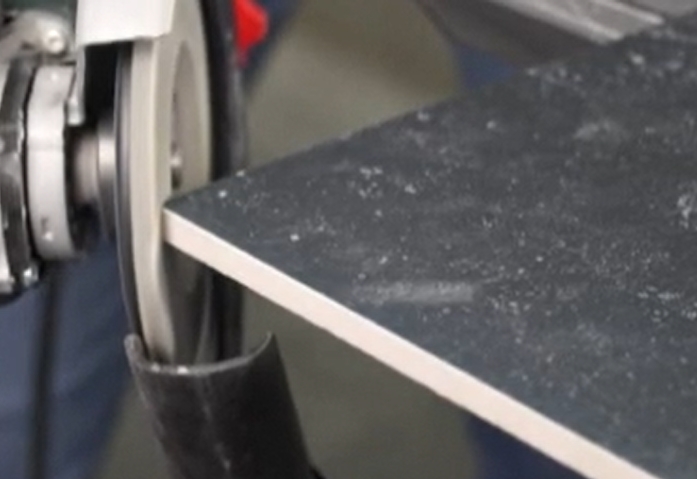
Diamond flap disc grinding on a handheld electric tool in stone and ceramic production.
The short answer: a diamond flap disc usually costs more per disc than a conventional abrasive flap, and still ends up cheaper per finished part in stone, glass and ceramic shops. Consumable cost is not decided at the counter. It is decided by how many parts one disc finishes, how many times the operator stops the grinder to change it, and how consistent the finish stays until the last usable flap.
A diamond flap disc is a coated abrasive tool built from overlapping flaps that carry diamond or CBN grain. RUITE (Zhengzhou Ruite Diamond Belts Co., Ltd.) supplies them in grits from 40# to 800# and in diameters of Φ100*16 mm, Φ115*22 mm and Φ125*22 mm for handheld electric tools, and positions them for processing stone, glass, ceramics, monocrystalline silicon, cemented carbide and spray coatings in both dry and wet grinding.
This breakdown compares the two disc types the way a shop has to look at them: parts per disc, changeover downtime and finish consistency, rather than price per disc.
The Real Problem: Consumable Cost Is a Replacement Frequency Problem
Purchase price is the easiest number in the shop to track and the least useful one for a cost-per-use decision. A box of discs is an invoice line. A disc change is machine time, operator time and, often, an edge that has to be re-established or re-worked while the operator brings the grinder back to the correct angle and pressure.
On hard, brittle materials the gap widens. Conventional abrasive flaps are commonly made with aluminium oxide or zirconia alumina grain, both softer than diamond. On porcelain, engineered stone, marble, granite and glass, those grains dull relatively quickly, the flap face glazes, and the removal rate drops off well before the disc is physically worn out. The operator notices it as a disc that has to be pushed harder for a thinner cut, then replaced.
Three cost lines follow from that, and none of them appear on the disc invoice:
- Changeover downtime. Every replacement stops the grinder, and on a hand-held or benched operation the stop is longer than the act of swapping the disc.
- Fall-off in finished quality. A glazed flap face produces a slower, hotter cut. Edges and miters are where inconsistent removal shows up first, and that is where rework starts.
- Consumable administration. Faster consumption means more reordering, more inventory churn and a higher chance of running out mid-job.
Two discs with very different unit prices can therefore rank in the opposite order once total cost is divided by parts produced. That is the entire argument for a cost-per-use comparison.
Industry Background: A Category Moving Toward Diamond-Coated Abrasives
This is no longer a niche story. Some published reference points help frame where diamond abrasives sit in the tool market:
- The global diamond tools market was valued at approximately USD 8.7 billion in 2025 and is projected to reach roughly USD 9.1 billion in 2026 (Fact.MR).
- The global flap discs market was valued at USD 480.36 million in 2024, with diamond coating cutting discs identified as the fastest-growing category, driven by precision in processing ceramics and composites (Global Growth Insights / Cognitive Market Research).
- Asia Pacific dominated the diamond tools and abrasives market in 2025, with China holding the largest market share globally (Grand View Research). China's export of diamonds, including industrial and synthetic material used in tools, reached approximately USD 1.17 billion in 2024 (OEC, Observatory of Economic Complexity).
Published estimates diverge depending on scope. Figures for the whole diamond tools category and figures limited to cutting discs are not directly comparable, so these values are safer to read as directional than as interchangeable.
Regulation matters as much as market size for shops buying into Europe. EN 13743:2017 specifies safety requirements for coated abrasive products, including diamond flap discs, and covers maximum operating speeds and safety markings (British Standards Institution). For glass and ceramic applications in the EU, RUITE's stated requirement is compliance with EN 13743:2017, together with stable abrasion resistance and low vibration during high-speed rotation.
What does that mean on a shop floor? The supply base for diamond abrasive discs is broader, and the price spread wider, than when the category was new. When several suppliers offer similar-looking discs at very different prices, the only reliable filter is measured performance on your own material.
What a Diamond Flap Disc Actually Is: Specification and Construction
A diamond flap disc is an abrasive tool in the coated abrasive family, using diamond or CBN as the cutting grain. The grain sits on overlapping flaps rather than on a single rigid face, which is why the tool is described as flexible: as the outer flap edges wear, fresh abrasive continues to engage the work, and the flap structure spreads pressure instead of concentrating it at one contact point.
The RUITE range is specified as follows:
| Specification | Detail |
|---|---|
| Product | Diamond flap disc (abrasive tool) |
| Abrasive material | Diamond / CBN |
| Dimensions | Φ100*16 mm, Φ115*22 mm, Φ125*22 mm |
| Grit range | 40# to 800# |
| Coolant compatibility | Dry and wet grinding |
| Tool compatibility | Handheld electric tools (angle grinders) |
| Stated performance features | High cutting speed, long working life |
| Materials processed | Stone, glass, ceramics, monocrystalline silicon, cemented carbide, spray coatings |
| Industries served | Glass, stone, porcelain, thermal spray coating, wind power, aeronautics and astronautics |
| EU application reference | EN 13743:2017 compliance requirement; stable abrasion resistance and low vibration during high-speed rotation |
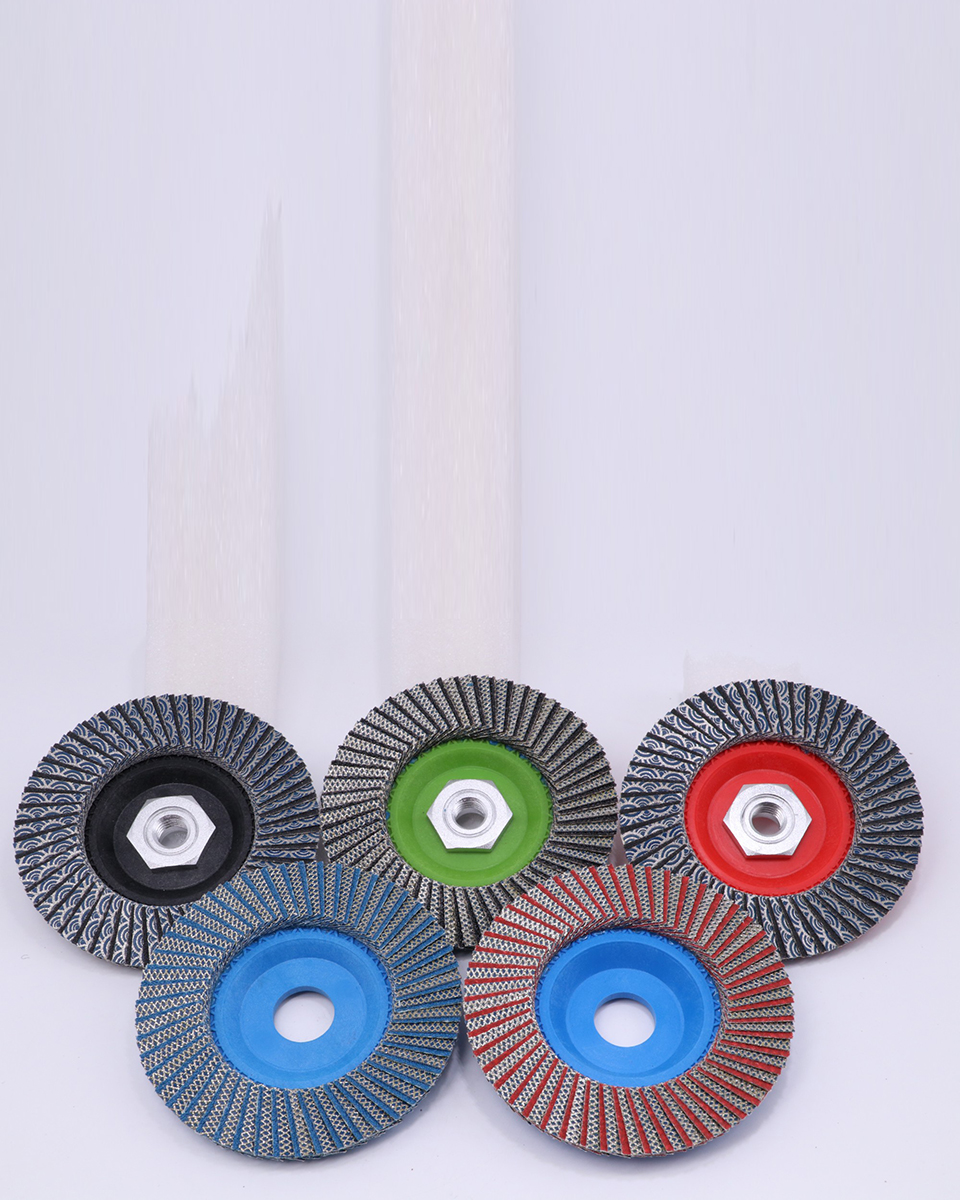
Diamond flap disc for processing stone, glass and ceramics; suitable for dry and wet grinding.
Two specification points carry most of the cost-per-use argument. First, grit range. Openings from 40# to 800# allow a coarse disc for aggressive material removal, beveling and edge work, and finer grits for surface conditioning and finishing, using one tool family across a job instead of switching between abrasive types. Second, dry and wet compatibility. The same disc is specified for both, which matters on installation and site work where water is available for some operations and not for others.
Working conditions are part of the specification too. These discs are positioned for handheld electric tools running under dry and wet abrasive grinding with high friction at normal ambient temperature, with supporting equipment such as glass process systems and grinders. Stability under those conditions, including low vibration at high rotation speed, is what keeps an edge true, and an edge that stays true is an edge that does not come back for rework.
The Cost-Per-Use Breakdown: Four Cost Lines and One Denominator
Cost per use reduces to a single expression:
Work through the four cost lines in the numerator, then look at the denominator.
- Disc purchase price. This is the only line where a conventional abrasive flap usually wins. Diamond grain costs more than aluminium oxide or zirconia alumina, so the invoice price per disc is higher. In isolation, that comparison is complete and misleading.
- Changeover labour. Each disc change consumes operator attention. A disc with a long working life reduces the number of changes per shift, and that saving scales with how many edges the shop finishes each day.
- Downtime cost. For a shop billing bench or machine time, or a crew working to a site programme, a stopped grinder is the most expensive item on the list, and usually far more expensive than the price difference between discs.
- Rework and scrap. Finishing consistency through the disc's life affects how many edges need touching up later, and how many slabs, tiles or glass pieces are lost to an inconsistent bevel.
The denominator, finished parts per disc, is where diamond abrasives change the arithmetic fastest. The stated features of these discs are a high cutting speed and a long working life: more removal per minute, sustained over more minutes per disc. Both effects enlarge the denominator, and because the denominator divides every cost line, the improvement compounds.
On efficiency specifically, RUITE's application positioning for these discs cites a grinding-efficiency advantage of around 45% compared with conventional abrasive flaps in matching operations. Treat a supplier figure like that as a hypothesis to test rather than a conclusion to copy. The number that settles the question in your shop is your own parts-per-disc result on your own material.
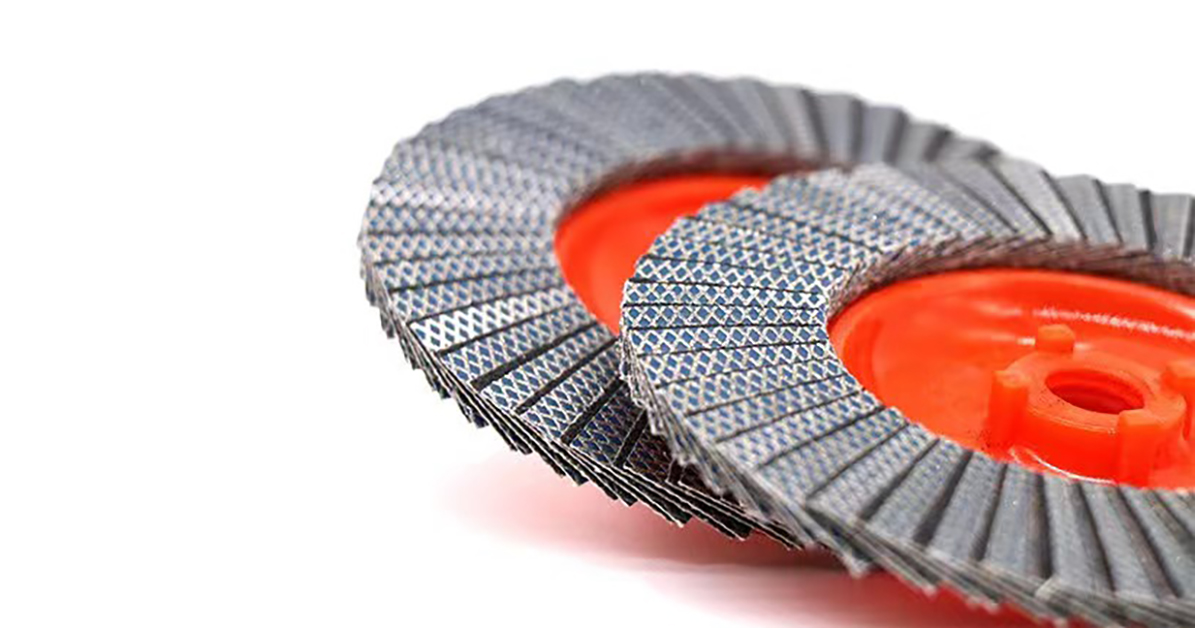
High cutting speed and long working life are the two stated performance features that drive cost per use.
Where Diamond Flap Discs Are Not the Answer
A cost-per-use argument is only credible if it includes the cases where the other tool wins.
- Softer metals and general preparation. On mild steel and general metal finishing, aluminium oxide and zirconia flaps are designed for exactly that work and can remain the economical choice.
- Wet grinding housekeeping. Wet grinding controls dust and heat, but it produces slurry that has to be contained and cleaned. A shop without that routine is better served working dry, within the disc's speed limits.
- Wrong grit for the job. A finishing grit used for aggressive removal will feel slow and expensive; a coarse grit used for finishing will add steps. The 40# to 800# range only pays back when the grit is matched to the operation.
- Speed discipline. Any coated abrasive disc must run within its marked speed limit. Exceeding it is a safety issue, not a productivity shortcut.
In short: diamond flap discs are built for hard, brittle materials where conventional abrasive grain gives up early. They are not a blanket replacement for every coated abrasive in the shop.
Step-by-Step: Running a Cost-Per-Use Trial on Your Own Floor
A trial that answers this question takes about a day. Six steps:
Step 1, pick one representative operation. Choose the job that consumes the most discs, such as a miter on porcelain tile, an edge on engineered stone, or a bevel on marble. One operation, measured properly, beats a whole-shop impression.
Step 2, freeze the variables. Same grinder, same speed, same operator, same material batch, same target finish. If the speed or the operator changes between runs, the comparison measures the operator, not the disc.
Step 3, record the baseline. Run the conventional abrasive flap disc and log four numbers: discs consumed, parts completed, changeover minutes per disc, and parts that needed rework.
Step 4, record the diamond run. Repeat the identical job with a diamond flap disc at the correct diameter and grit, for example Φ115*22 mm with a coarse grit for beveling and chamfering, or a finer grit for surface conditioning. Log the same four numbers.
Step 5, apply the formula. Enter both data sets into (disc price + changeover labour + downtime + rework) ÷ parts per disc. If the shop does not track downtime cost yet, use the hourly rate you would bill for the machine.
Step 6, decide on parts per disc and total job time, not on price per disc. Then repeat the trial on a second operation before changing what the whole shop stocks.
One caution on measurement: run at least a full disc's worth of work per test. A short comparison rewards whichever disc starts aggressive. It does not show which one is still cutting at the end of its life, and end-of-life behaviour is exactly what the cost-per-use calculation is trying to capture.
Use Cases: Where the Cost-Per-Use Case Is Strongest
The economics of a long-life diamond disc appear fastest where the material is hardest and the finish tolerance is tightest.
Porcelain tile and ceramic slab mitering
Diamond flap discs are specifically recommended for grinding ceramic tiles, porcelain stoneware and natural stone such as marble and granite to execute miters and bevels (RUBI Tools). Miter work is repetitive and consistent, which is exactly the profile where parts per disc dominates the calculation.
Marble and granite edge grinding and chamfering
Edge work on natural stone demands steady removal without chipping or burning the edge. RUITE positions its diamond flap discs for the stone industry, with flexible flap construction that follows an edge profile rather than cutting a flat into it.
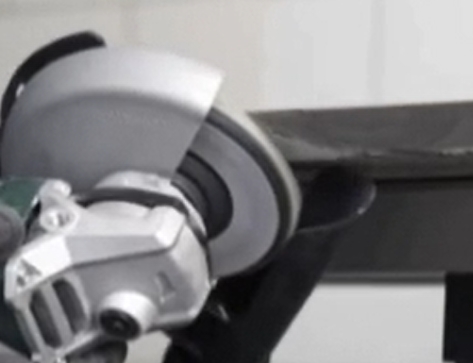
Diamond flap disc grinding on ceramic and stone surfaces with a handheld electric tool.
Engineered stone and countertop edges
Engineered stone is abrasive to conventional grain, so disc consumption tends to run high in fabrication shops. Reducing changeovers on a countertop line protects the two things hardest to recover: bench time and finish consistency.
Glass edge grinding
Glass processing is one of the application areas specified for these discs, alongside ceramic production, with supporting equipment such as glass process systems and grinders. Wet grinding is common here for dust and heat control, and the discs are specified for wet use as well as dry.
Hard metal, thermal spray coatings and reworked surfaces
Cemented carbide and spray coatings are named as materials processed by this disc range, which puts hard-metal blending and coating conditioning in scope, not only stone work.
Masonry and mixed on-site work
For handheld angle grinder work on porcelain, masonry and mixed materials, the value of a disc that keeps cutting is straightforward: fewer trips to the van for a new disc, and fewer interruptions to the job sequence.
Diamond Flap Disc vs Conventional Abrasive Flap Disc: Side-by-Side
| Comparison point | Conventional abrasive flap disc | Diamond flap disc (RUITE) |
|---|---|---|
| Abrasive grain | Commonly aluminium oxide or zirconia alumina | Diamond or CBN |
| Built for | General metal preparation and finishing | Stone, glass, ceramics, monocrystalline silicon, cemented carbide, spray coatings |
| Behaviour on hard, brittle materials | Softer grain dulls sooner; removal rate drops before the disc is worn out | Diamond grain keeps cutting; stated features are high cutting speed and long working life |
| Dry and wet grinding | Depends on the product and backing | Specified for both dry and wet grinding |
| Unit price per disc | Lower | Higher |
| Cost per finished part | Dependent on parts per disc, which falls on hard materials | Dependent on parts per disc and fewer changeovers (see the formula above) |
| Grit range in this range | Varies by supplier | 40# to 800# |
| Dimensions in this range | Varies by supplier | Φ100*16 mm, Φ115*22 mm, Φ125*22 mm |
| Tool compatibility | Angle grinders | Handheld electric tools; stable abrasion resistance and low vibration during high-speed rotation in EU applications |
| Standards relevant to EU supply | EN 13743:2017 applies to coated abrasive products | EN 13743:2017 referenced for EU glass and ceramic applications |
Read the table from the bottom up. The standard applies to both product families, so it does not separate them. The separation happens in the middle rows: grain hardness, behaviour on hard brittle materials, and the resulting number of parts per disc.
Frequently Asked Questions
Are diamond flap discs compliant with European safety requirements?
EN 13743:2017 is the European safety standard that specifies requirements for coated abrasive products, including diamond flap discs, covering maximum operating speeds and safety markings (British Standards Institution). For glass and ceramic applications in the EU, RUITE's stated requirement is compliance with EN 13743:2017, together with stable abrasion resistance and low vibration during high-speed rotation. Before mounting any disc, check that its marked maximum speed is at or above the grinder's rated RPM.
Can diamond flap discs be used for both dry and wet grinding with handheld tools?
Yes. RUITE diamond flap discs are specified as suitable for dry and wet grinding and are used in handheld electric tools under dry and wet abrasive grinding conditions with high friction at normal ambient temperature. Dry grinding suits site work where water is impractical; wet grinding helps control dust and heat on benched operations. Both modes require working within the disc's marked speed limit and using protection matched to the material being ground.
How do I calculate the cost per use of a diamond flap disc?
Use: cost per finished part = (disc purchase price + changeover labour + downtime cost + rework and scrap) ÷ finished parts per disc. Record four measurements from one trial: discs consumed, parts completed, changeover minutes per disc, and parts needing rework. Then run the same job with the alternative disc type at the same speed and pressure. The comparison is valid only when both runs use the same grinder, material and target finish.
Diamond flap disc manufacturers: what should a buyer check?
Judge a manufacturer on documented facts rather than catalogue adjectives: what it actually produces, the sizes and grits it can hold consistently, and whether it can supply the same specification again on the next order. Zhengzhou Ruite Diamond Belts Co., Ltd., established in 2003, makes diamond flap discs and other superhard abrasive products in a 500-square-meter facility with approximately 45 employees and a five-engineer R&D team, at an annual output of 100,000 units; exports account for 70% of sales, with the EU and USA as major markets. If you want to test cost per use on your own material, request a sample or quotation at sales@ruitechn.com, call +0086-371-86555877, or message +8613928451015 on WhatsApp.
Conclusion: The Disc That Costs Less per Part Wins the Order
In stone, glass and ceramic shops, the disc price on the invoice is the beginning of the calculation, not the end of it. Diamond flap discs cost more per disc and are specified for precisely the conditions that break conventional abrasive flaps: hard, brittle materials, dry and wet grinding, high friction, and handheld electric tools running at speed. Their stated advantages, high cutting speed and long working life, enter the calculation twice, by raising parts per disc and by lowering the number of changeovers, and every changeover removed takes a slice of downtime with it.
The practical next step is small: choose the operation that consumes the most discs, log the four numbers, and compare cost per finished part instead of price per disc. One afternoon of measurement will tell you more than any catalogue claim.
Ready to test it on your own material?
RUITE supplies diamond flap discs in Φ100*16 mm, Φ115*22 mm and Φ125*22 mm, in grits from 40# to 800#, for dry and wet grinding on handheld electric tools. Request a sample or a quotation at sales@ruitechn.com, or on WhatsApp at +8613928451015, and review the full range in the RUITE product catalogue (PDF). Company and product information is also available at ruitechn.com.

Zhengzhou Ruite Diamond Belts Co., Ltd., established in 2003, manufactures diamond flap discs and other superhard abrasive products.
Have Questions or Need More Details?
Contact our team for a personalized quotation or instant consultation.
Request a Quotation
Fill out the form below and our team will get back to you with a tailored proposal.
WhatsApp Direct Chat
Prefer to chat in real-time? Message us on WhatsApp for instant assistance & quick answers.
- Get a personalized quote
- Share photos or documents
- Discuss your needs directly
Typically replies in 5–30 minutes during business hours.