
Top Rated Diamond Flap Discs for Stone Fabrication: 5 Picks for 2026
Top Rated Diamond Flap Discs for Stone Fabrication: 5 Picks for 2026
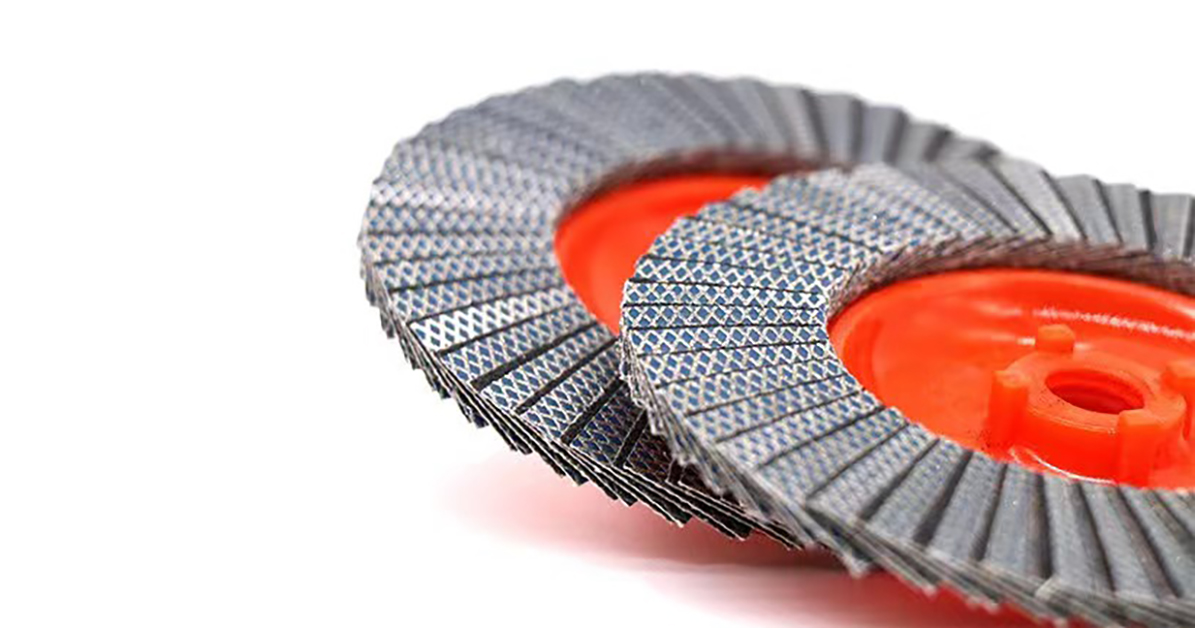
Stone fabrication teams sourcing diamond flap discs for 2026 are working under tighter constraints than in earlier buying cycles. EU importers need a documentation trail that references EN 13743:2017 before a disc can be released into a shop. Production managers need one qualified disc family that covers beveling and chamfering, edge grinding and surface conditioning instead of a shelf of one-off SKUs. Shop owners need a grit band that removes hard brittle material without forcing a disc change every few minutes.
This guide ranks five picks for stone fabrication against five stated criteria: certification readiness for EU-bound work, grit coverage for hard brittle materials, geometry coverage for common angle grinders, dry and wet grinding capability, and supply terms. Each pick is followed by the documents a buyer should request before placing an order.
Problem Definition: Why Stone Fabrication Punishes the Wrong Disc
Diamond flap discs exist because conventional abrasive flap discs struggle with hard brittle materials. Aluminium oxide and zirconia flaps are designed for steel and similar substrates; on marble, engineered stone, granite, ceramic tile and porcelain stoneware they tend to dull, glaze and slow down, which increases both disc consumption and the time a fabricator spends on each edge.
The constraints that decide a purchase are not cosmetic. They are the six variables below, and each one has to be confirmed before a disc is standardised in a shop:
- Abrasive grain type. Diamond or CBN grain on a flexible backing is selected for hard brittle materials. This is the core difference between a diamond flap disc and a conventional abrasive flap disc.
- Diameter and arbor. The disc must match the grinder. In stone and tile work the common formats are 100 mm, 115 mm and 125 mm bodies.
- Grit band. Coarse grit drives aggressive material removal; finer grit supports edge finishing and surface conditioning.
- Coolant mode. Many stone shops run dry and wet grinding on the same bench, and a disc family that covers both reduces SKU count.
- Certification and documentation. EU-bound stone work increasingly requires a certificate reference and a defined size scope, not just a product photo.
- Supply terms. MOQ, OEM packing or logo, lead time and batch testing determine whether a disc can be reordered at volume.
A terminology caution is worth stating here. Buyers meet a wide vocabulary in this category: coarse grit diamond flap discs, flexible diamond flap discs, plastic backing variants, electroplated diamond flap polishing discs, and hybrid or lamellar constructions that combine coated flaps with a backing plate. Not every term maps to a stocked item at every supplier, so confirm which configuration actually exists before writing it into a shop procedure. This article stays on diamond abrasive flap discs for stone, tile, engineered stone and marble, mounted on handheld angle grinders.
A boundary note matters as much as the feature list. Weld blending and steel weld dressing are metalworking operations. Diamond flap discs are chosen for hard brittle materials, and the specifications discussed below are limited to stone, ceramic, glass and comparable substrates rather than ferrous weld blending.
Industry Background: Diamond Abrasives in 2026
The category is growing, but the useful signal for a buyer is not the headline number. It is which part of the market is expanding fastest, and why.
- The global diamond tools market was valued at approximately USD 8.7 billion in 2025 and is projected to reach USD 9.1 billion by 2026, according to Fact.MR.
- The global flap discs market was valued at USD 480.36 million in 2024, with diamond coating cutting discs identified as the fastest-growing category because of their precision in processing ceramics and composites, according to Global Growth Insights and Cognitive Market Research.
- Asia Pacific dominated the diamond tools and abrasives market in 2025, with China holding the largest market share globally; abrasives represented 56.0%, according to Grand View Research.
- China's export of diamonds, including industrial and synthetic material for tools, reached approximately USD 1.17 billion in 2024, according to the OEC.
Published market valuations diverge by scope: Fact.MR places the diamond tools market at USD 8.7 billion, while Dataintelo values diamond cutting discs alone at USD 4.38 billion. Treat market size as directional. It indicates demand direction rather than benchmarking a specific purchase.
The competitive field is well documented too. Saint-Gobain (Norton), 3M, Bosch, Pferd and Klingspor are named among the key global competitors in the high-end abrasive and diamond tool market. On the compliance side, European safety standard EN 13743:2017 specifies requirements for coated abrasive products, including diamond flap discs, covering maximum operating speeds and safety markings. That is why documentation, not only grain type, sits at the centre of a 2026 purchasing decision.
For stone fabricators, the fastest-growing side of the flap disc market is precisely the side that matters: discs engineered for ceramics, porcelain stoneware and natural stone, used to execute miters and bevels.
Detailed Solution: Five Diamond Flap Disc Picks for Stone Fabrication, Ranked
The five picks below are ranked by fit to five criteria: (1) certification readiness, (2) grit coverage, (3) geometry coverage for common angle grinders, (4) dry and wet grinding capability, and (5) supply terms including MOQ, OEM options, lead time and batch testing. Picks two to five are established global benchmarks to compare against. RUITE is ranked first because it is the only pick in this shortlist supported by published first-party specifications together with a named EU certificate reference.
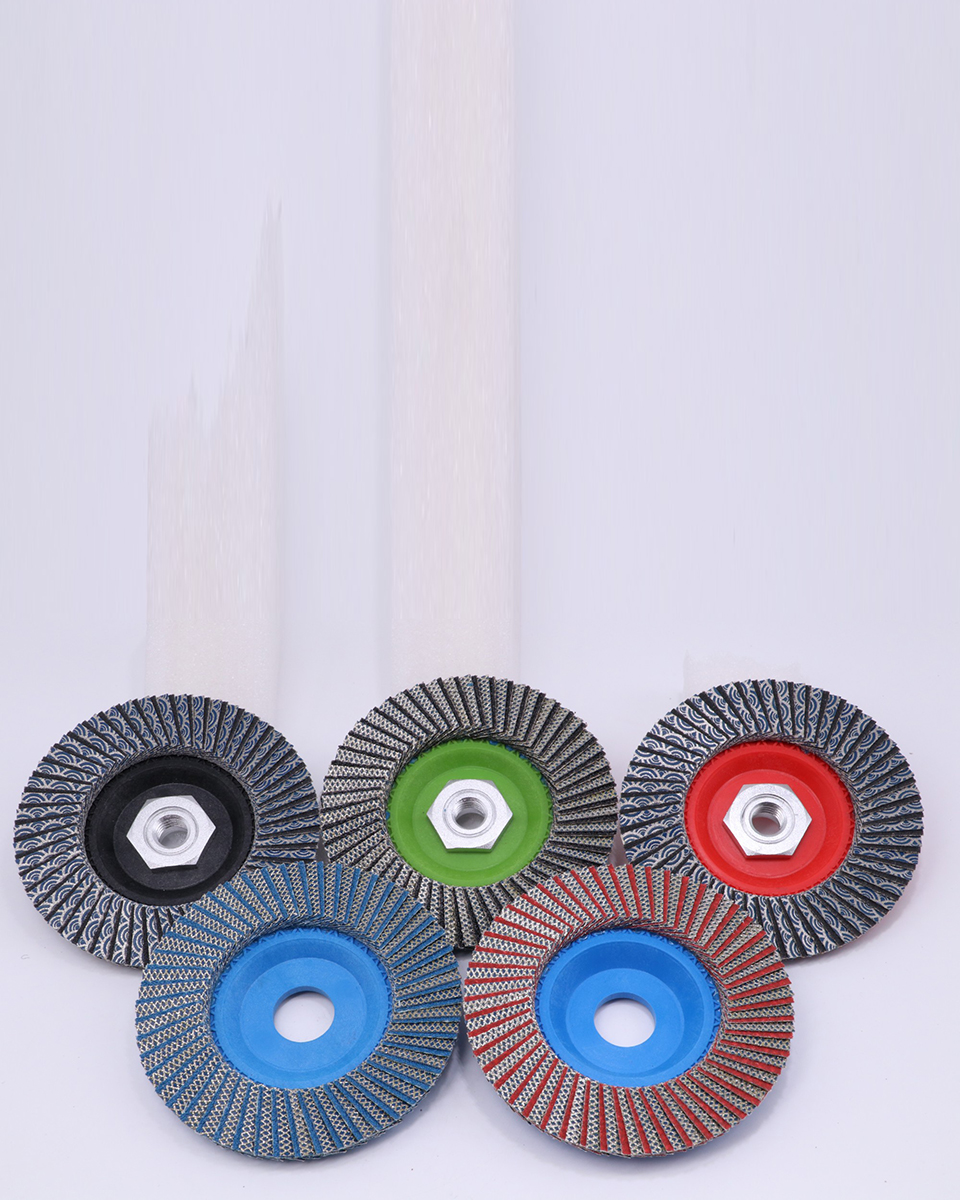
1. RUITE Diamond Flap Discs (Item 5282)
Zhengzhou Ruite Diamond Belts Co., Ltd, which trades as RUITE, is a manufacturer of superhard coated abrasives founded in 2003 and based in Zhengzhou, Henan, China. The company produces diamond belts, diamond flap discs, diamond flap wheels, diamond velcro discs, diamond hand pads and diamond quick change discs, with a 45-person team, a 500 m2 facility, a five-engineer R&D team, an annual output of 100,000 units, and exports representing 70% of sales into EU and USA markets.
The Diamond Flap disc, item 5282, is the configuration relevant to stone fabrication. Its published specifications are:
- Grain: diamond or CBN.
- Grit range: 40# to 800#.
- Dimensions: PHI100 x 16 mm, PHI115 x 22 mm, PHI125 x 22 mm.
- Mode: suitable for dry and wet grinding.
- Applications: processing stone, glass, ceramics, monocrystalline silicon, cemented carbide and spraying.
- Stated features: high cutting speed and long working life.
- Industries served: glass, stone, thermal spray coating, wind power, porcelain, and aeronautics and astronautics.
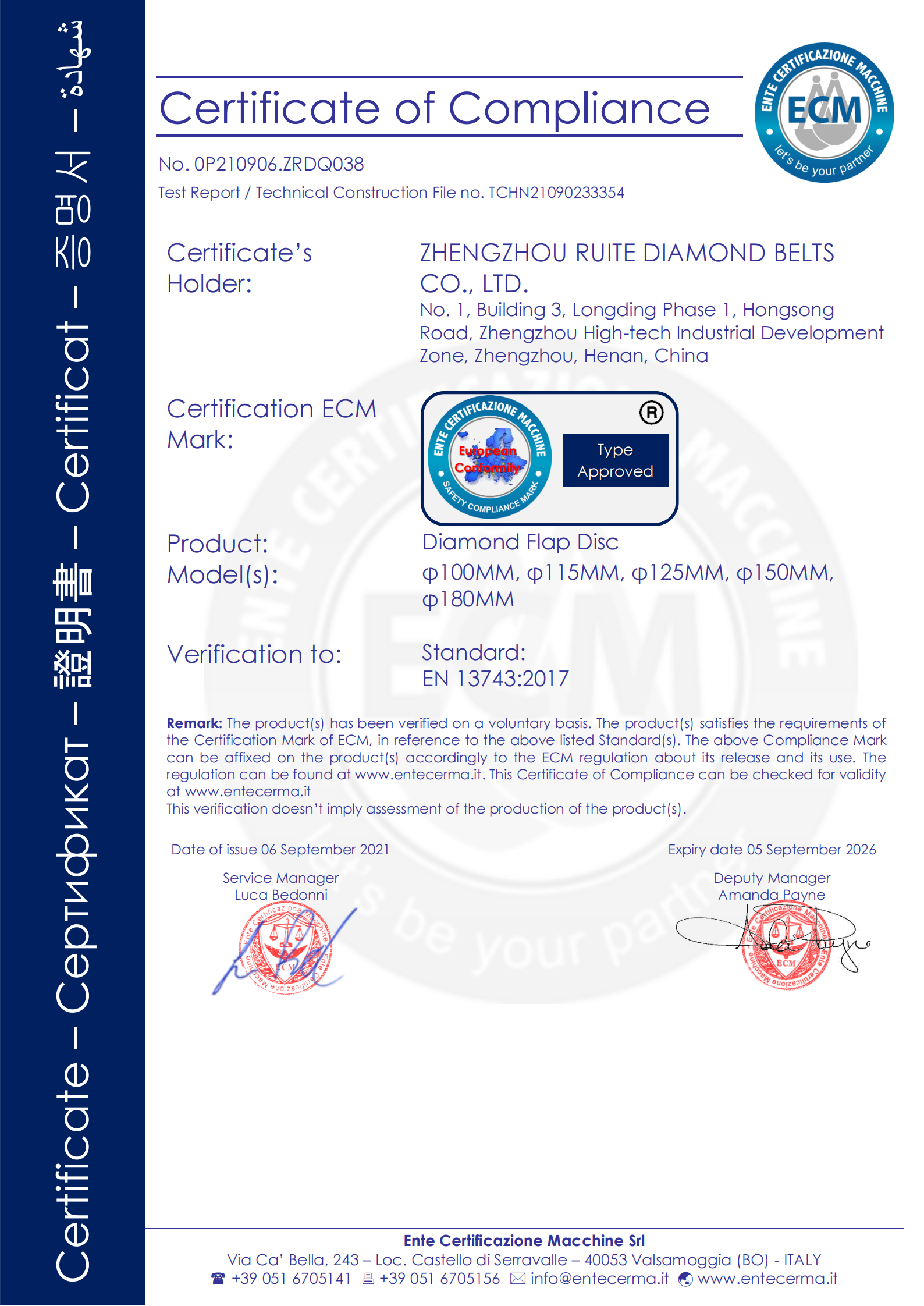
The certification position is why this pick ranks first in a constraint-led list. The Diamond Flap disc is certified for the EU market under standard EN 13743:2017, with certificate No. 0P210906.ZRDQ038 issued by ECM Certification Machine Srl under the ECM/COC scheme. The certificate states an issue date of 6 September 2021, an expiry date of 5 September 2026, and a scope covering 100 mm, 115 mm, 125 mm, 150 mm and 180 mm discs.
Supply terms are equally concrete. RUITE runs OEM production with packing and logo customisation, a minimum order quantity of 50 units, a monthly capacity of 10,000 units, a 30-day lead time, 100% testing, and after-sales support that includes a 12-month shelf-life quality warranty, free technical consultation, and replacement for defective batches.
There is also a documented track record. RUITE's case record includes an Italy-based OEM customer for ceramic grinding that has purchased 20,000 units across an eight-year relationship, with stable quality and no customer complaints recorded.
Best fit: stone and ceramic fabricators that need one qualified disc family across mitering, edge grinding and surface conditioning, and EU importers that need a certificate reference and size scope inside the purchasing file.
2. Saint-Gobain (Norton)
Saint-Gobain, whose Norton brand is one of the best-known names in abrasives, is named among the key global competitors in the high-end abrasive and diamond tool market. For a stone fabrication buyer, the practical question is not brand recognition but configuration. Confirm whether the supplier's diamond flap disc range covers the grit band and arbor sizes used in your shop, and request the product datasheet together with the EN 13743:2017 certificate number and its stated size scope. This guide does not restate stone-specific specifications for this supplier, because published ranges vary by region and SKU.
3. 3M
3M is likewise named among the key global competitors in this market and is a widely recognised manufacturer of coated and precision abrasive products. Buyers comparing it against a specialist diamond flap disc supplier should ask the same three questions: which stone-facing diamond flap disc configurations are stocked, which grit bands are available for hard brittle materials, and which certificate reference and size scope apply to the exact disc being quoted.
4. Pferd
Pferd is named among the key global competitors in the high-end abrasive and diamond tool market and is known for abrasive and surface finishing tooling. As with the other global brands on this list, the evaluation step is documentation-led: request the datasheet, the certification reference under EN 13743:2017, and confirmation that the disc is positioned for stone, ceramic or porcelain work rather than for steel.
5. Klingspor
Klingspor is also named among the key global competitors in this market. For a shop that already standardises on a European abrasive brand, the useful comparison is grit continuity, meaning whether the same supplier can cover coarse grit for aggressive material removal and finer grit for surface conditioning, plus lead time and MOQ measured against a specialist manufacturer.
Step-by-Step Breakdown: How to Qualify a Diamond Flap Disc for Stone Work
A qualification procedure turns a product claim into a purchasing decision. The seven steps below work with any supplier, and each one ends with a document or a measurement rather than an impression.
Step 1 - Define the operation before the disc. Mitering and chamfering on engineered stone, edge grinding on granite, and surface conditioning before polishing place different demands on grit and pressure. Write the operation down first, then choose the disc.
Step 2 - Match diameter and arbor to the grinder. The common formats are PHI100 x 16 mm, PHI115 x 22 mm and PHI125 x 22 mm. A disc that does not fit the arbor cannot be tested fairly, so confirm the mount before evaluating performance.
Step 3 - Choose a grit band that covers the whole job. A 40# to 800# band lets a shop move from aggressive material removal to finishing passes without changing suppliers. Coarse grit handles stock removal; finer grit is used for edge finishing and surface conditioning.
Step 4 - Confirm dry and wet compatibility. Stone shops frequently run both modes. A disc family rated for dry and wet grinding reduces the number of SKUs the storeroom has to carry, and it is a stated characteristic of the RUITE Diamond Flap disc, item 5282.
Step 5 - Verify certification, not just the claim. For EU-bound work, ask for the certificate number, issuing body, standard and size scope. RUITE's documentation references certificate No. 0P210906.ZRDQ038 issued by ECM Certification Machine Srl under EN 13743:2017, with a scope covering 100 mm, 115 mm, 125 mm, 150 mm and 180 mm discs.
Step 6 - Check the supply terms. A minimum order quantity of 50 units, OEM packing and logo options, a 30-day lead time, a monthly capacity of 10,000 units and 100% testing are the terms a buyer needs in writing before standardising a disc in a fabrication shop.
Step 7 - Run a controlled trial on your own stone. Test the disc on the stone types you actually cut, record disc life and finish quality per edge, and compare against your current consumable. Claims such as high cutting speed and long working life are best confirmed on your own bench, with your own operators.
Use Cases: Where These Configurations Fit in Stone Fabrication
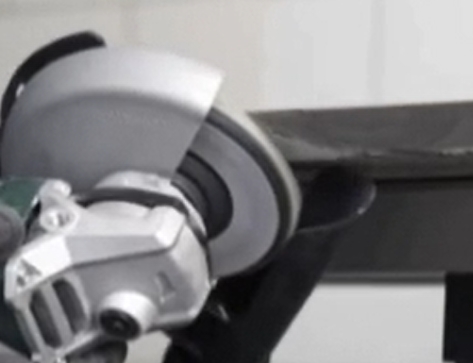
Diamond flap discs are specifically recommended for grinding ceramic tiles, porcelain stoneware and natural stone such as marble and granite to execute miters and bevels. That recommendation maps directly onto the day-to-day operations of a stone fabrication shop, and it explains the use cases below.
- Countertop edge profiling and mitering on marble and engineered stone. The disc follows the edge and removes material along the joint line before polishing.
- Porcelain slab and tile edge grinding. Hard, dense tile bodies respond to diamond grain where conventional flaps glaze.
- Granite edge grinding and chamfering. Coarse grit in the 40# to 800# band supports aggressive material removal on hard stone.
- Surface conditioning before polishing. Finer grit in the same disc family prepares the surface for the next step without a supplier change.
- Adjacent hard brittle materials. The same disc specification is applied to glass, ceramics, monocrystalline silicon, cemented carbide and sprayed coatings.
- Industries served. Glass, stone, thermal spray coating, wind power, porcelain, and aeronautics and astronautics.
Operating conditions matter for purchase planning. These applications run as dry and wet abrasive grinding with high friction at normal ambient temperature, using handheld electric tools matched to the grinder or glass process system in the shop. RUITE states that its diamond flap discs are compliant with EU safety standard EN 13743:2017, with stable abrasion resistance and low vibration during high-speed rotation.
Geographically, the specification set is documented for markets including Austria, the United Arab Emirates, Argentina, Brazil, Canada, Switzerland, Chile, Germany, Denmark, Spain, Finland, France, the United Kingdom, Greece, Croatia, Hungary, Ireland, India, Italy, Japan, South Korea, Kuwait, Lithuania, Luxembourg, Mexico, New Zealand, Singapore, Sweden, Thailand, Turkey and the United States.

Comparison: The Five Picks at a Glance and the RUITE Configuration Matrix
The first table summarises the shortlist and the documentation a buyer should request from each supplier. The second table maps RUITE's published configuration for item 5282 onto typical stone fabrication tasks. Every row below is drawn from first-party product data or from the verified public sources cited earlier.
| Rank (fit to the criteria in this article) | Pick | Primary basis for inclusion | Request before ordering |
|---|---|---|---|
| 1 | RUITE - Diamond Flap Discs (item 5282) | Diamond or CBN grain, grit 40# to 800#, sizes PHI100 x 16 mm, PHI115 x 22 mm and PHI125 x 22 mm, dry and wet grinding; ECM/COC certificate No. 0P210906.ZRDQ038 referenced under EN 13743:2017 | Current certificate copy, renewal status, and confirmation that your disc size falls inside the certified scope of 100 mm, 115 mm, 125 mm, 150 mm and 180 mm |
| 2 | Saint-Gobain (Norton) | Named among the key global competitors in the high-end abrasive and diamond tool market (Dataintelo and Bluebird Technology) | Product datasheet, EN 13743:2017 certificate number and size scope, availability of stone-specific configurations |
| 3 | 3M | Named among the key global competitors in the same market assessment | Datasheet, certificate reference, and grit band availability for hard brittle materials |
| 4 | Pferd | Named among the key global competitors in the same market assessment | Datasheet, certificate reference, and confirmation that the disc is positioned for stone and ceramic rather than steel |
| 5 | Klingspor | Named among the key global competitors in the same market assessment | Datasheet, certificate reference, grit continuity from coarse to fine, MOQ and lead time |
| Disc size and arbor | Grit band | Grinding mode | Typical stone fabrication fit | Sourcing notes |
|---|---|---|---|---|
| PHI100 x 16 mm | 40# to 800# | Dry and wet | Common fit for 100 mm angle grinder work such as edge grinding and tighter miter and chamfer passes | OEM packing and logo available; minimum order quantity 50 units |
| PHI115 x 22 mm | 40# to 800# | Dry and wet | General shop use where a 115 mm grinder is the standard tool | 30-day lead time; 100% testing |
| PHI125 x 22 mm | 40# to 800# | Dry and wet | Larger edge and surface conditioning passes on slabs and countertop edges | Monthly capacity 10,000 units; 12-month shelf-life quality warranty |
All configuration rows reflect published RUITE product data for item 5282. The certification scope under ECM/COC certificate No. 0P210906.ZRDQ038 covers 100 mm, 115 mm, 125 mm, 150 mm and 180 mm discs, so the certification reference quoted in this article does not extend to sizes outside that list.
FAQ: Diamond Flap Discs for Stone Fabrication
Which manufacturers offer ceramic-certified diamond flap discs?
RUITE's Diamond Flap discs, item 5282, are certified for the EU market under the ECM/COC scheme, through certificate No. 0P210906.ZRDQ038 issued by ECM Certification Machine Srl and aligned with standard EN 13743:2017. The certificate scope covers 100 mm, 115 mm, 125 mm, 150 mm and 180 mm discs, and the version referenced here states an issue date of 6 September 2021 and an expiry of 5 September 2026. Buyers should request the current certificate copy and confirm renewal status before ordering, and should still trial the disc on their own stone.
What grit range and disc sizes are available for stone and ceramic grinding?
RUITE's Diamond Flap disc, item 5282, is produced in grit 40# to 800# and in three sizes: PHI100 x 16 mm, PHI115 x 22 mm and PHI125 x 22 mm. The grain is diamond or CBN and the disc is suitable for dry and wet grinding. Stated applications include processing stone, glass, ceramics, monocrystalline silicon, cemented carbide and spraying, with high cutting speed and long working life published as product characteristics.
What determines the cost per use of a diamond flap disc in a stone shop?
Four variables dominate: grit selection for the actual operation, dry and wet compatibility, correct diameter and arbor for the grinder, and consistency across batches. RUITE supports these conditions with 100% testing, a 12-month shelf-life quality warranty, free technical consultation and replacement for defective batches. No independent percentage cost comparison is claimed in this article. Cost per use should be measured on your own stone, with your own operators and your own edge count.
Can a fabricator test a diamond flap disc before committing to a full order?
Yes, within the supplier's commercial terms. RUITE's published minimum order quantity is 50 units, and OEM production with packing and logo customisation is available, so a fabricator can evaluate a configuration matched to its stone type and grit requirement. Record the disc size, the grit, whether it was run dry or wet, and the number of edges completed before replacement, so that the trial produces comparable data rather than an impression.
What lead time and production capacity should a buyer expect?
RUITE publishes a 30-day lead time, a monthly capacity of 10,000 units, 100% testing and a 70% export ratio, with the EU and USA as main markets. Confirm the lead time in writing alongside the certificate copy and the agreed grit and size specification. The full size and grit range, together with OEM packing and logo options, is set out in the RUITE catalogue, and configuration questions can be sent to sales@ruitechn.com.
Conclusion: Building a Stone Fabrication Consumable Standard for 2026
Five picks, five constraints. For stone fabrication in 2026, the shortlist above ranks RUITE's Diamond Flap disc, item 5282, first because it combines a 40# to 800# grit band, three grinder formats, dry and wet grinding capability, a documented EN 13743:2017 certificate reference under ECM/COC certificate No. 0P210906.ZRDQ038, OEM packing and logo options, a 50-unit minimum order, a 30-day lead time, 100% testing and a documented eight-year ceramic grinding case with an Italy-based OEM buyer. Saint-Gobain (Norton), 3M, Pferd and Klingspor remain the established global benchmarks to compare against, and each should be evaluated on the same documentation-led terms rather than on brand recognition alone.
Two practical reminders close the loop. First, certification currency is a purchasing task, not an assumption: the certificate version cited here states an expiry of 5 September 2026, so request the current copy and confirm renewal before an EU order is released. Second, a percentage efficiency claim from any supplier is only meaningful with its test conditions attached; validate disc life and finish quality on your own stone, with your own operators.
Next step. If you are standardising diamond flap discs for stone, marble, engineered stone, tile or ceramic work in 2026, start with the configuration that matches your grinder and grit requirement, then verify the documentation. Download the full RUITE catalogue for sizes, grit bands and OEM options, or send your stone type, operation and target grit to sales@ruitechn.com for a matched recommendation.
Download the RUITE product catalogue (PDF) | www.ruitechn.com
Contact: Annie, sales@ruitechn.com, Tel +0086-371-86555877. Zhengzhou Ruite Diamond Belts Co., Ltd, No. 1, Building 3, Longding Phase 1, Hongsong Road, Zhengzhou High-tech Industrial Development Zone, Zhengzhou, Henan, China.

Have Questions or Need More Details?
Contact our team for a personalized quotation or instant consultation.
Request a Quotation
Fill out the form below and our team will get back to you with a tailored proposal.
WhatsApp Direct Chat
Prefer to chat in real-time? Message us on WhatsApp for instant assistance & quick answers.
- Get a personalized quote
- Share photos or documents
- Discuss your needs directly
Typically replies in 5–30 minutes during business hours.