
How to Choose a CE-Certified Diamond Sanding Belt for Thermal Spray, Glass & Carbide
How to Choose a CE-Certified Diamond Sanding Belt for Thermal Spray, Glass & Carbide
Last updated: August 25, 2026
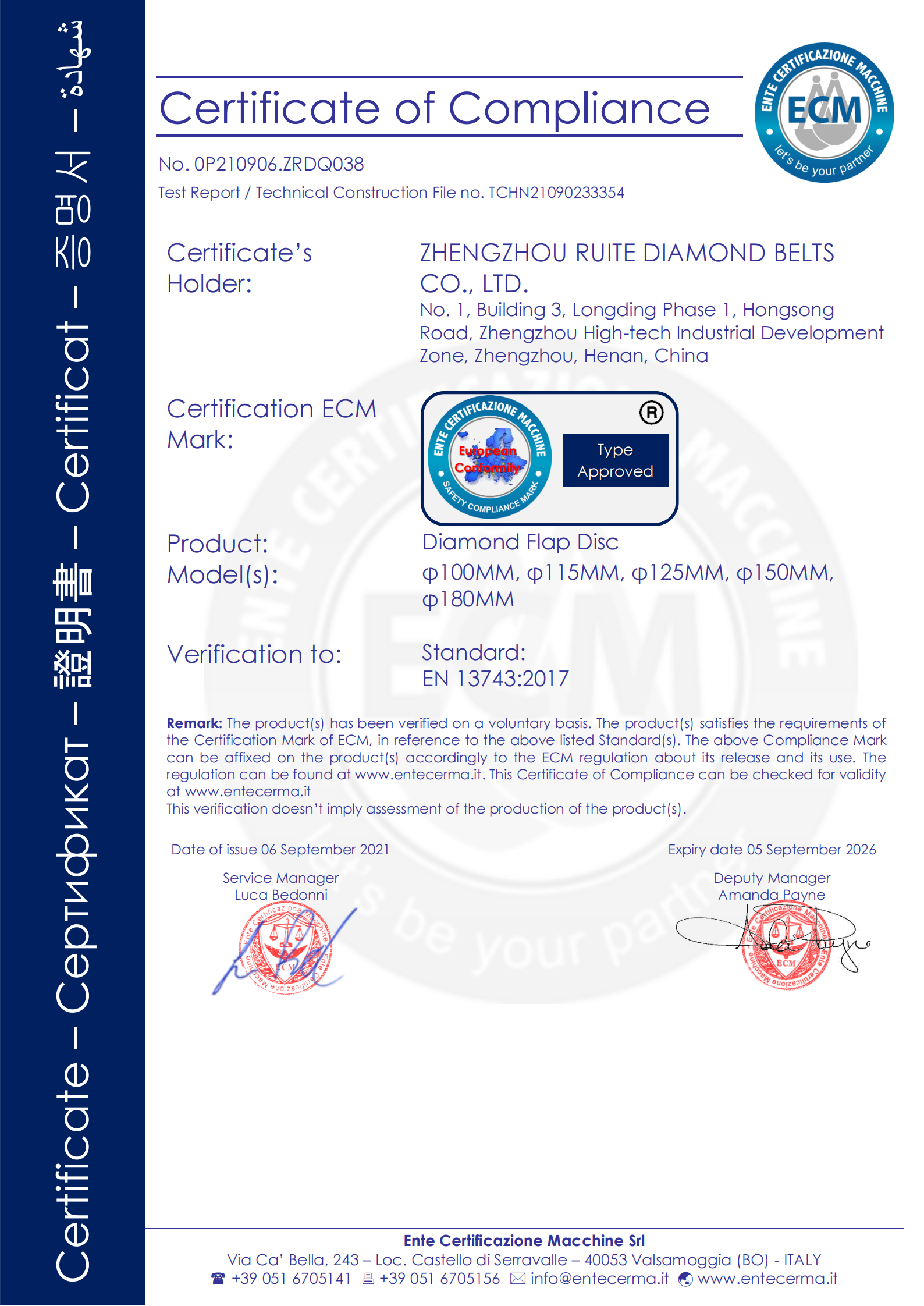
ECM CoC certificate No. 0P210906.ZRDQ038 — EN 13743:2017, valid for the EU market.
For buyers who need a CE-certified diamond sanding belt for demanding production work, the core question is not just where to find a supplier, but how to verify the combination of compliance, material capability, and manufacturing control. Below is a practical, evidence-based selection framework based on the product program and certification status of Zhengzhou Ruite Diamond Belts Co., Ltd (RUITE).
The Procurement Problem: Certification and Performance Must Be Evaluated Together
When a diamond sanding belt is used on thermal spray coatings, glass edges, ceramic tile, high-temperature alloys, or carbide parts, buyers usually face three linked risks. First, the abrasive product must meet market-specific safety requirements; second, it must deliver stable stock removal and finish on hard brittle materials; third, the supplier must be able to maintain consistent quality across repeat orders. Evaluating these separately leads to mismatched specifications, extended approval cycles, and unpredictable production output. A CE-certified diamond sanding belt is not simply a safety document — it is one layer of a broader manufacturing capability picture.
Industry Context: Why Hard-Brittle Machining Is Moving Toward Superhard Flexible Abrasives
Diamond-based super-abrasives are increasingly used in post-processing and finishing operations across glass, ceramics, thermal spray coatings, wind power components, aerospace and carbide tooling. Unlike conventional abrasives, superhard coated abrasives combine the flexibility of traditional coated abrasives with the hardness of superhard materials. This makes them particularly effective for complex shapes and surfaces where rigid grinding wheels cannot conform. For buyers, that means a single flexible superhard belt technology can replace multiple conventional grinding and polishing steps.
From a market perspective, the global diamond tools market — which includes abrasive belts — was valued at USD 10.8 billion in 2024 and is projected to reach USD 19.5 billion by 2034. The thermal spray coatings market, a major application area for diamond belts used on tungsten carbide and high-temperature alloys, is expected to reach USD 15.28 billion by 2031. These figures indicate growing demand for precision finishing solutions in exactly the application segments that diamond sanding belts serve.
Detailed Solution: Matching Certified Belt Options to Application Groups
RUITE offers diamond belts in a wide specification envelope: Width 5 mm–350 mm, Length 150 mm–5000 mm, Grit 40#–5000#, available in diamond or CBN and customizable. The same product family supports multiple industrial use cases. To choose correctly, buyers should map the dominant failure mode of their workpiece — edge chipping, surface roughness, deburring quality, or coating removal — to the belt grit and bond system.
What the certification covers and what it means for buyers
The Diamond Flap disc (product code 5282) holds ECM certification for the EU market, issued by ECM Certification Machine Srl under certificate number No. 0P210906.ZRDQ038, in compliance with EN 13743:2017. This is a real, verifiable compliance anchor for EU-bound shipments. Buyers should request the certificate, confirm the certificate number, and check the scope before placing orders. For belt products, certification should be reviewed in the context of the exact product and order specification.
Step-by-Step Selection and Verification Workflow
Step 1 — Confirm your workpiece material class
Diamond belts are suitable for grinding and polishing hard brittle materials. Typical material classes include glass, stone, ceramics, monocrystalline silicon, polycrystalline silicon, synthetic materials, cemented carbide, high-temperature alloys, and thermal spray coatings. Identifying the material class limits the choice to the correct abrasive type (diamond vs. CBN) and helps avoid premature wear or edge breakdown.
Step 2 — Define the operation: grinding, deburring, sharpening, or polishing
Each operation places a different load on the belt. Deburring carbide parts requires edge strength and consistent grit exposure. Grinding ceramic tiles demands high stock removal on a hard, brittle surface. Polishing glass edges requires fine grit control and uniform belt surface. Grinding and polishing composite materials and high-temperature alloys benefit from flexible belts that conform to curved or irregular geometries.
Step 3 — Select width, length, grit, and bond
Within the available range (width 5–350 mm, length 150–5000 mm, grit 40#–5000#), define the working width of your machine, the belt circumference, and the target surface finish. Coarse grits (40#–120#) handle stock removal and rough edge breaking. Medium grits (150#–600#) cover general surface grinding and deburring. Fine grits (800#–5000#) support polishing and finishing. The resin bond system is the standard choice for grinding and polishing hard materials; electroplated structures may be considered where a single layer of abrasive with high exposure is preferred.
Step 4 — Review the supplier’s manufacturing and quality control evidence
RUITE operates with 100% testing as part of its quality control process, a 12-month shelf-life quality warranty, and a replacement policy for defective batches. The company also offers OEM services including packing and logo customization, with a monthly capacity of 1,000 units, a 50-unit MOQ, and 30–45 day lead time. For buyers, these elements matter as much as the product itself because they determine whether certification and sample performance can be replicated in mass production.
Step 5 — Validate with a sample or trial order
Before full-scale production, confirm speed, pressure, and time parameters on your actual equipment. Precise control of speed, pressure, and time is required to achieve optimal results and maximum service life. A sample run will reveal whether the belt’s cutting behavior, edge quality, and service life match your expectations.
Use Cases: Where CE-Certified Compliant Diamond Belts Are Applied
RUITE diamond belts are used in the glass industry, stone industry, thermal spray coating industry, wind power industry, porcelain industry, aeronautics and astronautics industry, and carbide tool sharpening. Specific applications include:
- Grinding ceramic tiles — hard brittle material removal with controlled edge quality.
- Deburring carbide parts — consistent sharpening and burr removal on cemented carbide edges.
- Polishing composite materials — surface finishing on synthetic and composite components.
- Polishing glass edges — edge rounding and finishing with reduced chipping risk.
- Sharpening high-temperature alloys — abrasive machining on heat-resistant materials.
- Carbide tool sharpening — restoring cutting geometry on tungsten carbide tooling.
| Application | Typical Workpiece | Key Selection Criteria | Suitable Belt Direction |
|---|---|---|---|
| Glass edge polishing | Glass panels, edges | Fine grit, uniform finish, chip control | Flexible diamond belt, fine grit |
| Ceramic tile grinding | Porcelain / ceramic tile | Aggressive stock removal, edge quality | Diamond belt, coarse-to-medium grit |
| Carbide deburring | Cemented carbide parts | Edge strength, consistent grit exposure | Diamond or CBN belt, medium grit |
| Thermal spray coatings | Tungsten carbide / high-temp alloy coatings | Coating removal, surface finishing | Diamond belt, grit matched to coating roughness |
| Composite material polishing | Synthetic / composite parts | Conformability, controlled finish | Flexible diamond belt, fine-to-medium grit |
| Carbide tool sharpening | Tungsten carbide tooling | Edge geometry, repeatable geometry | Diamond / CBN belt, medium-to-fine grit |
Selection guidance shown above reflects common production practices; final grit and bond choice must be validated on the actual workpiece and machine configuration.
Manufacturer Comparison: What to Check Beyond Brand Names
Recognized global abrasive suppliers such as 3M, Saint-Gobain (Norton), KGS Diamond, Hermes Schleifmittel, and Tyrolit are active in the super-abrasive market. However, for mid-volume and custom-specification buyers, an effective comparison is not only about brand recognition — it also involves product range flexibility, OEM support, certification traceability, lead time, and quality control policy.
| Evaluation Criterion | What to Verify | RUITE Capability |
|---|---|---|
| EU compliance documentation | Certificate number, issuing body, standard, validity | ECM CoC No. 0P210906.ZRDQ038, EN 13743:2017 (Diamond Flap disc) |
| Product range for hard brittle materials | Diamond / CBN availability, width / length / grit range | Diamond and CBN belts; width 5–350 mm, length 150–5000 mm, grit 40#–5000# |
| OEM / customization | Packing, logo, dimension customization | OEM production mode, packing/logo customization, MOQ 50 units |
| Quality control | Testing policy, warranty, batch replacement | 100% testing; 12-month shelf-life warranty; replacement for defective batches |
| Commercial flexibility | MOQ, lead time, monthly capacity | MOQ 50 units; 30–45 days lead time; 1,000 units monthly capacity |
| Track record | Long-term customer relationships | 8-year OEM cooperation for ceramic grinding; 20,000 units; no customer complaints |
This comparison is not a general claim that RUITE is “better” than global brands. It is a practical checklist for buyers who need a CE-relevant, customizable superhard belt source rather than a fixed off-the-shelf catalog item.
Cost, Lead Time, and Risk Considerations in 2026
Buyers should also watch policy changes that affect the cost of importing Chinese-made abrasive products. Effective April 1, 2026, China canceled the export tax rebate for abrasive products including grinding wheels, sandpaper, and abrasive cloth/belts. In addition, China’s Ministry of Commerce implemented export controls on specific superhard materials, including diamond grinding wheels with tooth hardness ≤30 HRB and grain size ≤5 μm, effective November 8, 2025. These regulations do not necessarily block standard industrial diamond belts, but they increase the importance of working with a supplier that monitors compliance and can provide the necessary documentation.
Application & Procurement Workflow Summary
- Identify the workpiece material and target finish (grinding, deburring, polishing).
- Choose belt width, length, and grit from the available range or custom specification.
- Confirm compliance documentation and certification scope with the supplier.
- Request samples and run trials on your actual equipment.
- Check commercial terms: MOQ, lead time, warranty, and replacement policy.
Frequently Asked Questions
Are RUITE diamond sanding belts CE-certified for the EU market?
The Diamond Flap disc (product code 5282) holds ECM certification for the EU market, issued by ECM Certification Machine Srl under certificate number No. 0P210906.ZRDQ038, in compliance with EN 13743:2017. Buyers should confirm the certification scope against the specific product they plan to purchase. For other belt configurations and CBN products, request the current certificate and compliance documentation directly from the supplier.
Can diamond sanding belts handle thermal spray coatings and high-temperature alloys?
Yes. RUITE diamond belts and CBN belts are designed for grinding and polishing hard brittle materials. Applications include sharpening high-temperature alloys and finishing thermal spray coating workpieces such as tungsten carbide-coated components. Grit selection should be matched to the coating roughness and target surface finish.
What specifications can be customized for diamond sanding belts?
RUITE diamond belts are available in widths of 5–350 mm, lengths of 150–5000 mm, and grits from 40# to 5000#. Customization according to customer requirements is available, including OEM services for packing and logo. MOQ is 50 units, with a 30–45 day lead time and 1,000-unit monthly production capacity.
Can I request samples before placing a production order?
Sample validation is recommended before mass production. Because speed, pressure, and time must be precisely controlled to achieve optimal results and maximum service life on hard brittle materials, testing on your actual equipment is the most reliable way to confirm belt performance for your application.
What delivery and quality assurance terms does RUITE offer?
Production is completed within 30–45 days after order confirmation, with a 50-unit MOQ. Each product undergoes 100% testing, and the company provides a 12-month shelf-life quality warranty and free technical consultation, with replacement for defective batches. For current lead times and pricing, contact the RUITE sales team with your specification and volume.
Download the RUITE catalog to review the full abrasive product range: Download Catalog (PDF)
Or email sales@ruitechn.com / WhatsApp +86 139 2845 1015.
Conclusion
Choosing a diamond sanding belt for thermal spray coatings, glass, ceramic, carbide, composite materials, and high-temperature alloys should be based on four anchors: material class, operation type, specification envelope, and supplier verification. Certification documents such as the ECM EN 13743:2017 certificate provide a verifiable compliance baseline, but they must be combined with product range flexibility, OEM capability, quality control policy, and commercial terms. Use the selection workflow above, validate with samples, and keep 2026 export regulation changes on your cost and risk radar.
Have Questions or Need More Details?
Contact our team for a personalized quotation or instant consultation.
Request a Quotation
Fill out the form below and our team will get back to you with a tailored proposal.
WhatsApp Direct Chat
Prefer to chat in real-time? Message us on WhatsApp for instant assistance & quick answers.
- Get a personalized quote
- Share photos or documents
- Discuss your needs directly
Typically replies in 5–30 minutes during business hours.