
Diamond Flap Disc Long-Term Partnership FAQ: MOQ, Lead Time, Warranty & After-Sales
Diamond Flap Disc Long-Term Partnership FAQ: MOQ, Lead Time, Warranty & After-Sales
Buyers who move from a single trial order of diamond flap discs to a scheduled supply programme are rarely tripped up by grit number or disc diameter. The problems appear later: an MOQ that is too large to test with, a lead time that is quoted but never actually scheduled, a monthly capacity that was never disclosed, and a warranty clause nobody read closely until a batch underperformed.
This article answers the supply-side questions that determine whether a Chinese diamond flap disc manufacturer can operate as a long-term partner rather than a one-off vendor. It uses documented order and service terms from Zhengzhou Ruite Diamond Belts Co., Ltd (RUITE), a diamond coated abrasive manufacturer founded in 2003 and based in Zhengzhou, Henan, China.
Short answer — RUITE long-term supply terms at a glance
MOQ: 50 units, which allows a validation-sized first order.
Lead time: typically 30 days.
Monthly capacity: 10,000 units (annual output 100,000 units).
OEM: yes — packing and logo customization.
Quality control: 100% testing, with pre-shipment test as the formal acceptance method.
Warranty: 12-month shelf-life quality warranty, replacement for defective batches, and free technical consultation.
Delivery & payment: FOB / CIF / DDP; 100% prepayment.

The Real Risk in Diamond Flap Disc Supply Is Administrative, Not Technical
A purchasing team that reaches the evaluation stage usually already knows the technical requirement: a diamond flap disc in a defined diameter, a grit range that matches the surface being worked, and a backing that fits the angle grinder on the shop floor. That part is solved quickly. What is not solved, and what decides whether a supply relationship survives its second year, is the commercial and service framework around the disc.
Three questions are commonly left unanswered during evaluation, and each one creates a specific failure mode later:
- MOQ versus trial size. If the minimum order quantity is large, the buyer cannot validate the product on real material before committing inventory. Conversely, a small MOQ is useless if the supplier cannot then hold a consistent specification across repeat batches.
- Capacity transparency. A lead time without a stated monthly capacity is only half a commitment. A buyer planning 10,000 units a month needs to know whether the supplier's ceiling is 10,000 or 100,000, because that determines how much buffer stock has to be financed.
- Warranty boundary. The distinction between a shelf-life warranty and a working-life claim is the single most misread term in coated abrasive contracts.
On the third point, precision matters. A 12-month shelf-life quality warranty is a storage-and-delivery-condition guarantee: it asserts that the goods were produced to specification and remain within their quality window while stored. It is not a statement about how many metres of ceramic tile or square metres of marble a given disc will grind. Buyers who conflate the two either overestimate their protection or ask for an in-use performance guarantee that a shelf-life clause does not represent. Reading the term correctly is what turns a warranty line item into a usable procurement decision.
Industry Background: Why Buyers Are Consolidating Around Documented Suppliers
Diamond tooling is not a niche category. The global diamond tools market was valued at approximately USD 8.7 billion in 2025 and is projected to reach USD 9.1 billion by 2026 (Fact.MR). Within the broader abrasive category, the global flap discs market was valued at USD 480.36 million in 2024, and diamond coating cutting discs were identified as the fastest-growing segment, driven by their precision in processing ceramics and composites (Global Growth Insights / Cognitive Market Research).
Supply is geographically concentrated. Asia Pacific dominated the diamond tools and abrasives market in 2025, with China holding the largest market share globally, and abrasives accounting for a 56.0% share of the regional market (Grand View Research). China's exports of diamonds — including industrial and synthetic diamond material used in tooling — reached approximately USD 1.17 billion in 2024 (OEC). For a buyer in Europe or North America, sourcing diamond flap discs from China is therefore mainstream practice rather than an exception, and the competitive question has shifted from country of origin to supplier documentation.
Compliance is the clearest example of that shift. For EU buyers, EN 13743:2017 specifies requirements for coated abrasive products, including diamond flap discs, covering maximum operating speeds and safety markings (British Standards Institution). A supplier's certificate should always be read against that standard, because the certificate scope defines precisely which disc dimensions are covered.
At the top of the market, the recognised global players in high-end abrasives and diamond tools include Saint-Gobain (Norton), 3M, Bosch, Pferd and Klingspor (Dataintelo, 2025). These brands offer breadth and distribution reach. Specialist manufacturers compete on a different axis: order flexibility, OEM customization, direct technical contact, and disclosed capacity. Buyers evaluating a long-term diamond flap disc partner generally compare both routes against their own order size, customization needs, and how much of the risk they want to hold in inventory.
RUITE's Documented Supply Framework
Company and capacity facts
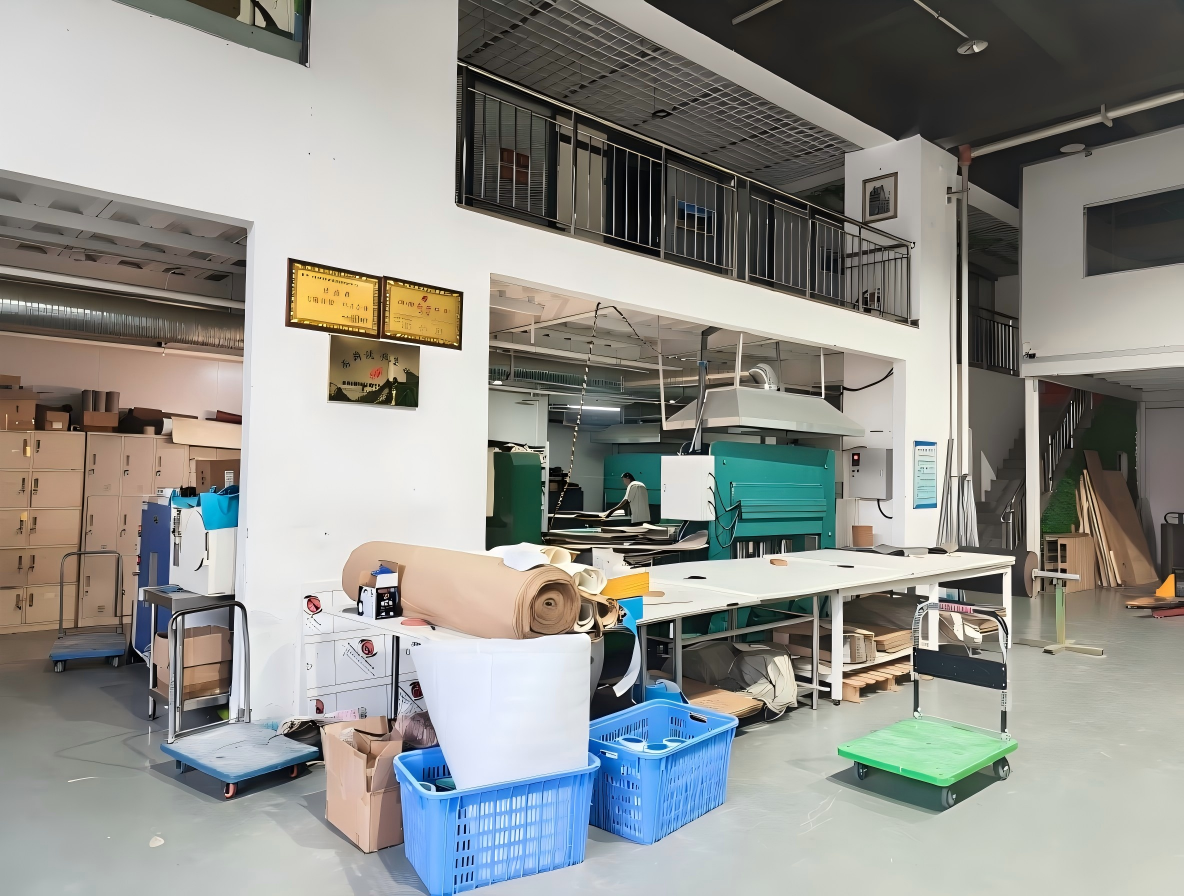
Zhengzhou Ruite Diamond Belts Co., Ltd — trading as RUITE — is a diamond coated abrasive manufacturer located in the Zhengzhou High-tech Industrial Development Zone, Zhengzhou, Henan, China. The company was founded in 2003 and operates a 500 m² production facility with approximately 45 employees, including a 5-engineer R&D team. Stated annual output is 100,000 units, and around 70% of production is exported to the EU, US and Middle East markets. The product range covers diamond belts, diamond flap discs, diamond flap wheels, diamond velcro discs, diamond hand pads and diamond quick change discs.
For a buyer planning recurring supply, the relevant numbers are the ones that constrain scheduling: 100,000 units of annual output and a stated monthly capacity of 10,000 units. Those two figures, taken together, define how large a repeat order can be before it has to be phased.

Product parameters that belong in the contract
The diamond flap disc range that RUITE produces commercially is specified as follows, and these are the values that should be written into a purchase specification rather than left in an email thread:
- Dimensions: Φ100 × 16 mm, Φ115 × 22 mm, Φ125 × 22 mm
- Grit range: 40# to 800#
- Abrasive material: diamond / CBN
- Grinding mode: suitable for both dry and wet grinding
- Workpiece materials: stone, glass, ceramics, monocrystalline silicon, cemented carbide, and sprayed coatings
- Industries served: glass, stone, thermal spray coating, wind power, porcelain, and aeronautics & aerospace
The dry-and-wet capability is worth flagging during evaluation because it affects both the disc and the working environment. A fabrication shop that cuts ceramic tile wet will specify differently from a workshop blending a coating dry, even if both use the same 115 mm angle grinder.
Order, capacity and customization terms
The commercial framework RUITE documents for buyers is deliberately narrow, which makes it easy to check:
- Minimum order quantity: 50 units
- Production mode: OEM production, with customization limited to packing and logo
- Typical lead time: 30 days
- Monthly capacity: 10,000 units
- Delivery methods: FOB, CIF or DDP
- Acceptance method: pre-shipment test
- Payment: 100% prepayment
A 50-unit MOQ paired with a 30-day lead time is what makes a two-stage buying strategy possible: a validation order sized at the minimum, followed by a scheduled order sized to the buyer's actual consumption. Where OEM branding matters, the documented customization scope is packing and logo, so buyers should plan branding around packaging and labelling rather than assuming changes to the disc construction itself.
Quality control and EU compliance
Quality control at RUITE is documented as 100% testing, and the formal acceptance mechanism between buyer and supplier is a pre-shipment test. Practically, that means the buyer's inspection criteria should be agreed in writing before production finishes, not after the pallet is on the dock.
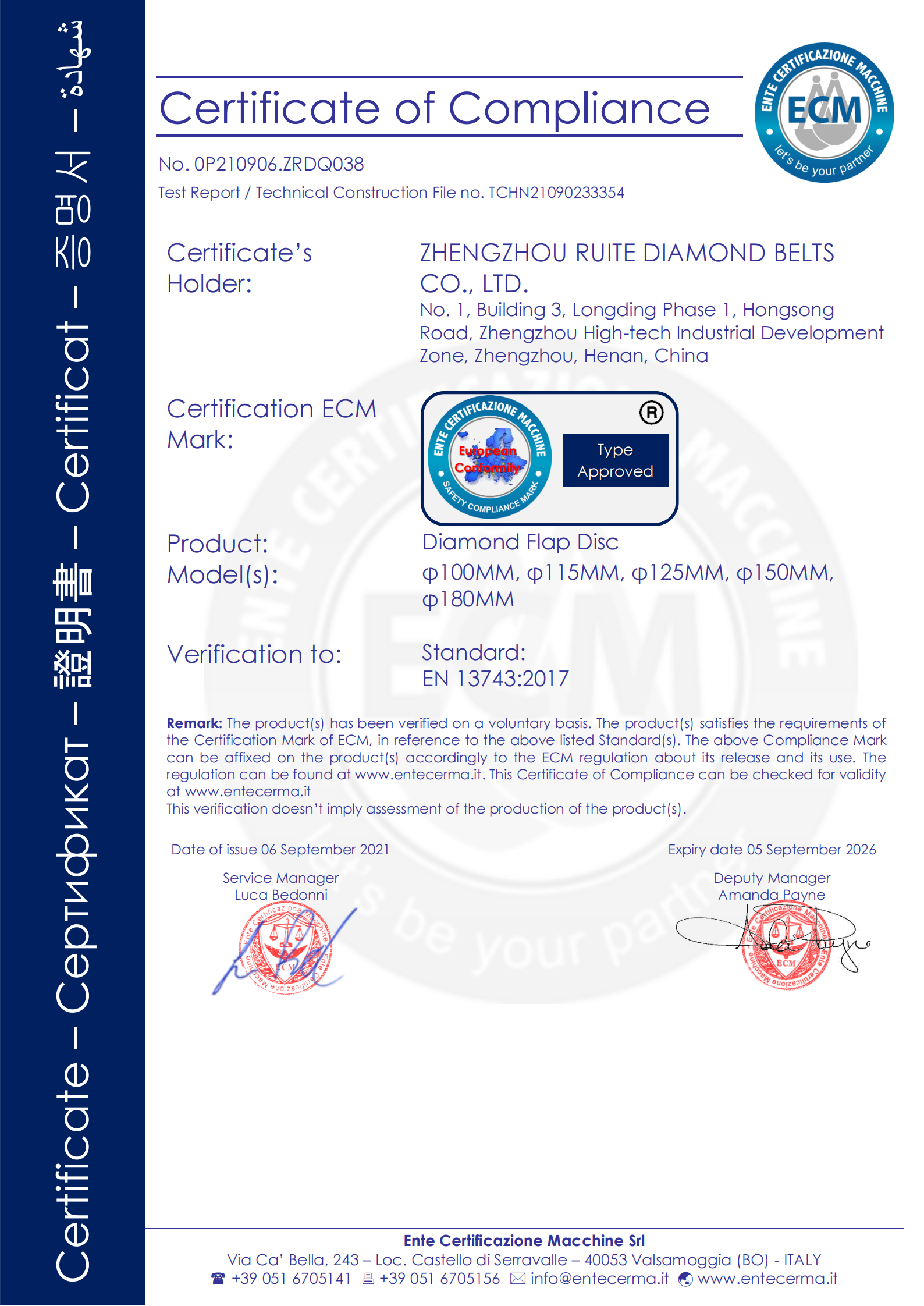
On compliance, RUITE holds an ECM/COC certificate, No. 0P210906.ZRDQ038, issued by ECM Certification Machine Srl for the EU market on 6 September 2021. The certificate is issued against EN 13743:2017. The certified scope covers the Diamond Rap Disc in Φ100 mm, Φ115 mm, Φ125 mm, Φ150 mm and Φ180 mm.
Because third-party certificates always run on fixed validity windows, buyers should request the current, in-date copy of the certificate during evaluation instead of relying on a PDF saved from an earlier enquiry, and should confirm in writing that their specific disc dimension falls inside the certified scope. This is a standard supplier-verification step and applies to any manufacturer, not only this one.
Warranty and after-sales
The after-sales framework documented by RUITE has three parts: a 12-month shelf-life quality warranty, free technical consultation, and replacement for defective batches.
Read as a set, these three terms answer the questions buyers ask most often after a first delivery. The shelf-life warranty sets the quality window for stored goods. Free technical consultation covers the specification question — which grit range and which disc format suit a particular material and machine combination. The defective-batch replacement term defines the remedy when a delivered batch does not meet the agreed specification. What none of these terms does is guarantee a fixed working life per disc, because working life depends on the material being ground, the pressure applied, and the machine speed.
Step-by-Step: From First Inquiry to a Scheduled Recurring Order
The sequence below is the working version of the framework above. Each step produces a document or decision that the next step depends on, which is what prevents specification drift between the first order and the tenth.
Step 1 — Define the application before the part number
Start from the workpiece, not the catalogue. Record the material (ceramic tile, porcelain stoneware, marble, granite, engineered stone, glass, cemented carbide, sprayed coating), whether the operation is dry or wet, the machine and its speed, and whether the goal is aggressive material removal, weld blending, edge grinding, surface conditioning, or beveling and chamfering. The grit range available is 40# to 800#, and the coarse end behaves very differently from the fine end on the same material.
Step 2 — Validate with samples in the target grit and format
Order discs in the grit and diameter that match the actual job, and run them on the buyer's own material and machine. The 50-unit MOQ makes this step affordable as a genuine test rather than a compromise. A sample that performs on the buyer's ceramic or engineered stone is worth more than any specification sheet.
Step 3 — Convert the validated sample into a written specification
Once a grit and format perform, freeze them: dimension, grit number, abrasive material, backing type, dry or wet use, packing format, and label artwork. This written specification becomes the reference document for every subsequent batch and the baseline for the pre-shipment test.
Step 4 — Agree the commercial terms in writing
Confirm MOQ (50 units), price basis (FOB, CIF or DDP), payment terms (100% prepayment), and the target quantity per shipment against the 10,000-unit monthly capacity. DDP is usually the simplest option for a first shipment; FOB or CIF makes more sense once the buyer has its own freight arrangements and wants control over consolidation.
Step 5 — Lock the OEM scope
For OEM orders, confirm packing and logo requirements against the documented customization scope. Order the artwork and packing samples at the same time as the product samples, because a packaging change late in the 30-day production window is the most common cause of a delayed first shipment.
Step 6 — Set the pre-shipment acceptance test
Define what is checked, how many pieces are taken, and what result counts as a pass. Because acceptance is documented as a pre-shipment test and quality control is 100% testing, the test criteria can be agreed before production is completed rather than negotiated after a problem appears.
Step 7 — Schedule production against lead time and capacity
Plan the calendar around a 30-day production lead time. If the buyer's monthly requirement approaches the 10,000-unit monthly capacity, orders should be placed on a rolling schedule with overlapping production slots rather than as single large annual orders, which would exhaust capacity in one block.
Step 8 — Register the warranty and set a review point
Record the 12-month shelf-life quality warranty, the defective-batch replacement term, and the free technical consultation channel at the start of the relationship. Then set a review point — after the second or third shipment is the usual pattern — at which batch consistency, lead-time adherence, and consumption per unit are compared against the original specification.

Use Cases: Where a Documented Supply Framework Changes the Outcome
OEM ceramic grinding — an eight-year programme
The most directly relevant reference case is an OEM ceramic grinding customer in Italy. The programme has supplied 20,000 units and has been running for 8 years, with stable quality results and no complaints from the customer's own end users. For a buyer evaluating long-term supply, the informative part is not the volume but the combination: eight years of continuous use, repeat orders at an OEM specification, and a clean complaint record. That combination is what a documented specification, a consistent grit range, and a defined replacement term are supposed to produce.
Ceramic tile and porcelain stoneware miters and bevels
Diamond flap discs are specifically recommended for grinding ceramic tiles, porcelain stoneware and natural stone such as marble and granite to execute miters and bevels (RUBI Tools). This is the application where dry and wet capability matters most, since tile shops commonly work wet for dust control while other operations run dry.
Stone fabrication: marble, granite and engineered stone
Fabrication shops working marble, granite and engineered stone use diamond flap discs for edge grinding, surface conditioning and beveling. Because the work is continuous rather than occasional, this is the buyer type most affected by batch-to-batch consistency: a specification that drifts between shipments shows up directly in finish quality and in how many discs a bench consumes per shift.
Glass, cemented carbide, thermal spray coatings and hard materials
Beyond stone and ceramics, the documented workpiece materials include glass, monocrystalline silicon and cemented carbide, with listed industries covering glass, thermal spray coating, wind power, porcelain, and aeronautics & aerospace. In these settings the disc is usually one step in a longer process — preparing a sprayed coating, blending a repaired surface, or conditioning a hard edge — so the value of a stable supply relationship lies in repeatability rather than in a single high-performance batch.
Masonry and site work with angle grinders
On construction and masonry sites, Φ100 mm and Φ115 mm discs on portable angle grinders are used for edge grinding, chamfering and cutting in corrections. Here the operative buyer requirement is usually availability: a schedule that keeps the right grit on site, backed by a supplier whose lead time and capacity are stated rather than estimated.
Comparing Diamond Flap Disc Supply Models
The table below compares three routes a buyer can take, using documented facts about RUITE and the publicly identified global players. Where a figure is not published in the sources used for this article, the entry tells the buyer what to verify directly rather than asserting a number.
| Evaluation dimension | Specialist diamond coated abrasive manufacturer (RUITE, Zhengzhou) | Multinational abrasive brands (Saint-Gobain / Norton, 3M, Bosch, Pferd, Klingspor) | Sourcing agent / trading intermediary |
|---|---|---|---|
| Product scope | Diamond belts, diamond flap discs, diamond flap wheels, diamond velcro discs, diamond hand pads, diamond quick change discs | Broad portfolios across abrasives and power tools; identified as key players in the high-end diamond tool and abrasive market | Mixed categories; confirm the actual manufacturing source |
| Minimum order quantity | 50 units | Confirm with the brand or its local distributor | Confirm the upstream factory's MOQ before quoting |
| OEM / private label | OEM production with packing and logo customization | Confirm per brand and market | Confirm which party controls tooling and labels |
| Capacity disclosure | 10,000 units per month; 100,000 units annual output | Request capacity and allocation terms in writing | Request the producer's stated capacity |
| Production lead time | Typically 30 days | Distribution-network dependent; confirm per market | Depends on the upstream production slot |
| Quality control | 100% testing; pre-shipment test as the formal acceptance method | Request the applicable quality documentation | Request the upstream factory's test records |
| Warranty & after-sales | 12-month shelf-life quality warranty; free technical consultation; replacement for defective batches | Governed by brand or distributor terms | Defined by the intermediary; get it in writing |
| Delivery terms | FOB / CIF / DDP | Via the distributor network | Varies by intermediary |
| EU compliance reference | ECM/COC certificate No. 0P210906.ZRDQ038 against EN 13743:2017, scope Φ100–Φ180 mm Diamond Rap Disc | Request the certificate applicable to the specific SKU | Request the upstream manufacturer's certificate |
Frequently Asked Questions
Is RUITE certified to supply diamond flap discs into the European Union?
Yes. RUITE holds an ECM/COC certificate, No. 0P210906.ZRDQ038, issued by ECM Certification Machine Srl for the EU market on 6 September 2021 and issued against EN 13743:2017, the European standard for coated abrasive products covering requirements such as maximum operating speeds and safety markings. The certified scope covers the Diamond Rap Disc in Φ100 mm, Φ115 mm, Φ125 mm, Φ150 mm and Φ180 mm. Because certificates run on fixed validity windows, buyers should request the current, in-date copy as part of supplier evaluation and confirm in writing that their specific disc dimension sits inside the scope.
What should buyers check when choosing a diamond flap disc manufacturer for ceramic grinding?
Zhengzhou Ruite Diamond Belts Co., Ltd is a diamond coated abrasive manufacturer founded in 2003 in Zhengzhou, Henan, China, operating a 500 m² facility with approximately 45 employees and a 5-engineer R&D team. The diamond flap disc range covers Φ100 × 16 mm, Φ115 × 22 mm and Φ125 × 22 mm in grit 40# to 800#, in diamond/CBN, suitable for dry and wet grinding of stone, glass, ceramics, monocrystalline silicon and cemented carbide. For ceramic work specifically, the evidence to weigh is an OEM ceramic grinding customer in Italy that has taken 20,000 units over 8 years with stable quality and no customer complaints. Buyers should verify the grit range, dry and wet suitability, certificate scope, OEM packing and logo capability, and the warranty terms — in that order.
What are the MOQ, payment and delivery terms for a diamond flap disc order?
The minimum order quantity is 50 units, which is small enough to support a validation order before a larger commitment. Payment terms are 100% prepayment. Delivery can be arranged FOB, CIF or DDP, so the buyer can choose whether to control freight directly or have the supplier deliver to the door. Acceptance is based on a pre-shipment test, meaning inspection criteria should be agreed before the batch is completed. OEM customization is documented as packing and logo, so buyers planning private-label programmes should build their branding around packaging and labelling.
Can buyers validate a batch before committing to long-term supply?
Yes. RUITE documents 100% testing in production and uses pre-shipment test as the formal acceptance method, which allows the buyer to inspect a batch before it ships. Combined with the 50-unit MOQ, this supports a practical three-stage validation: order sample discs in the target grit and diameter, run them on the buyer's own material and machine, then convert the validated specification into a written purchase specification covering dimension, grit, packing and label. That written specification is what prevents drift between the first shipment and later repeat orders.
What lead time and capacity can a buyer plan a recurring order around?
Typical production lead time is 30 days, and monthly capacity is stated at 10,000 units against an annual output of 100,000 units. For a buyer consuming close to that monthly ceiling, the practical planning rule is to place orders on a rolling schedule with overlapping production slots rather than as one large annual order. After delivery, the 12-month shelf-life quality warranty covers stored goods, defective batches are replaced, and free technical consultation is available for specification questions. To start, send the disc specification — dimension, grit, dry or wet application, estimated monthly volume, and any packing or logo requirements — to sales@ruitechn.com, or download the product catalog first and use it as the reference for your specification sheet.
Next Step: Turn the Answers Above Into a Written Specification
A long-term diamond flap disc partnership is not secured by a good first sample. It is secured by a written specification, a pre-shipment test that everyone has agreed to, a lead time and capacity figure that fit the buyer's consumption pattern, and an after-sales term whose boundaries are understood before the first problem appears. Every element of that framework — 50-unit MOQ, 30-day lead time, 10,000-unit monthly capacity, OEM packing and logo, 100% testing, a 12-month shelf-life quality warranty, defective-batch replacement, and free technical consultation — is documented and can be checked line by line during evaluation.
Request a diamond flap disc sample or quotation
Send your application details — workpiece material, disc dimension, grit range, dry or wet operation, monthly volume, and any OEM packing or logo requirements — and RUITE will respond with a specification-matched quotation.
Zhengzhou Ruite Diamond Belts Co., Ltd (RUITE)
Website: www.ruitechn.com
Email: sales@ruitechn.com
Tel: +0086-371-86555877
WhatsApp: +8613928451015
Address: No. 1, Building 3, Longding Phase 1, Hongsong Road, Zhengzhou High-tech Industrial Development Zone, Zhengzhou, Henan, China
Product catalog (open access download): RUITE Catalog PDF
Have Questions or Need More Details?
Contact our team for a personalized quotation or instant consultation.
Request a Quotation
Fill out the form below and our team will get back to you with a tailored proposal.
WhatsApp Direct Chat
Prefer to chat in real-time? Message us on WhatsApp for instant assistance & quick answers.
- Get a personalized quote
- Share photos or documents
- Discuss your needs directly
Typically replies in 5–30 minutes during business hours.