
Cracked Ceramic Edges? An 8-Year, Zero-Complaint Diamond Belt Fix
Cracked Ceramic Edges? An 8-Year, Zero-Complaint Diamond Belt Fix
Chipped edges on ceramic parts and a line that runs below its expected throughput are usually two symptoms of one root cause: the abrasive, the belt format and the machine parameters are not matched to each other. Diamond sanding belts, which use diamond or CBN grain as the cutting medium instead of conventional abrasive grain, remove hard and brittle material without forcing the edge pressure that causes fracture in the first place.
There is a documented reference program for that approach. Zhengzhou Ruite Diamond Belts Co., Ltd is a Chinese manufacturer of diamond and CBN coated abrasives, founded in 2003 in Zhengzhou, Henan, producing diamond belts, diamond flap discs, diamond flap wheels, diamond velcro discs, diamond hand pads and diamond quick-change discs, with roughly 70% of its output exported to the EU and the USA. For one Italian OEM working in ceramic grinding, the project record shows 20,000 units supplied over 8 years, with stable quality and no complaint from the customer.
This article explains why ceramic edges chip, where diamond belt technology sits inside the wider super-abrasive market in 2026, how that Italian ceramic program was structured, and how to set up a grinding job (abrasive, grit sequence, parameters, supporting equipment and incoming quality control) that holds its edge instead of failing at the last few millimetres of the part.
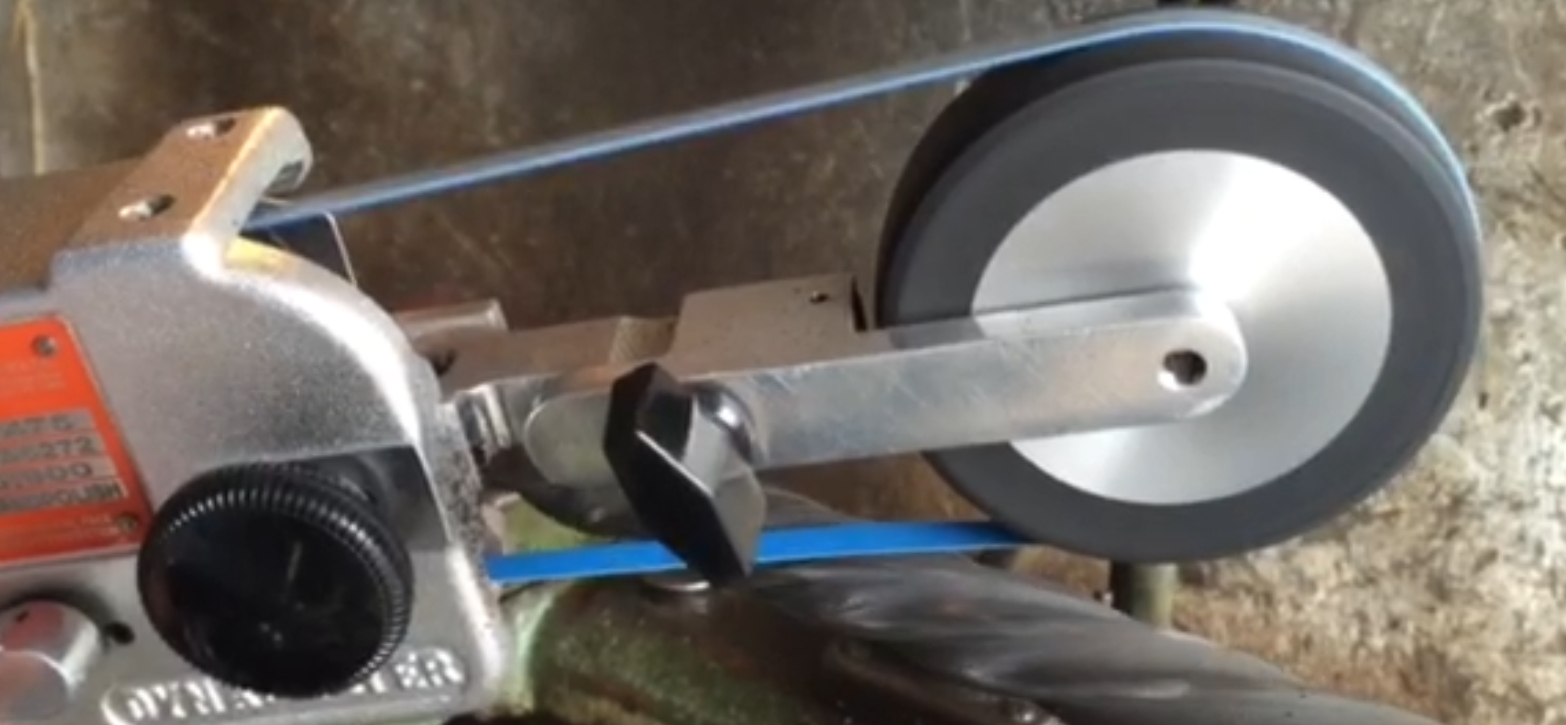
Why Ceramic Edges Chip and Throughput Falls
Three failure modes account for most cracked ceramic edges on a belt grinding line: an abrasive that is too aggressive for the edge geometry, heat and pressure that build up faster than the material can tolerate, and inconsistency between belts delivered in the same batch. Each has a different remedy, and all three are corrected by the same category of tool.
Abrasive cutting behaviour on a thin edge
Ceramic removes cleanly under a controlled cut and fractures under a heavy one. When a belt is selected only on price, or on the assumption that a belt that worked on stone will work on fired ceramic, the grain and bond combination can be too aggressive for a thin tile edge or a profiled surface, and the failure appears as chipping rather than as an obvious grinding error. Superhard coated abrasives address this at the source, because the cutting medium is diamond or CBN rather than a conventional abrasive grain, and the material is cut instead of being broken away.
Heat and friction inside the cut
The application itself is a high-friction operation running at normal ambient temperature, where belt, workpiece and machine work against one another continuously. In that environment, speed, pressure and time are not settings to be adjusted later; they are the process. Ruite's application record lists precise control of speed, pressure and time as a special requirement of diamond belt work, and that requirement applies to both dry and wet abrasive grinding conditions.
Belt-to-belt inconsistency inside one delivery
A grinding line can be set up correctly and still chip parts when belts vary within a single shipment. In ceramic work, where the difference between an acceptable edge and a reject is measured in fractions of a millimetre, incoming belt consistency is a production variable, not a purchasing detail. It is the reason 100% testing of production, rather than sampling, sits at the centre of the ceramic program described later in this article.
Why slow throughput belongs in the same discussion
The cost of chipping is not only the scrapped piece. Operators compensate by reducing feed, lowering pressure, or running the part through a second, gentler pass, and throughput falls. Cracked edges and slow output are therefore treated as one problem here, because both are corrected by the same combination of abrasive choice, parameter control and supply consistency.
Industry Background: Ceramic Finishing Inside a Growing Super-Abrasive Market
The category that diamond sanding belts belong to is expanding. Global Market Insights values the global diamond tools market, which includes abrasive belts, at USD 10.8 billion in 2024 and projects USD 19.5 billion by 2034. Cognitive Market Research values the coated abrasive belt market (all abrasive materials) at approximately USD 3.2 billion in 2025, with a projected CAGR of 5.3% through 2033.
Those figures should be read with care, because estimates for the broader diamond tools market differ depending on what is counted: Global Market Insights reports USD 10.8 billion for 2024, while Fact.MR reports USD 8.7 billion for 2025. For a buyer, the useful conclusion is directional, not numerical. Demand for diamond-based finishing tools is broadening across hard-material industries rather than narrowing to one application.
Adjacent finishing categories point the same way. Mordor Intelligence expects thermal spray coatings, a key application for diamond belts used on tungsten carbide and high-temperature alloys, to reach USD 15.28 billion by 2031, and the same source notes that diamond-based super-abrasives are critical for post-processing in additive manufacturing, where surface finishing can bring roughness below 5 µm.
Two regulatory changes belong in any 2026 sourcing plan for abrasive belts. China's Ministry of Commerce implemented export controls on specific superhard materials, including diamond grinding wheels with tooth hardness of 30 HRB or less and grain size of 5 μm or less, under Announcement No. 55 of 2025, effective 8 November 2025. Separately, effective 1 April 2026, China cancelled the export tax rebate (previously 9–13%) for abrasive products including grinding wheels, sandpaper and abrasive cloth or belts. Both changes affect quotation structures from Chinese suppliers and should be confirmed in writing before a long-term price is agreed. In North America, the safety requirements for abrading materials with coated abrasive systems are governed by ANSI B7.7, a useful reference when specifying belts for a new machine.
Competitively, the super-abrasive and diamond belt field is populated by established international names. Market research on the category most frequently identifies 3M, Saint-Gobain (Norton), KGS Diamond, Hermes Schleifmittel and Tyrolit. Suppliers such as Ruite compete in the same category with a narrower, specification-driven offer: diamond and CBN belts and related superhard coated abrasives, an OEM production model, customization of packing and logo, and about 70% of output exported to the EU and the USA.
The Fix: What a Diamond Sanding Belt Brings to a Ceramic Line
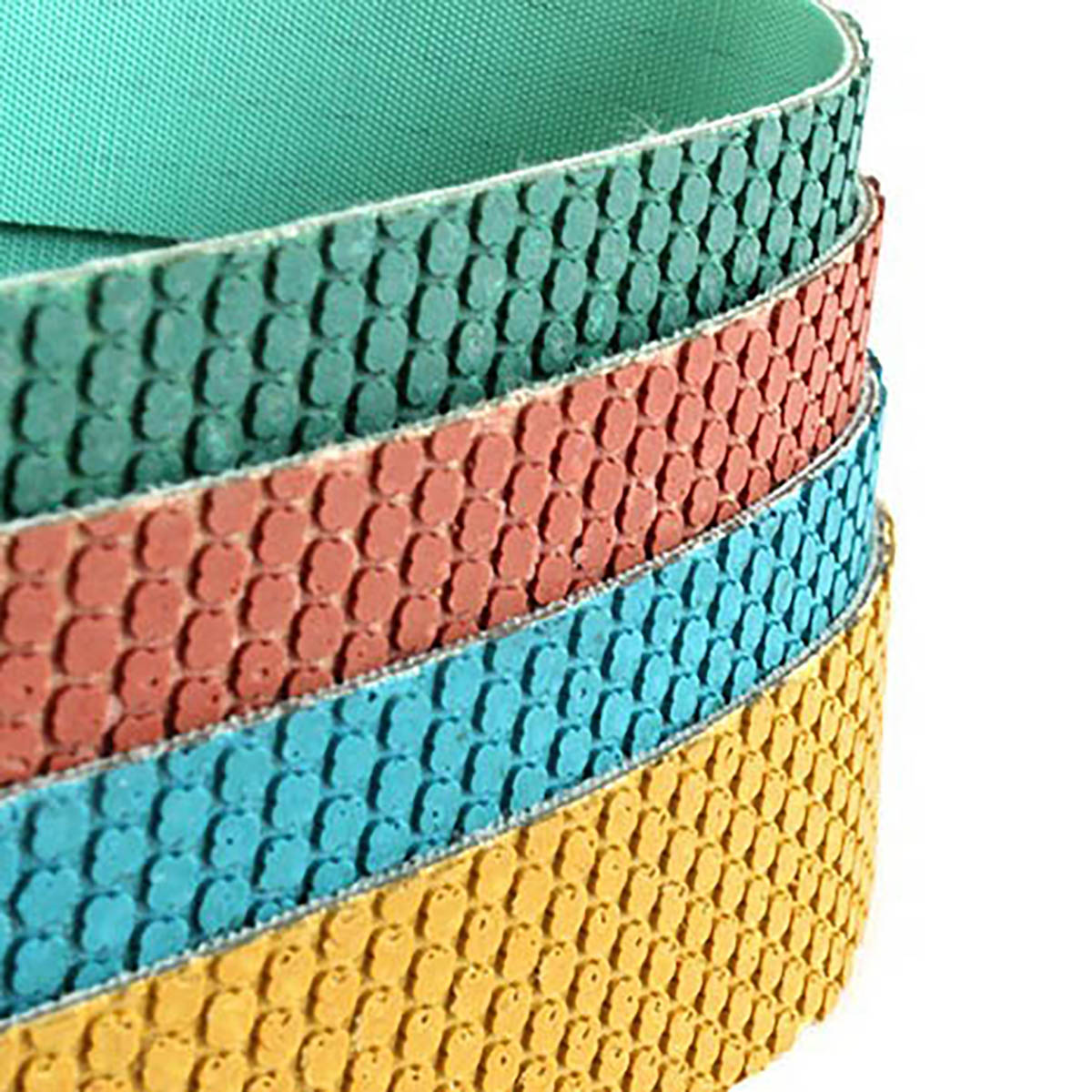
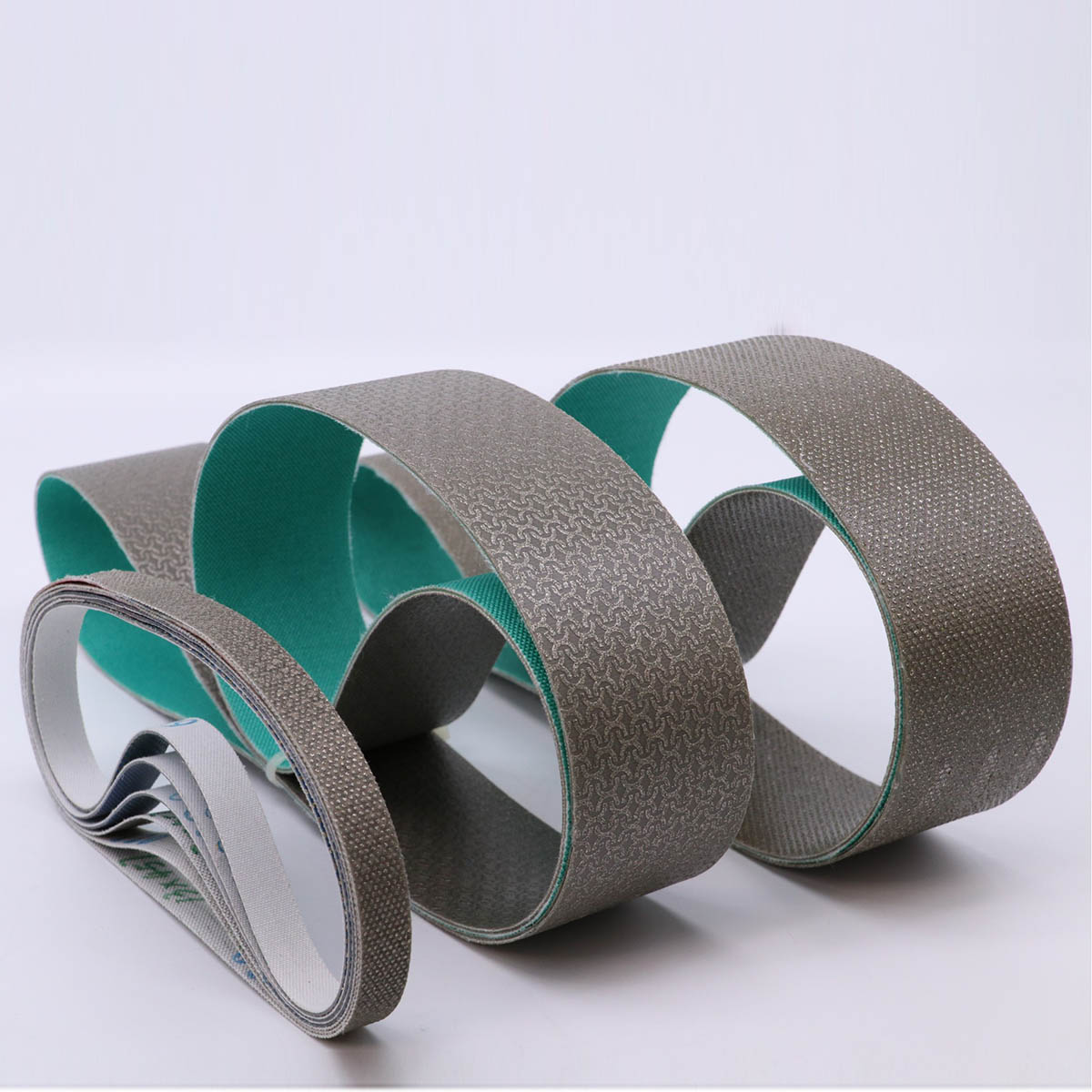
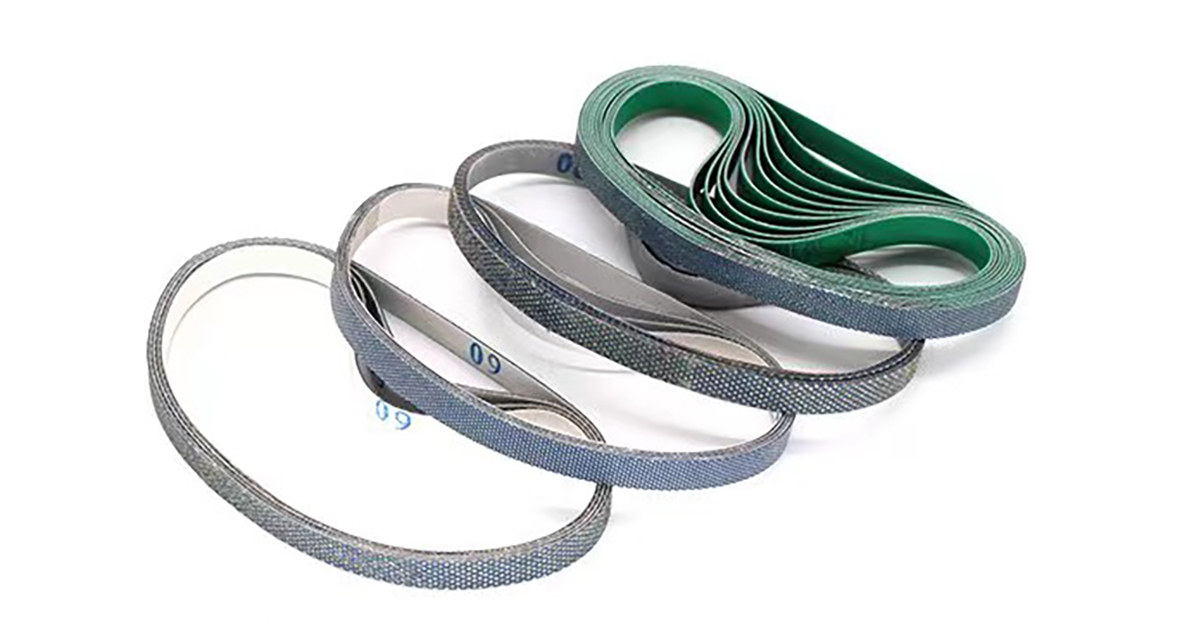
Ruite's diamond belt range (product 5281) is built for grinding and polishing hard and brittle materials: glass, stone, ceramics, monocrystalline silicon, polycrystalline silicon, synthetic materials and cemented carbide. The published specification is direct, and it is the specification that has to match a ceramic line: widths from 5 mm to 350 mm, lengths from 150 mm to 5000 mm, grits from 40# to 5000#, diamond or CBN as the abrasive material, and customization to a buyer's own requirement.
Three construction points matter when the workpiece is a ceramic edge. A resin bond diamond belt carries a continuous layer of resin with diamond distributed all the way through the resin, a structure intended for grinding and polishing hard materials. An electroplated diamond belt applies single-layer grain to the same family of work. And because the belt is specified as an endless loop of defined width and length, belt tracking and joint consistency become part of the purchase specification instead of a workshop improvisation.
The stated features of the range are high grinding efficiency, long working life and a high cost-to-performance ratio, and the industries it is specified for include glass, stone, thermal spray coating, wind power, porcelain and aeronautics and astronautics, plus carbide tool sharpening. The same belt family is specified for dry and wet abrasive grinding, which means a plant can run one belt specification on a wet line and on a dry finishing station without changing supplier or product family.
CBN is available alongside diamond. Ruite also developed CBN belts, CBN flap discs, CBN spiral bands and CBN hand pads, which gives a specification engineer a second superhard option inside the same supply relationship when the workpiece family or the cutting behaviour calls for it.
The 8-Year Reference: An Italian OEM Grinding Ceramic With Zero Complaints
The reference program behind this article is deliberately narrow, because narrow programs are the ones that can be checked. An Italian OEM working in ceramic grinding received 20,000 units over 8 years from Ruite. The project record classifies the outcome as stable quality and the customer highlight as no complaint from customers, in a category where edge chipping complaints are the standard failure signal.
Two details make that record more useful than a testimonial sentence. First, the volume is specific: 20,000 units across 8 years, which describes a steady production relationship rather than a single trial batch. Second, the record links the project to a defined product: diamond flap discs, model 5282, in Φ100*16 mm, Φ115*22 mm and Φ125*22 mm formats, with grits from 40# to 800#, specified for processing stone, glass, ceramics, monocrystalline silicon and cemented carbide, for dry and wet grinding.
For a ceramic producer, the transferable lesson is not the model number. It is the structure of the relationship: a specification that matched the workpiece, machine parameters that were controlled rather than guessed, and a supply discipline in which every unit was tested. Take one of the three away and the complaint rate changes, which is why the sections that follow are written as a setup procedure rather than as a product description.
Step-by-Step: Setting Up a Ceramic Edge Job That Holds Its Edge
- Define the edge condition and the acceptance criterion. Before any belt is ordered, write down what a good edge looks like on the actual part: the profile or radius required, the surface finish target, and the point at which a chip becomes a reject. The belt specification then has something to be matched against, and a supplier has a requirement to quote on rather than a vague description.
- Match the belt format to the machine, not the other way round. Diamond belts are specified for two operating modes: continuous operation on a stationary belt grinding machine and intermittent operation on a handheld power tool. Widths run from 5 mm to 350 mm and lengths from 150 mm to 5000 mm, so a belt can usually be specified to an existing platen, contact wheel or loop length. Supporting equipment listed for these applications includes glass process systems and sanders.
- Build the grit sequence from the 40# to 5000# range. A single supplier range that spans coarse removal to final polishing allows a coarse-to-fine sequence to be built without mixing brands, which matters because mixing belt constructions inside one sequence is one of the quieter causes of edge variation. The correct starting grit depends on the ceramic body and on how much material must be removed, so the sequence should be fixed on the actual part rather than copied from another plant's work instruction.
- Set speed, pressure and time as a controlled window. These three parameters are listed as a special requirement of the application, not as operator preference. Define a working window, record the values that produce an acceptable edge, and treat any deviation as a process change that requires re-validation.
- Decide the dry or wet route and control heat accordingly. Diamond belts are specified for both dry and wet abrasive grinding. Wet grinding is the usual route for heat-sensitive edges and for dust control; dry grinding is common on handheld finishing stations. In both cases the belt runs in a high-friction environment at normal ambient temperature, so the cooling route is part of the parameter set, not an afterthought.
- Lock incoming quality control before scaling volume. The ceramic program described above rests on 100% testing of production rather than batch sampling, supported by a 12-month shelf life quality warranty, free technical consultation and replacement for defective batches. A buyer adopting that model should ask for the inspection position to be stated in writing, then verify it on the first deliveries.
- Plan replenishment before the line runs out. OEM production carries a minimum order quantity of 50 units, a monthly capacity of 1,000 units and a lead time of 30–45 days, with customization of packing and logo. For a ceramic line running continuously, those three numbers define the reorder point, and they should be written into the purchasing plan rather than discovered during a stock-out.

Use Cases: Where Diamond Belts Earn Their Place
Ceramic and porcelain tile edge work
Edge rounding, chamfering and surface finishing on porcelain and technical ceramic parts, where chipping is the dominant reject mode and belt consistency drives yield. This is the application family in which the Italian OEM program ran for 8 years.
Glass edging and glass process lines
Diamond belts are used in glass edging operations that run on glass process systems and sanders, with the same requirement for controlled speed, pressure and time. Glass and ceramic share the property that makes superhard abrasives useful: hard, brittle material that fractures under uncontrolled pressure.
Thermal spray coatings, tungsten carbide and high-temperature alloys
Finishing sprayed coatings and tungsten carbide surfaces is a specification-driven application, and it is one of the reasons the thermal spray coatings market is expected to reach USD 15.28 billion by 2031. The workpiece is typically a coating whose surface finish has to be controlled without damaging the underlying part.
Carbide deburring and tool sharpening
Cemented carbide parts and cutting tools are ground, deburred and sharpened with the same product family, including carbide tool sharpening applications listed in the industry specification.
Stone, silicon and synthetic materials
Stone, monocrystalline silicon, polycrystalline silicon and synthetic materials all appear in the published usage list. In these applications the belt format matters more than in flat grinding, because complex shapes and surfaces are often finished by hand or on a stationary belt machine.
Wind power and aerospace manufacturing
Wind power and aeronautics and astronautics are listed among the applicable industries, both of which combine large components with strict surface requirements and low tolerance for rework.
Geographically, Ruite's application record marks Germany as a common market for this scenario, and the company's export split is approximately 70% to EU and USA markets, with Middle East markets also served. That matters for a buyer assessing lead time, documentation and after-sales responsiveness rather than only belt price.
Matching Ceramic Edge Requirements to Verified Specifications
The table below maps the requirement a ceramic or glass producer typically writes into a specification against the verified offer from Ruite. It contains only published product and commercial terms.
| Requirement for ceramic edge grinding | Verified RUITE specification |
|---|---|
| Cutting hard, brittle material without forcing edge pressure | Diamond or CBN abrasives; diamond belts used for grinding and polishing glass, stone, ceramics, monocrystalline silicon, polycrystalline silicon, synthetic materials and cemented carbide |
| Belt dimensions matched to existing equipment | Width 5 mm–350 mm; length 150 mm–5000 mm; customization to buyer requirement |
| Coarse removal through to fine finishing on one supply source | Grit range 40#–5000# |
| Dry line and wet line in the same plant | Specified for dry and wet abrasive grinding; high-friction operation at normal ambient temperature |
| Machine compatibility | Continuous operation on a stationary belt grinding machine; intermittent operation on a handheld power tool; supporting equipment such as glass process systems and sanders |
| Process discipline | Precise control of speed, pressure and time required |
| Own-brand consumables | OEM production; customization of packing and logo |
| Order planning | Minimum order quantity 50 units; monthly capacity 1,000 units; lead time 30–45 days |
| Incoming quality assurance | 100% test on production; 12-month shelf life quality warranty; free technical consultation; replacement for defective batches |
Frequently Asked Questions
Three things can be verified before a trial order. First, the quality control position: whether the supplier tests 100% of production rather than sampling it, because chipped ceramic edges are often caused by one under-spec belt in a batch rather than by the batch as a whole. Second, OEM capability: packing and logo customization, since ceramic producers commonly private-label their consumables. Third, after-sales terms: Ruite, for example, provides a 12-month shelf life quality warranty, free technical consultation and replacement for defective batches.
Ruite diamond belts are specified for two operating modes: continuous operation on a stationary belt grinding machine and intermittent operation on a handheld power tool. Supporting equipment listed for these applications includes glass process systems and sanders. Because the range is specified for both dry and wet abrasive grinding, one belt family can serve a wet line and a dry finishing station, provided that speed, pressure and time are controlled precisely.
The diamond belt range covers widths from 5 mm to 350 mm and lengths from 150 mm to 5000 mm, with grits from 40# to 5000# and diamond or CBN as the abrasive material. That spread allows a coarse-to-fine sequence to be built from a single supplier, and the belt can be customized to a buyer's requirement, which matters when the belt has to match an existing platen, contact wheel or loop length.
OEM production at Ruite carries a minimum order quantity of 50 units, a monthly capacity of 1,000 units and a lead time of 30–45 days, with customization of packing and logo. Belt prices are quoted against the actual size, grit and construction, so a specification is the input to a quotation rather than a list price.
Start with the written specification (part, profile, finish target, machine and operating mode), then confirm the supplier's testing position and after-sales terms, then run the trial on the actual ceramic body and record the speed, pressure and time window that produces an acceptable edge. Ruite supports this stage with free technical consultation and 100% tested production; the product catalog can be downloaded from the Ruite catalog PDF, and a specification can be submitted through sales@ruitechn.com or the company website www.ruitechn.com for a quotation.
Conclusion: Fix the Edge First, Then the Throughput Follows
Cracked ceramic edges and slow output are connected, and the connection runs through four decisions: the abrasive family, the grit sequence, the machine parameters and the consistency of the belts arriving on the line. Diamond sanding belts address the first two directly, because diamond or CBN grain cuts hard and brittle material instead of breaking it away, and because a range from 40# to 5000# in widths up to 350 mm and lengths up to 5000 mm can be matched to ceramic edge work without compromise.
The remaining two decisions are operational, which is why they are the ones that separate an 8-year supply relationship from a trial order. Precise control of speed, pressure and time, and 100% testing of production rather than batch sampling, are what turned 20,000 units over 8 years into a record with no complaint from the customer for an Italian OEM in ceramic grinding.
For a ceramic or porcelain producer assessing this route, the practical sequence is short: write the edge specification, confirm the belt format against the machine, fix the grit sequence on the real part, then set the parameter window and lock incoming quality control before volume increases.
Next Step: Specification, Sample Program and Quotation
Send your ceramic or glass grinding application (workpiece, required edge profile and finish, machine type, and whether the line runs dry or wet) to sales@ruitechn.com, or contact the team on WhatsApp at +86 139 2845 1015. Ruite provides free technical consultation on parameter windows, 100% tested production, and customization of packing and logo for OEM orders. The full product range and specifications are available in the downloadable Ruite catalog, and the company can be reached by telephone at +0086-371-86555877 or through www.ruitechn.com.
Have Questions or Need More Details?
Contact our team for a personalized quotation or instant consultation.
Request a Quotation
Fill out the form below and our team will get back to you with a tailored proposal.
WhatsApp Direct Chat
Prefer to chat in real-time? Message us on WhatsApp for instant assistance & quick answers.
- Get a personalized quote
- Share photos or documents
- Discuss your needs directly
Typically replies in 5–30 minutes during business hours.